Immigration Law Blog
Stay up-to-date on the latest immigration law news, with the Cohen, Tucker & Ades team's insights behind the headlines

Consular posts worldwide—including U.S. Embassies in Paris, Kingston, Madrid, and Doha—are issuing detailed pre-interview questionnaires to immigrant visa applicants. These inquiries focus squarely on preventing reliance on public benefits and rigorously evaluating the statutory public charge ground of inadmissibility.
For years, many petitioners and beneficiaries assumed that submitting a signed Form I-864 (Affidavit of Support) meeting federal poverty guidelines was enough. Today, consular officers are looking far beyond the I-864, scrutinizing applicant self-sufficiency, prospective healthcare arrangements, family debt profiles, and joint sponsor credibility.
Arriving unprepared or treating these pre-interview inquiries casually can lead to 221(g) administrative processing delays, intense requests for evidence, or outright visa denials.
Consular officers evaluate the “totality of circumstances” using detailed questionnaires that probe six primary areas:
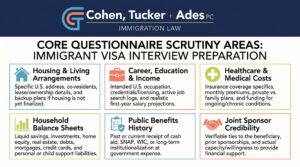
Key focus areas consular officers evaluate during immigrant visa interviews to prevent reliance on public benefits, compiled by Cohen, Tucker + Ades, P.C.
Officers across posts (e.g., France, Spain, Jamaica) require candidates to demonstrate an actionable living arrangement:
Secured Accommodations: Provide a specific U.S. residential address where the beneficiary will reside.
Contingency Plans: If housing has not yet been secured, explain precisely how housing will be found, where the family will stay initially, and how upfront deposits or rent will be paid.
Household Composition: Detail everyone who will reside with the beneficiary, including their relationship and financial independence.
Consular officers want to know how adult beneficiaries will support themselves from day one:
Career Trajectory: Outline intended lines of work and how current education, training, and professional experience match that field.
Licensing Requirements: If the intended career requires U.S. certifications, state licenses, or bridge exams (e.g., healthcare, education, law, skilled trades), explain who will provide financial support while credentials are being obtained.
Documented Job Search Efforts: Consular questions explicitly ask whether the applicant has begun seeking employment, requiring descriptions of applications submitted, recruiter contacts, or firm job offers.
Expected Compensation: Be prepared to quote realistic, market-aligned first-year salary expectations.
Medical costs remain one of the primary drivers of public charge concerns. Questionnaires from Doha and Madrid ask detailed questions regarding medical viability:
Ongoing Care: Detail any chronic conditions listed in the panel physician report (such as diabetes, cardiovascular disease, or respiratory illness) and specify how treatment will be funded without public assistance.
Insurance Proof: State whether the applicant will be added to a family member’s employer-sponsored plan, obtain private health coverage, or purchase coverage through the ACA marketplace, noting specific expected monthly premiums.
Elderly & Derivative Care: For retirement-aged applicants, officers examine who will serve as caregivers in old age to avoid long-term institutionalization at public expense.
Consular officers assess personal balance sheets rather than relying on standard affidavit figures alone:
Liquid vs. Illiquid Assets: Clearly present verifiable evidence of cash savings, brokerage accounts, real estate holdings, or foreign business interests.
Debt and Liabilities: Fully disclose liabilities, including auto loans, revolving credit card balances, mortgages, and legal obligations like alimony or child support.
Retirement Adequacy: Embassy Doha specifically asks whether older applicants have enough working years left to accumulate savings or qualify for Social Security/Medicare (40 quarters/10 years), or whether they will receive foreign pensions while residing in the U.S.
If your petition relies on a joint sponsor, expect focused scrutiny:
Relationship and Motivation: Officers evaluate the closeness of the relationship between the joint sponsor, petitioner, and beneficiary to verify whether the sponsor will actually step in if financial trouble arises.
Sponsorship Bandwidth: Questionnaires probe how many other immigrants the joint sponsor has historically signed for and whether their past commitments limit their capacity to support your family.
Conduct a Mock Consular Interview: Never walk into the embassy without rehearsing your answers. Formulate clear, consistent responses for intended U.S. living costs, salary figures, and health insurance plans.
Compile Independent Documentation: Bring proof of liquid assets, job offers, resume/CV, written relocation budgets, and printouts of potential insurance premiums directly to the interview window.
Submit Statements Early Where Permitted: Consular sections such as London and Madrid allow applicants to proactively submit written statements and evidence via CEAC or consular email addressing public charge factors before the interview date.
Audit Your Joint Sponsor’s Profile: Confirm that your joint sponsor’s tax records, household size, prior sponsorships, and address history are current and documented.
Under Section 212(a)(4) of the Immigration and Nationality Act (INA), consular officers must evaluate whether an immigrant visa applicant is likely at any time to become a public charge. While a sufficient Form I-864 is legally required, officers must also examine the applicant’s age, health, family status, financial resources, education, and skills.
Failure to provide clear answers or documentation regarding your employment, housing, or healthcare plans can cause the officer to issue a refusal under INA Section 221(g). This places the application in administrative processing pending submission of comprehensive financial and personal evidence, delaying visa issuance by weeks or months.
No. While an approved I-864 from a qualifying sponsor is mandatory, consular officers possess independent authority to evaluate whether the beneficiary is personally self-sufficient. If an officer believes the household’s assets, debts, or earning capacity indicate a likelihood of relying on government support, they can issue a public charge refusal despite a compliant I-864.
You do not need to have active U.S. health insurance on the day of the interview. You must, however, present a credible plan: show that you can be enrolled on your petitioner’s employer-sponsored policy, provide written quotes for private market health insurance plans in your destination state, or demonstrate sufficient personal funds to pay projected premiums and out-of-pocket costs.
At Cohen, Tucker + Ades, our immigration attorneys routinely prepare petitioners and beneficiaries for the realities of modern consular processing. If your family has an upcoming immigrant visa interview, contact our team to ensure your documentation and interview preparation are sound.
Wendy R. Barlow, Esq.is a Partner at Cohen, Tucker + Ades, P.C. with nearly 20 years of experience in high-stakes immigration litigation. A graduate of the Maurice A. Deane School of Law at Hofstra University, Wendy is admitted to practice in New York and New Jersey as well as before the U.S. Supreme Court and multiple Federal Circuit Courts. Wendy is recognized for her ability to handle cases that many consider insurmountable.
Disclaimer: This blog post contains general information and is for informational purposes only. It is not legal advice and does not create an attorney-client relationship between you and Cohen, Tucker + Ades P.C. Immigration laws and fee schedules are subject to frequent change. The information provided herein may not reflect the most current legal developments. You should not act or refrain from acting based on information contained in this post without seeking professional counsel from an attorney licensed in your jurisdiction. Cohen, Tucker + Ades P.C. expressly disclaims all liability in respect to actions taken or not taken based on any or all of the contents of this post.