Immigration Law Blog
Stay up-to-date on the latest immigration law news, with the Cohen, Tucker & Ades team's insights behind the headlines

By Wendy R. Barlow, Esq. | Partner at Cohen, Tucker + Ades Specializing in Complex Immigration Matters
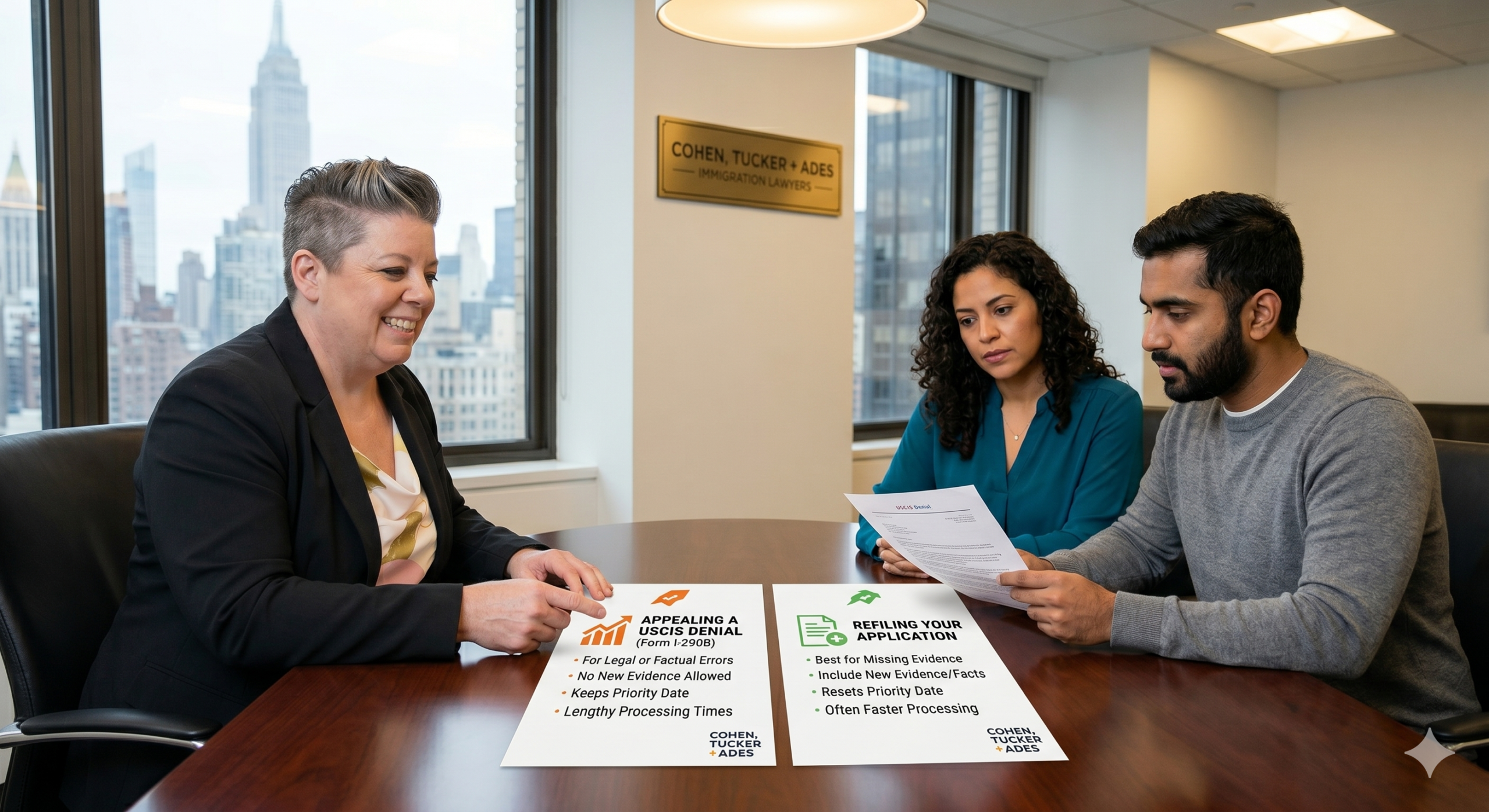
Should I appeal or refile my USCIS denial? Generally, you should appeal if USCIS made a legal error and you want to keep your original priority date. You should refile if your application was missing evidence or if you have new facts to present, as refiling is often faster and allows for a “clean slate.”
Receiving a denial from U.S. Citizenship and Immigration Services (USCIS) is a high-stakes moment. At Cohen, Tucker + Ades, we specialize in helping clients “thread the labyrinth” of immigration law to find a path forward.
When your Form I-485, I-130, I-140, I-129, or N-400 is denied, you generally have 30 days to act. Understanding the strategic difference between an administrative appeal and refiling is the key to saving your status.
An appeal is filed via Form I-290B (Notice of Appeal or Motion) and sent to the Administrative Appeals Office (AAO).
Legal Misinterpretation: The officer misunderstood the law or your specific visa category.
Factual Error: You provided the required documents, but the officer claimed they were missing.
Maintaining Priority Dates: If your “place in line” is critical (common in employment-based Green Cards), an appeal keeps that date alive.
Appeals are restrictive. You generally cannot submit new evidence. If your case was weak the first time, an appeal will likely fail.
Refiling means submitting a brand-new application package with new fees.
Missing Documentation: You forgot to include a birth certificate, translation, or financial record.
Change in Circumstances: You now have more evidence of a “bona fide” marriage or new professional achievements.
Speed: Refiling is often significantly faster than the 12–24 month wait time for an appeal.
While refiling requires a new filing fee, it is often the most cost-effective route because it bypasses the lengthy, complex litigation of the appellate process.
| Feature | USCIS Appeal | Refiling Application |
| Best For | Fixing Officer Errors | Fixing Applicant Mistakes |
| New Evidence? | No | Yes (Encouraged) |
| Wait Time | 6–24 Months | Standard Processing |
| Priority Date | Preserved | Reset |
| Form Required | I-290B | Original Form (e.g., I-485) |
Filing an appeal does not automatically grant you “legal stay.” If your underlying status has expired, you may begin accruing unlawful presence. Consult with an immigration attorney immediately to avoid accruing unlawful presence or being placed in removal proceedings.
Motion to Reopen: Based on new facts or evidence.
Motion to Reconsider: Based on a claim that the decision was an incorrect application of law, fact, or USCIS policy.
As of 2026, the filing fee for Form I-290B is $800 (though fees are subject to change). This is in addition to legal fees for preparing the brief.
A denial letter isn’t just a “no”—it’s a legal roadmap that explains exactly why USCIS rejected your case. At Cohen, Tucker + Ades, we perform a “Denial Audit” to determine if an officer erred or if your evidence was insufficient.
Don’t guess with your future. Contact Cohen, Tucker + Ades today for a comprehensive case review.
Wendy R. Barlow, Esq.is a Partner at Cohen, Tucker + Ades, P.C. with nearly 20 years of experience in high-stakes immigration litigation. A graduate of the Maurice A. Deane School of Law at Hofstra University, Wendy is admitted to practice in New York and New Jersey as well as before the U.S. Supreme Court and multiple Federal Circuit Courts. Wendy is recognized for her ability to handle cases that many consider insurmountable.
Disclaimer: This blog post contains general information and is for informational purposes only. It is not legal advice and does not create an attorney-client relationship between you and Cohen, Tucker + Ades P.C. Immigration laws and fee schedules are subject to frequent change. The information provided herein may not reflect the most current legal developments. You should not act or refrain from acting based on information contained in this post without seeking professional counsel from an attorney licensed in your jurisdiction. Cohen, Tucker + Ades P.C. expressly disclaims all liability in respect to actions taken or not taken based on any or all of the contents of this post.