Immigration Law Blog
Stay up-to-date on the latest immigration law news, with the Cohen, Tucker & Ades team's insights behind the headlines

In the world of federal immigration compliance, the “10-day grace period” has long been a safety net for employers. If U.S. Immigration and Customs Enforcement (ICE) found a clerical error on a Form I-9, you typically had 10 business days to “cure” it.
That has officially changed.
On March 16, 2026, ICE updated its Form I-9 Inspection Fact Sheet, introducing the most significant shift in enforcement strategy in years. For the attorneys at Cohen, Tucker + Ades, this update signals a clear message to the business community: proactive compliance is no longer optional—it is the only way to avoid substantial financial penalties.
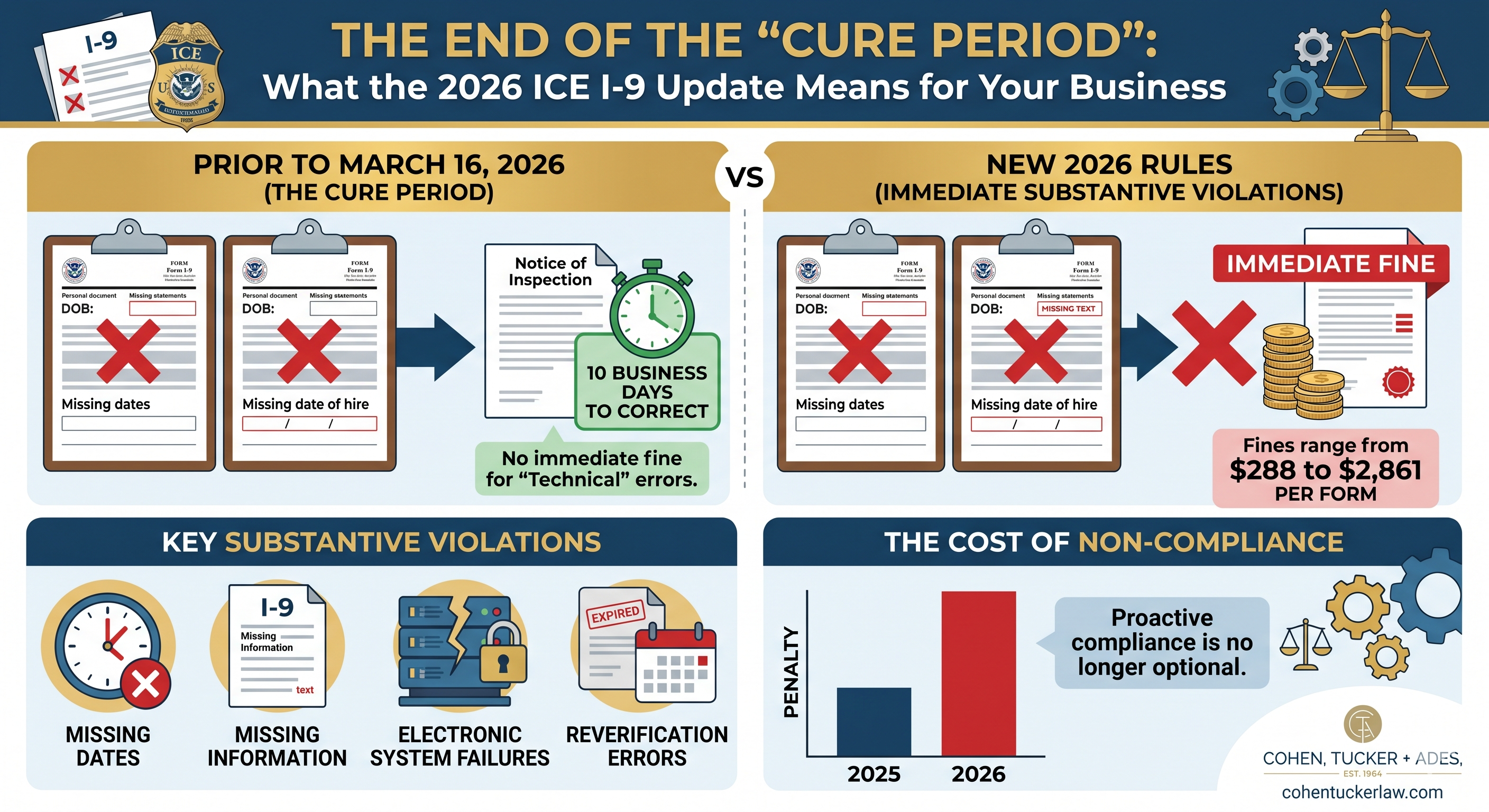
The 2026 update reclassifies over 10 common administrative errors from “technical” (correctable) to “substantive” (immediate fine). This means that mistakes once considered minor—like a missing date of birth or a missing signature date—now trigger immediate monetary penalties ranging from $288 to $2,861 per form.
The most alarming part of this update is the elimination of the “10-day cure period” for many common mistakes. Below are the errors that ICE now considers substantive violations upon discovery:
Missing Dates: Failing to ensure an employee dates Section 1 or the employer dates Section 2 at the time of hire.
Missing Information: Missing Date of Birth (Section 1) or Date of Hire (Section 2) are no longer considered minor clerical errors.
Electronic System Failures: If your electronic I-9 software fails to meet federal standards for security or audit trails, every form in that system may be considered a substantive violation.
Reverification Errors: Failure to sign or date the reverification portion (Supplement B) on or before the expiration of work authorization.
ICE has also adjusted its civil penalty matrix. For a first-time offense, substantive violations can cost nearly $3,000 per employee. For a mid-sized company with 100 employees, an error rate of 50% (which is common in paper-based filing) could result in a fine exceeding $140,000.
Given that ICE often issues a Notice of Inspection (NOI) with only three business days’ notice, you cannot afford to wait for an audit to fix your files. We recommend the following steps:
Conduct an Internal Audit: Review your current and terminated I-9 files now. Identifying and correcting errors before a Notice of Inspection is served can significantly mitigate risk.
Review Electronic Systems: Ensure your digital I-9 provider is fully compliant with the latest DHS “Alternative Procedure” and electronic storage standards.
Update HR Training: Your hiring managers must understand that “getting to it later” is no longer an option. Section 1 must be completed on the first day of work, and Section 2 by the third day.
Legal Counsel Review: Work with an immigration attorney to establish a “Good Faith” defense, which may help mitigate fines if an audit does occur.
Since 1964, Cohen, Tucker + Ades has been at the forefront of immigration law. Our team understands the “labyrinth” of ICE regulations and provides the corporate solutions necessary to protect your business from aggressive federal enforcement.
Are your I-9 records audit-ready? Don’t wait for a Notice of Inspection to find out. Contact us today for a comprehensive compliance review.
Wendy R. Barlow, Esq.is a Partner at Cohen, Tucker + Ades, P.C. with nearly 20 years of experience in high-stakes immigration litigation. A graduate of the Maurice A. Deane School of Law at Hofstra University, Wendy is admitted to practice in New York and New Jersey as well as before the U.S. Supreme Court and multiple Federal Circuit Courts. Wendy is recognized for her ability to handle cases that many consider insurmountable.
Disclaimer: This blog post contains general information and is for informational purposes only. It is not legal advice and does not create an attorney-client relationship between you and Cohen, Tucker + Ades P.C. Immigration laws and fee schedules are subject to frequent change. The information provided herein may not reflect the most current legal developments. You should not act or refrain from acting based on information contained in this post without seeking professional counsel from an attorney licensed in your jurisdiction. Cohen, Tucker + Ades P.C. expressly disclaims all liability in respect to actions taken or not taken based on any or all of the contents of this post.
Sources: