Immigration Law Blog
Stay up-to-date on the latest immigration law news, with the Cohen, Tucker & Ades team's insights behind the headlines

On May 22, 2026, USCIS issued Policy Memorandum PM-620-1099, drastically altering how Adjustment of Status (Form I-485) applications are reviewed. USCIS now explicitly defines adjustment of status as an “extraordinary relief” rather than a routine procedure. Under this new directive, officers must evaluate the “totality of the circumstances” to determine whether an applicant deserves a positive exercise of discretion to adjust their status within the United States, or if they should be forced to leave the country and undergo consular processing abroad.
If you or your employees have a pending or upcoming I-485 application, this policy change represents a significant shift in risk. Our complex immigration litigation and corporate solutions teams break down what this means for you and how to safeguard your status.
For decades, adjusting status inside the United States under INA section 245(a) was the standard path for eligible foreign nationals physically present in the country. While always technically discretionary, it was rarely denied purely on a “lack of equities” if the applicant met all statutory requirements.
The new USCIS Policy Memorandum upends this standard. Officers are now actively issuing Requests for Evidence (RFEs) and grilling applicants during interviews about why they chose not to apply for an immigrant visa at a consular post abroad. Crucially, the memo explicitly states that simply having a clean record (the absence of negative factors) is no longer enough to win an approval.
The policy memo applies broadly to Adjustment of Status applications filed under INA 245 where the applicant has the theoretical option to seek an immigrant visa abroad.
Employment-Based green cards (EB-1, EB-2, EB-3)
Family-Based green cards (Spouses, children, and parents of USCs or LPRs)
Diversity Visas
Asylee and Refugee adjustments
Special Immigrant-based adjustments (EB-4)
Certain statutory adjustment categories are exempt from this discretionary review, including NACARA, Refugee adjustments, and HRIFA/LRIF applications.
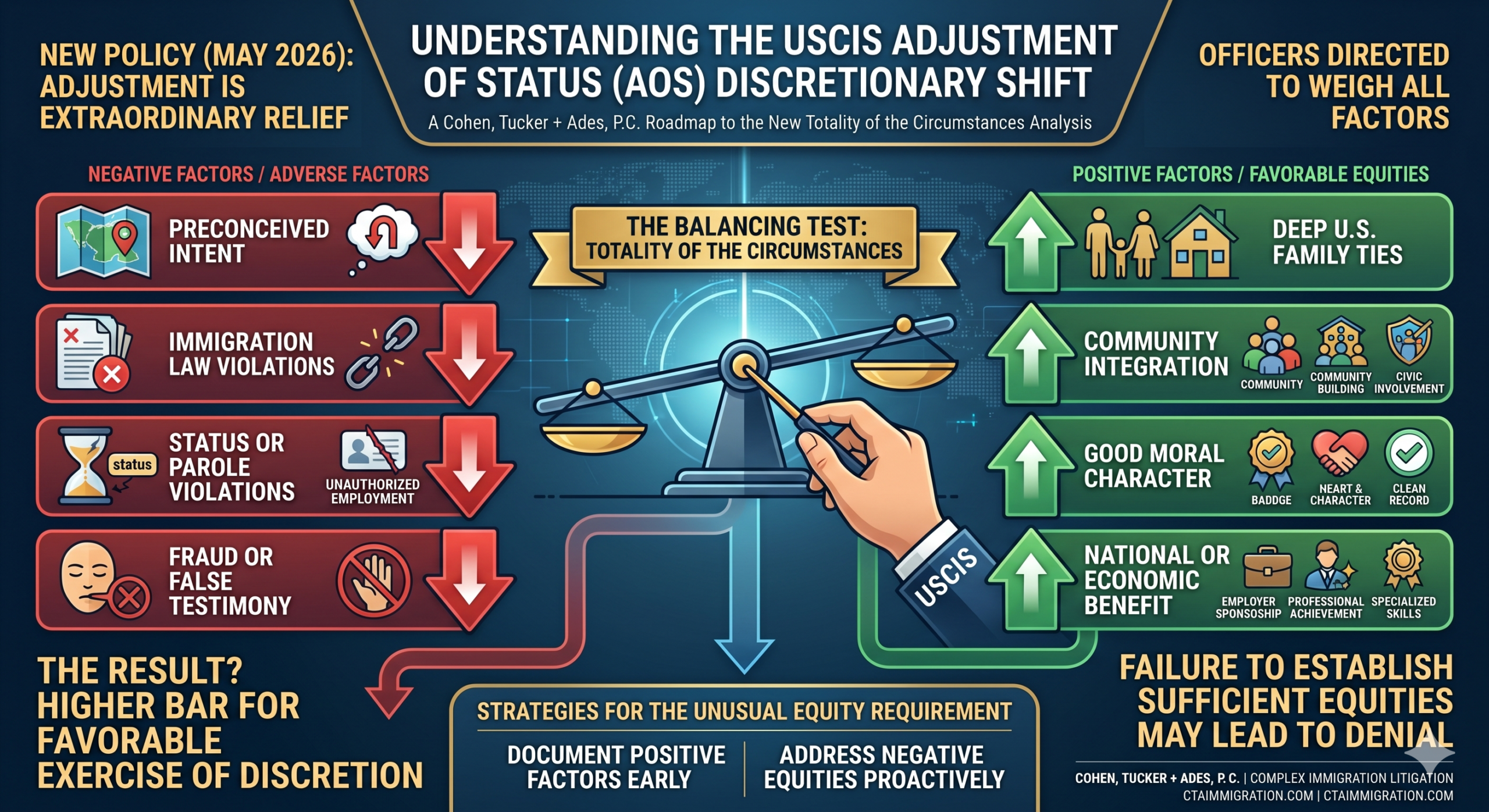
USCIS officers are now strictly weighing negative and positive factors to decide your case.
Immigration Violations: Any past visa overstays or unauthorized employment.
Preconceived Intent: Entering the U.S. on a nonimmigrant visa (like a B-1/B-2 tourist visa or F-1 student visa) with a hidden intent to bypass consular processing by filing an I-485.
Failure to Depart: Staying in the U.S. after your authorized period of stay or nonimmigrant program has ended.
Inconsistent Conduct: Behaving in a way that contradicts the explicit terms of your visa or parole status.
If you have any of the adverse factors listed above, you must demonstrate “unusual or even outstanding equities” to get approved. USCIS will look for:
Deep U.S. Family Ties: Having a U.S. citizen or permanent resident spouse or children, particularly where separation would cause extreme hardship.
Long-Term Community Integration: A robust local history backed by tax records, continuous employment history, and community involvement letters.
National or Economic Benefit: Specialized professional skills, employer sponsorship letters, or clear economic contributions to the U.S..
Exceptional Moral Character: An unblemished record, charitable contributions, and professional accomplishments.
Given the high stakes—where an I-485 denial can instantly trigger removal proceedings if you have not maintained an underlying nonimmigrant status—strategic planning is vital.
If you are relying solely on an adjustment-based Employment Authorization Document (EAD) to work and have let your underlying nonimmigrant status slip, you are in a higher-risk category. This is especially true for applications filed under section 245(k).
Strategy: Whenever possible, maintain or change to a dual-intent status (such as an H-1B or L-1 visa) while your green card application is pending.
When filing initial I-130 or I-140 petitions, it may be safer to indicate “immigrant visa processing” abroad, even if you later plan to adjust in the U.S.. Why? If you indicate “adjustment of status” on the initial form and your I-485 is later denied, you will face massive delays waiting for Form I-824 to process just to transfer your underlying approval back to the National Visa Center (NVC) for consular processing.
Do not wait for an RFE. If you have a pending or upcoming I-485 filing, your legal team should front-load the application with a comprehensive legal brief and compelling documentary evidence highlighting your positive equities.
At Cohen, Tucker + Ades, P.C., we have spent over 60 years guiding families and corporations through the nation’s most complex immigration crises. This new policy memorandum is ripe for legal challenge, and our experienced federal litigation and deportation defense teams are already prepared to push back against unlawful USCIS denials.
If your application has been impacted by an RFE, or if you need an aggressive, proactive strategy for your upcoming green card filing, do not leave your future to chance.
Wendy R. Barlow, Esq.is a Partner at Cohen, Tucker + Ades, P.C. with nearly 20 years of experience in high-stakes immigration litigation. A graduate of the Maurice A. Deane School of Law at Hofstra University, Wendy is admitted to practice in New York and New Jersey as well as before the U.S. Supreme Court and multiple Federal Circuit Courts. Wendy is recognized for her ability to handle cases that many consider insurmountable.
Disclaimer: This blog post contains general information and is for informational purposes only. It is not legal advice and does not create an attorney-client relationship between you and Cohen, Tucker + Ades P.C. Immigration laws and fee schedules are subject to frequent change. The information provided herein may not reflect the most current legal developments. You should not act or refrain from acting based on information contained in this post without seeking professional counsel from an attorney licensed in your jurisdiction. Cohen, Tucker + Ades P.C. expressly disclaims all liability in respect to actions taken or not taken based on any or all of the contents of this post.
Sources: