Immigration Law Blog
Stay up-to-date on the latest immigration law news, with the Cohen, Tucker & Ades team's insights behind the headlines

Key Takeaways for International Students & Scholars
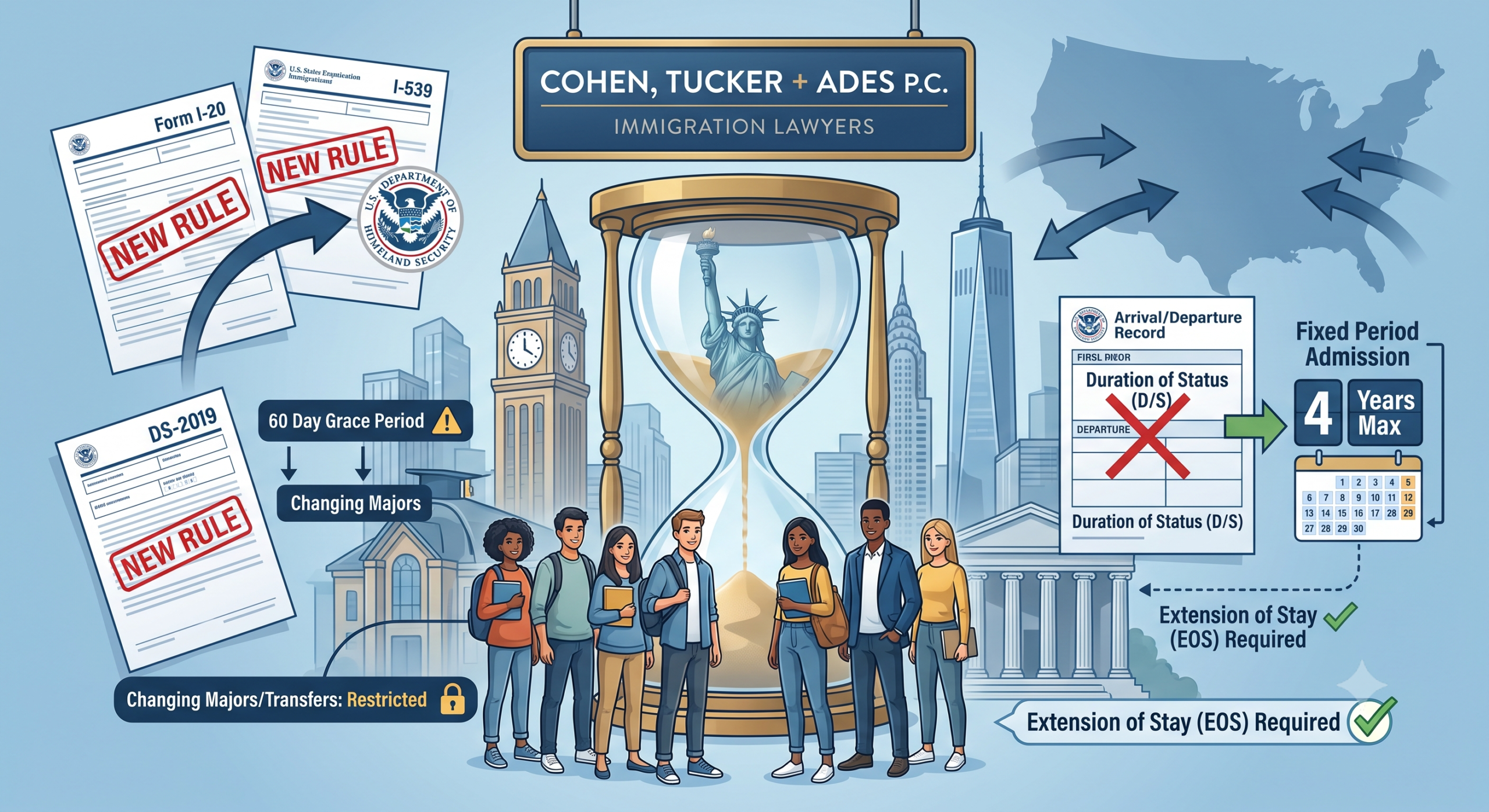
End of Duration of Status (D/S): The Department of Homeland Security (DHS) has officially finalized the rule ending open-ended “Duration of Status” for F, J, and M nonimmigrants.
4-Year Maximum Admission Cap: F and J visa holders will now be admitted for a fixed period tied to their program end date, not to exceed a maximum of 4 years per admission.
Mandatory USCIS Extension of Stay (Form I-539): Students and exchange visitors who need more time to finish their degrees or training must now file a formal Extension of Stay directly with USCIS rather than relying solely on university DSO extensions.
Grace Period Reduced: The post-program departure and status transition window for F-1 students drops from 60 days to 30 days.
Academic Restrictions: Tight limitations now apply to changing majors, transferring schools in the first academic year, or pursuing lateral/lower-level degrees.
For nearly half a century, international students (F visas), exchange visitors (J visas), and vocational students (M visas) entered the United States under the “Duration of Status” (D/S) framework. As long as an individual maintained full-time enrollment and kept their Form I-20 or DS-2019 up to date with their Designated School Official (DSO) or Responsible Officer (RO), their physical presence in the U.S. remained lawful.
The Department of Homeland Security’s final rule officially replaces Duration of Status with fixed periods of admission and strict federal oversight.
If you are currently studying on an F-1 visa, conducting research under a J-1 status, or planning higher education in the U.S., understanding how these regulatory changes affect your legal status, OPT transitions, and post-graduation plans is vital.
At Cohen, Tucker + Ades P.C., our experienced immigration attorneys have spent decades guiding foreign students, scholars, and educational institutions through evolving U.S. immigration policy. Here is a detailed breakdown of what has changed, how it impacts you, and what action steps you should take immediately.
| Policy Feature | Previous “Duration of Status” System | New Fixed Period Admission System |
| Admission Expiration | Valid for duration of academic program + grace period | Fixed end date on Form I-94 (Max 4-year limit) |
| Program Extensions | Handled internally by DSO / RO updating Form I-20 or DS-2019 | Requires formal Form I-539 application to USCIS + biometrics |
| F-1 Grace Period | 60 days following program or OPT completion | 30 days following program or EAD expiration |
| School & Major Changes | Flexible transfers & changes with university notification | Restricted during Year 1; grad student major changes restricted |
| Unlawful Presence | Accrued only after formal USCIS finding or immigration judge order | Accrues immediately the day after I-94 expiration if no EOS is pending |
Instead of an I-94 stamp reading “D/S”, Customs and Border Protection (CBP) officers at U.S. ports of entry will now assign a specific date on your I-94 arrival record.
The 4-Year Cap: Most foreign students and exchange scholars will be granted admission for their program length or up to 4 years, whichever is shorter.
PhD Candidates & Medical Residency: Degree programs that naturally take 5–7 years will require at least one formal application for an Extension of Stay midway through the academic track.
Previously, extending an academic program meant working with your international student office to get an updated Form I-20. Under the new rule:
Updating your I-20 or DS-2019 is still necessary, but it is no longer sufficient.
You must file Form I-539 (Application to Extend/Change Nonimmigrant Status) directly with USCIS prior to your I-94 expiration date.
Applicants are subject to government processing fees, biometric appointments (fingerprinting), background checks, and formal USCIS adjudication.
F-1 students previously enjoyed a 60-day grace period post-graduation to prepare for departure, apply for Optional Practical Training (OPT), or transfer to another institution.
The post-completion grace period for F-1 visa holders is now reduced to 30 days.
This significantly compresses the timeline to secure employment, submit OPT filings, or transition to another nonimmigrant visa category (such as H-1B, O-1, or TN).
To prevent what DHS describes as “perpetual enrollment,” the regulation places rigid constraints on academic choices:
First-Year Transfers: Undergraduate students generally cannot change their major or transfer schools during their first academic year without specific federal exemptions.
Graduate Programs: Graduate students face severe limitations on changing educational objectives or shifting majors during their degree program.
Lateral or Lower Degrees: Pursuing a second degree at the same level or enrolling in a lower educational level (e.g., finishing a Master’s and enrolling in another Master’s or Bachelor’s) faces heightened scrutiny and restrictions.
Warning: The Unlawful Presence Trap
Because status now expires on a hard date listed on your I-94 rather than when you leave school, remaining in the U.S. past your I-94 expiration without a timely filed USCIS extension will cause you to begin accruing unlawful presence immediately. Accruing 180 days of unlawful presence triggers a mandatory 3-year bar from entering the United States, while 365 days triggers a 10-year bar.
USCIS Processing Backlogs: Form I-539 adjudications routinely take several months. Filing early is mandatory to protect your work authorization (CPT/OPT) and legal residence.
Impact on OPT and H-1B Cap-Gap: With hard expiration dates on your I-94 and shortened grace periods, coordinating your STEM OPT extensions or transition to H-1B employer sponsorship requires precise calendar planning.
Transition Rules for Current Students: Foreign nationals currently in the U.S. under the old D/S rule are granted a transition period, capping authorized stay at a maximum of four years from the effective date of the new rule.
Check Your I-94 Expiration Date Immediately: Visit the official CBP I-94 website to confirm your exact expiration date rather than relying on your Form I-20 or DS-2019 end date.
Calendar EOS Filings at Least 120–180 Days in Advance: If your academic program will extend past your current I-94 date, initiate the extension process with your DSO and legal counsel months before it expires.
Do Not Rely Solely on DSO Advice for USCIS Filings: While university international offices provide essential guidance on I-20s, formal Form I-539 petitions carry legal consequences regarding status maintenance and unlawful presence.
Consult Immigration Counsel Before Changing Majors or Transferring: Ensure your proposed academic changes will not violate federal transfer caps or invalidate your stay.
Under Duration of Status (D/S), international students and exchange visitors were permitted to stay in the U.S. as long as they complied with program rules and maintained an active Form I-20 or DS-2019. Under fixed admission, visa holders are given a specific expiration date on their I-94 record (capped at a maximum of 4 years per stay), after which they must apply for a formal extension with USCIS.
Yes, Optional Practical Training (OPT) and STEM OPT remain available for eligible F-1 students. However, your work authorization and period of stay must be carefully aligned with your fixed I-94 date and USCIS extension applications.
If your degree program (e.g., PhD or dual-degree program) requires more than 4 years, you must file Form I-539 (Extension of Stay) with USCIS before your initial 4-year fixed period expires. You will need to provide documentation from your academic institution justifying the additional time.
Current F-1 and J-1 visa holders admitted under the previous “Duration of Status” rules will transition automatically, with their stay capped at a maximum of four years from the regulation’s effective date or until their current program completion date, whichever is shorter.
Navigating complex changes in U.S. visa regulations requires expert legal guidance. At Cohen, Tucker + Ades P.C., our team of dedicated immigration attorneys assists international students, university professors, researchers, and corporate employers in maintaining lawful status and avoiding costly immigration pitfalls.
Our services for international students & exchange scholars include:
Extension of Stay (EOS) preparation and filing with USCIS (Form I-539).
Counsel on school transfers, degree level changes, and academic objective updates.
Transition planning from F-1/J-1 to work visas (H-1B, O-1, L-1, TN) and permanent residency (Green Cards).
Unlawful presence risk assessments and status reinstatement petitions.
Don’t wait until your status is at risk. Contact Cohen, Tucker + Ades P.C. today to schedule a comprehensive consultation with an experienced NYC immigration attorney.