However, recent data from U.S. Citizenship and Immigration Services (USCIS) highlights a changing landscape. From shifting approval rates to a noticeable rise in Requests for Evidence (RFEs), filing an EB-1A today requires a strategic, highly detailed approach.
Below, we break down what the latest numbers mean, why RFEs are on the rise, and how petitioners can position themselves for success.
What Is the Current EB-1A Approval Rate?
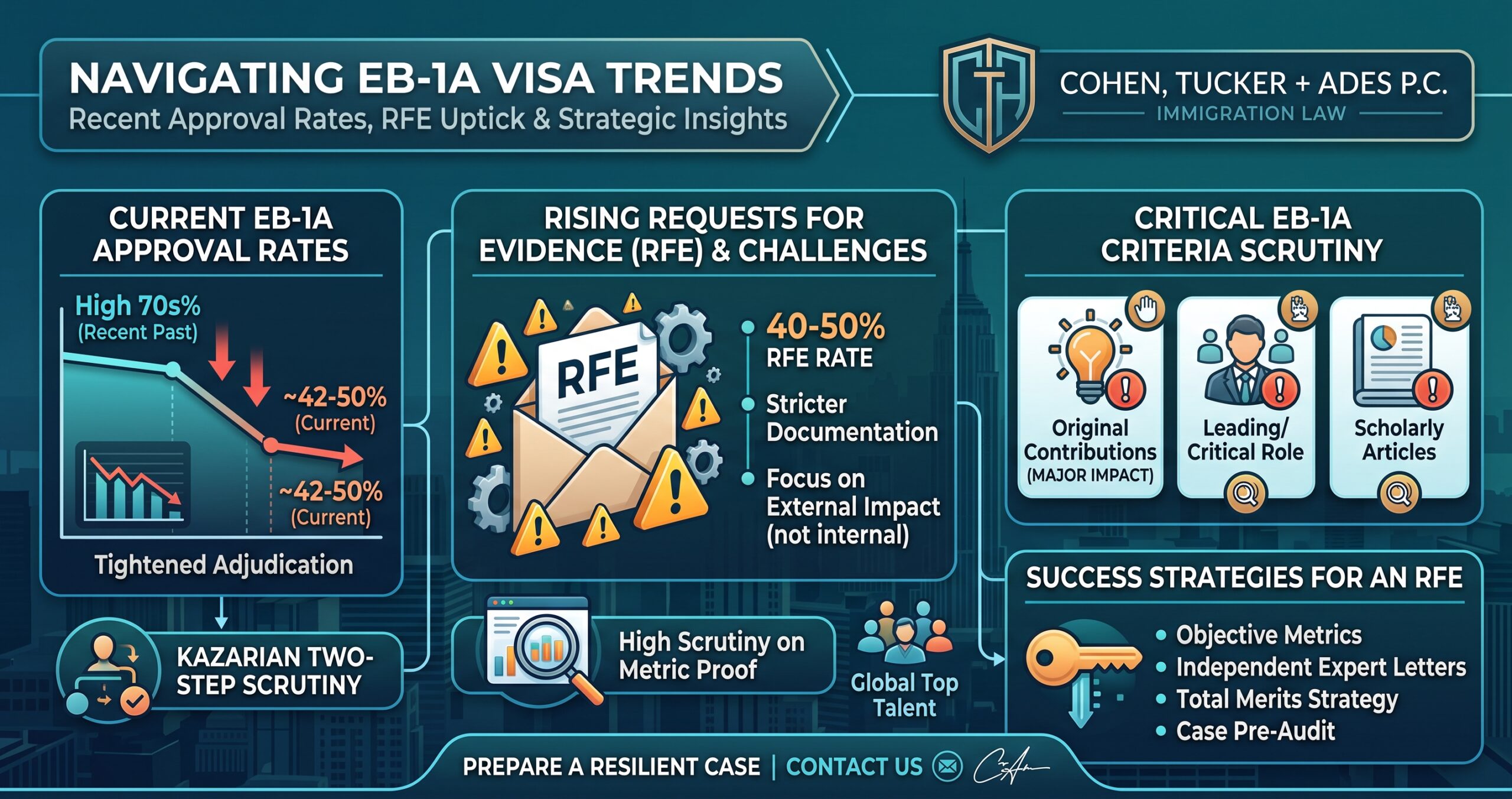
USCIS adjudication standards for the EB-1A category have tightened significantly compared to previous years. While overall approval rates held near 70–75% in prior cycles, recent quarterly figures reveal a decline:
| Period |
Approval Rate Trend |
Key Context |
| FY 2024 |
~84.7% |
High approval volumes following post-pandemic filing surges. |
| FY 2025 |
~66.9–75.0% |
Increased total filing volumes led to heightened adjudication standards. |
| Current / Recent Quarters |
~42–50% |
A sharper decline in approval rates for first-time submissions, driven by heavier reliance on RFEs. |
Key Takeaway for Applicants: While these statistics may sound alarming, they do not mean qualified candidates are being turned away across the board. Rather, USCIS has shifted away from approving “borderline” cases on initial review, choosing instead to issue targeted RFEs.
Why Are RFEs on the Rise for EB-1A Petitions?
Practitioners across the U.S. have observed a steep uptick in RFEs, with estimates suggesting that 40% to 50% of EB-1A filings now receive a Request for Evidence.
An RFE is not a denial. However, it signals that the reviewing officer demands stronger, more specific documentation to satisfy USCIS standards. Key drivers behind this rise include:
1. Stricter Application of the Kazarian Two-Step Analysis
Meeting 3 out of the 10 regulatory criteria is only Step One of the process. Under Step Two—the Final Merits Determination—adjudicators evaluate whether the totality of the evidence demonstrates that you have sustained national or international acclaim and are among the small percentage at the top of your field. Officers are actively utilizing Step Two to issue RFEs even when minimum criteria are met.
2. High Filing Volumes and Vetting Automation
As EB-1A filing volumes increase, USCIS officers are utilizing updated digital vetting tools to cross-reference publications, citation metrics, and claims of industry impact. Generic support letters, template-driven recommendation packages, or questionable publication outlets draw immediate scrutiny.
3. Shift from Internal Achievements to External Impact
A common reason for recent RFEs is an over-reliance on internal accomplishments—such as high performance within a single firm—without demonstrating broader industry influence. USCIS expects independent proof that your work has been adopted, cited, or utilized by others in your field.
Which Criteria Are Under the Most Scrutiny?
While every petition is unique, recent USCIS adjudication patterns show that three regulatory criteria are receiving the heaviest scrutiny:
-
Original Contributions of Major Significance: Officers want to see how your work changed or influenced the field. Merely holding a patent, publishing a paper, or launching a product is no longer sufficient without proof of broad external adoption or citation.
-
Leading or Critical Role: Having an executive or senior title is only half the equation. You must also prove that the organization itself has a distinguished reputation nationally or internationally.
-
Scholarly Articles / Published Material: Adjudicators actively check journal impact factors, citation counts, and editorial reputations to filter out low-tier or predatory outlets.
Strategic Steps for a Successful EB-1A Petition
Despite stricter standards, well-documented petitions continue to achieve high rates of success—even following an RFE. To build a resilient EB-1A case in today’s environment:
-
Emphasize Independent Evidence: Prioritize testimony and letters from recognized experts who have no direct relationship with you, but can objectively attest to your impact.
-
Document Objective Metrics: Quantify your achievements using third-party metrics—such as industry adoption rates, total downloads, independent citation counts, or commercial revenue generated.
-
Bridge Experience to Impact: Structure your narrative so that every piece of evidence explicitly answers: “Why does this achievement matter to the broader field?”
-
Prepare for the RFE Stage: Build a comprehensive evidentiary foundation at the initial filing phase to ensure you can swiftly address potential officer queries during an RFE window.
Frequently Asked Questions
Does receiving an RFE mean my EB-1A petition will be denied?
No. Receiving an RFE simply means USCIS requires further clarification or additional objective evidence before making a decision. Industry data shows that well-crafted RFE responses continue to enjoy strong overall approval rates.
What is the most common reason for an EB-1A RFE?
The most common reason is failing to satisfy the Final Merits Determination. Applicants often meet three basic evidentiary criteria on paper, but fail to clearly document how those achievements demonstrate sustained national or international acclaim.
How can I improve my chances of EB-1A approval?
Work with experienced legal counsel to conduct a rigorous pre-filing audit of your evidence. Focus on independent evaluation letters, verifiable third-party metrics, and clear documentation showing how your work has impacted your industry at large.
How Cohen, Tucker + Ades Can Help
Navigating the evolving requirements of an EB-1A petition demands a legal strategy that goes beyond hitting basic checklists. At Cohen, Tucker + Ades P.C., our experienced immigration attorneys evaluate every case through the lens of current USCIS trends, anticipating potential scrutiny and framing your achievements for maximum impact.
If you are considering an EB-1A petition or need assistance responding to a Request for Evidence, contact Cohen, Tucker + Ades P.C. today to schedule a consultation with our immigration team.
About the Author
Wendy R. Barlow, Esq. is a Partner at Cohen, Tucker + Ades, P.C. with nearly 20 years of experience in high-stakes immigration litigation. A graduate of the Maurice A. Deane School of Law at Hofstra University, Wendy is admitted to practice in New York and New Jersey as well as before the U.S. Supreme Court and multiple Federal Circuit Courts. Wendy is recognized for her ability to handle cases that many consider insurmountable.
Disclaimer: This blog post contains general information and is for informational purposes only. It is not legal advice and does not create an attorney-client relationship between you and Cohen, Tucker + Ades P.C. Immigration laws and fee schedules are subject to frequent change. The information provided herein may not reflect the most current legal developments. You should not act or refrain from acting based on information contained in this post without seeking professional counsel from an attorney licensed in your jurisdiction. Cohen, Tucker + Ades P.C. expressly disclaims all liability in respect to actions taken or not taken based on any or all of the contents of this post.