Immigration Law Blog
Stay up-to-date on the latest immigration law news, with the Cohen, Tucker & Ades team's insights behind the headlines

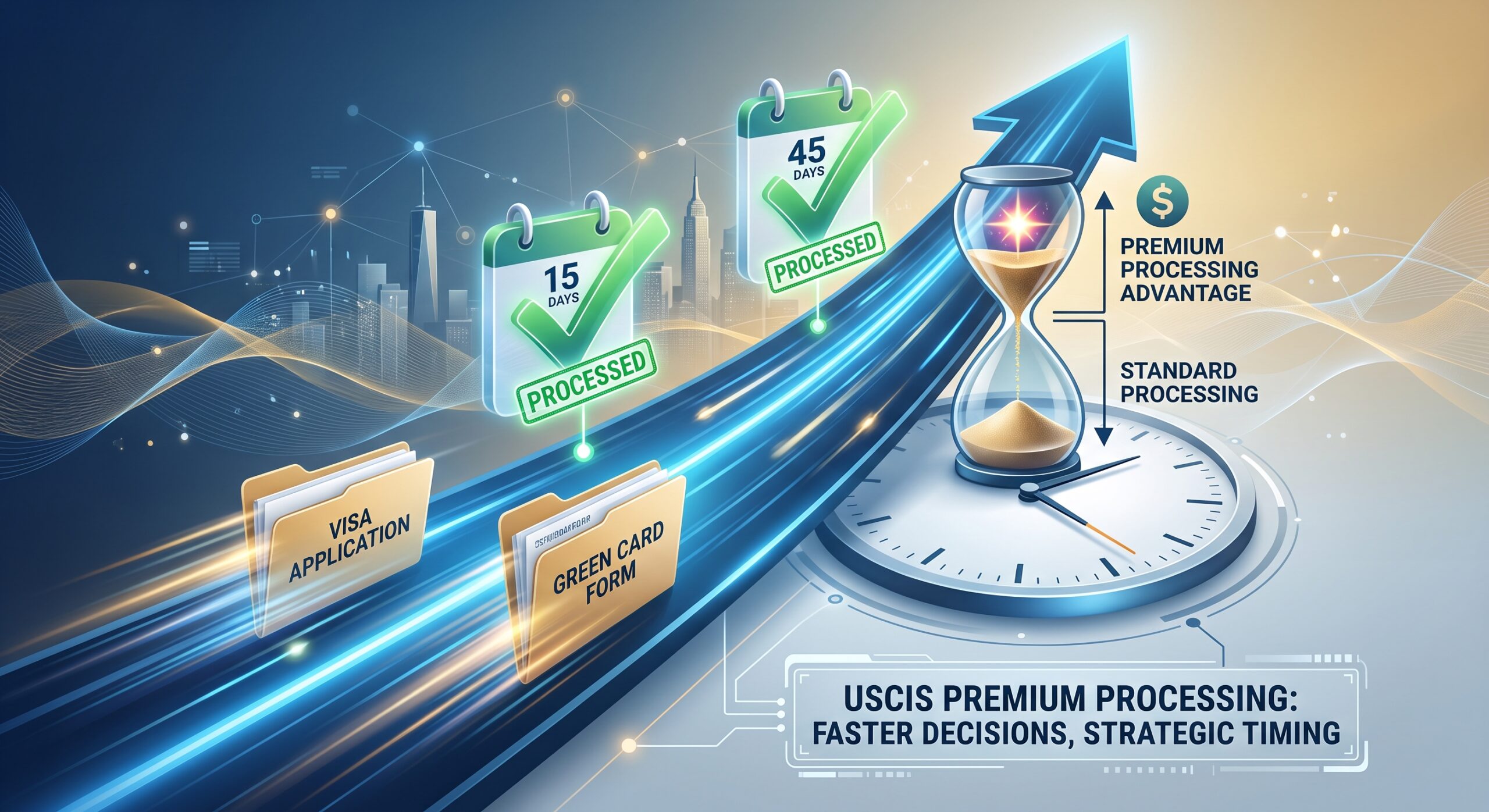
Waiting months for a U.S. Citizenship and Immigration Services (USCIS) decision can freeze career moves, delay business expansions, and create unnecessary stress. USCIS Premium Processing offers an expedited review path for select immigration petitions, accelerating processing times down to 15 to 45 calendar days.
Navigating when to upgrade, what the service actually guarantees, and when it might work against your strategy requires a clear view of the rules.
USCIS Premium Processing is an optional fee-based service using Form I-907 (Request for Premium Processing Service). It guarantees that USCIS will take adjudicative action on eligible petitions within a specific timeframe.
“Action” within the premium timeframe does not automatically mean an immediate approval. It means USCIS will issue one of four outcomes within the deadline:
An approval notice
A denial notice
A Notice of Intent to Deny (NOID)
If USCIS issues an RFE or NOID, the premium processing clock pauses and resets once the requested documentation is received.
| Feature | Standard Processing | Premium Processing |
| Filing Form | Standard Petition (e.g., Form I-129, I-140) | Form I-907 (filed concurrently or added later) |
| Timeline | 3 to 18+ months (varies by form & service center) | 15 to 45 calendar days (varies by form class) |
| Cost | Standard filing fees apply | Standard fee + Form I-907 Fee ($1,685 – $2,805) |
| Guaranteed Outcome | No | Action guaranteed within deadline or fee refunded |
Premium processing applies primarily to employment-based nonimmigrant worker petitions (Form I-129) and immigrant petitions for alien workers (Form I-140), alongside select student and exchange visitor applications (Form I-765 and Form I-539).
Form I-129 (Nonimmigrant Workers): E-1, E-2, E-3, H-1B, H-2B, H-3, L-1A, L-1B, LZ (Blanket L), O-1, O-2, P-1, P-1S, P-2, P-2S, P-3, P-3S, Q-1, TN-1, and TN-2.
Form I-140 (Immigrant Petitions): EB-1A (Extraordinary Ability), EB-1B (Outstanding Professors/Researchers), EB-2 (Advanced Degree/Exceptional Ability), EB-3 (Skilled Workers, Professionals, Other Workers).
Form I-765 (Application for Employment Authorization): F-1 students seeking OPT or Science, Technology, Engineering, and Math (STEM) OPT extensions.
Form I-140: EB-2 National Interest Waiver (NIW) and EB-1C (Multinational Executives and Managers).
Form I-539 (Application to Extend/Change Nonimmigrant Status): F-1, F-2, M-1, M-2, J-1, and J-2 nonimmigrants changing or extending status.
Note: Premium processing is generally not available for family-based green cards (Form I-130), adjustment of status applications (Form I-485), or naturalization applications (Form N-400).
Paying for faster processing is not always the best legal move for every applicant. Strategic use of Form I-907 depends on your current immigration status, employment deadlines, and overall immigration roadmap.
Approaching Status Expiration: If an employee’s work authorization or H-1B 6-year cap is nearing its end, premium processing ensures timely approval before status expires.
H-1B Spousal Work Authorization (H-4 EAD): Accelerating an I-140 approval allows a spouse holding H-4 status to file for their EAD sooner.
International Travel Requirements: When foreign travel is necessary, having an approved notice avoids being stuck abroad waiting for a petition to clear.
Job Changes & H-1B Transfers: Expediting a transfer petition minimizes the gap between leaving an employer and starting a new role safely.
Potential RFEs on Complex Cases: If a petition (such as an EB-2 NIW or O-1 visa) is borderline, submitting under premium processing gives USCIS officers a tight window to review. In some instances, this limited timeframe increases the likelihood of an RFE as the officer seeks more time or clarification.
Priority Date Bottlenecks: If your priority date for a green card is years away, paying to expedite an I-140 petition may not speed up your actual green card approval—unless you need the approved I-140 for H-1B extensions beyond 6 years.
Depending on the form type, USCIS guarantees adjudicative action within 15, 30, or 45 calendar days from the date they receive a properly filed Form I-907.
If USCIS fails to issue a decision, RFE, or NOID within the specified calendar timeframe, they are legally required to refund the Form I-907 fee and continue processing the case on an expedited basis.
Yes. You can upgrade an eligible petition to Premium Processing at any time while the application remains pending with USCIS by filing Form I-907 referencing your original receipt number.
No. Premium processing speeds up the response time, but it does not alter the legal standards used to evaluate your eligibility or increase the likelihood of an approval.
Deciding whether to utilize Premium Processing requires weighing government fees against work deadlines, travel plans, and case strength. At Cohen, Tucker + Ades P.C., our team brings decades of combined experience guiding individuals and corporations through employment-based immigration strategies.
Contact Cohen, Tucker + Ades P.C. today to schedule a confidential consultation and map out the right timeline for your immigration goals.