Immigration Law Blog
Stay up-to-date on the latest immigration law news, with the Cohen, Tucker & Ades team's insights behind the headlines

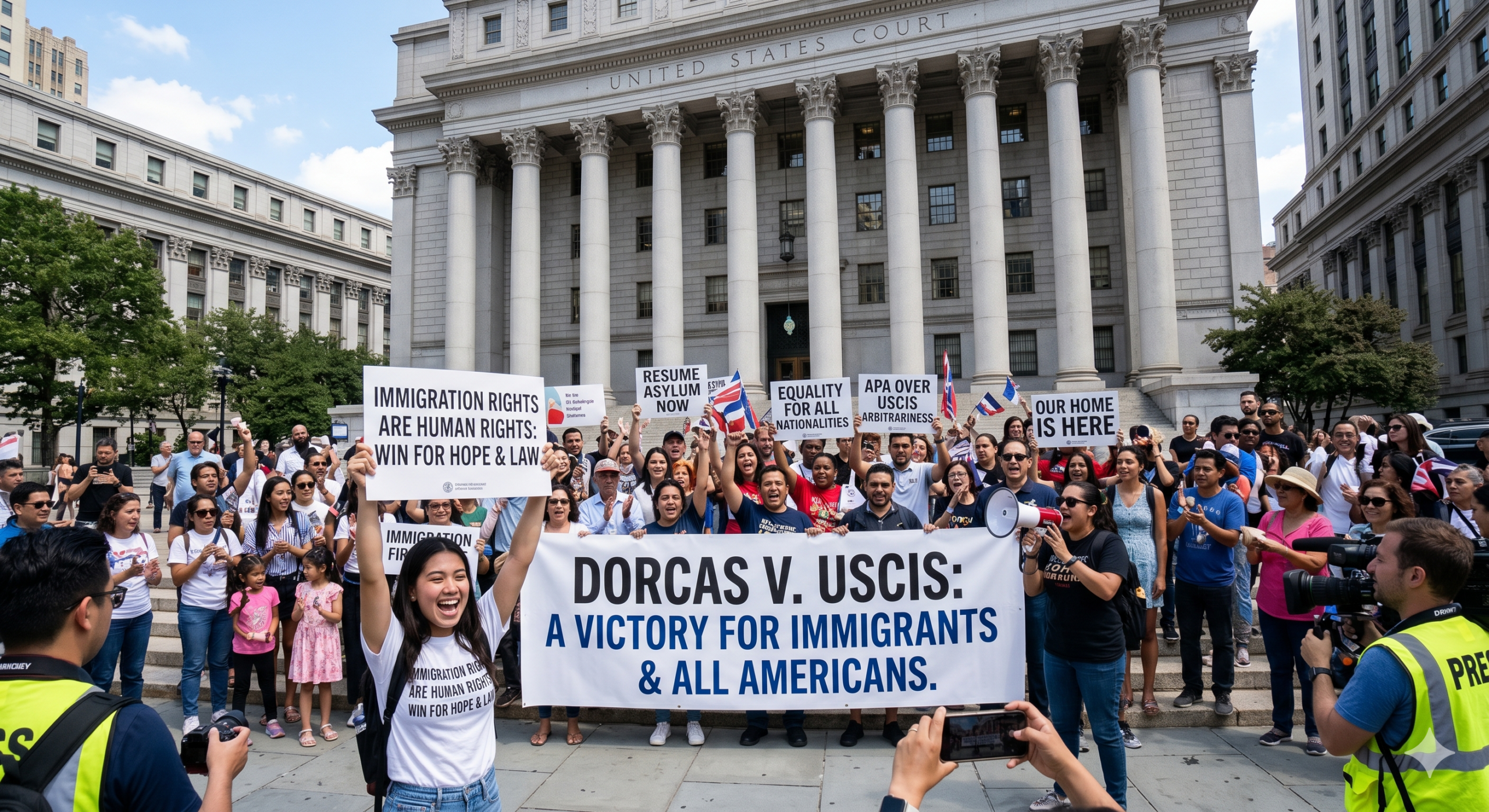
In a massive victory for immigrant communities and the rule of law, a federal court has completely dismantled a series of restrictive policies that ground U.S. Citizenship and Immigration Services (USCIS) processing to a halt.
On June 5, 2026, Chief Judge John J. McConnell, Jr. of the U.S. District Court for the District of Rhode Island issued a sweeping 135-page decision in Dorcas International Institute of Rhode Island, et al. v. USCIS, et al. The court declared four major USCIS policies unlawful, ordering them immediately vacated and set aside nationwide.
For months, thousands of applicants who followed every rule, paid their fees, and passed their interviews were trapped in indefinite legal limbo. This ruling officially orders USCIS to get back to work and adjudicate these cases.
The federal court ruled that USCIS violated the Administrative Procedure Act (APA) and exceeded its statutory authority by indefinitely freezing immigration applications and asylum processing. The court held that while the President has authority to regulate entry into the United States, USCIS cannot use national security as a pretext to unlawfully freeze domestic benefits based solely on an applicant’s country of birth.
The Dorcas ruling targeted four specific, interconnected measures rolled out by the administration between late 2025 and early 2026:
The Global Asylum Hold Policy: This policy had completely frozen decisions on affirmative asylum applications (Form I-589) nationwide, regardless of the applicant’s country of origin.
The Benefits Hold Policy: This measure placed an indefinite freeze on processing critical benefits—including adjustments of status (Green Cards), Employment Authorization Documents (EADs/work permits), and naturalization (citizenship)—for nationals of 39 designated “high-risk” or travel-ban countries.
The Comprehensive Re-Review Policy: This required USCIS to pull back and re-adjudicate previously approved benefit requests for any individual from the designated countries who entered the U.S. on or after January 20, 2021.
The Country-Specific Factors Policy: This directed USCIS officers to automatically treat an applicant’s nationality from a designated country as a “significant negative factor” when weighing discretionary decisions.
In a pointed rebuke, Judge McConnell wrote that the administration’s severe processing delays could not be attributed to anything the applicants did wrong, stating that their legal limbo arose “solely by the happenstance of their birth.”
The court’s decision rests on core principles of administrative law:
Exceeded Statutory Authority: The court found that Congress never gave USCIS the power to selectively stop adjudicating cases. For example, statutory language explicitly dictates that asylum applications must be adjudicated within 180 days absent exceptional circumstances.
Arbitrary and Capricious: The agency failed to provide a reasoned explanation or a legitimate administrative record to justify why an across-the-board freeze was necessary.
Ignored Reliance Interests: The court emphasized that applicants had invested significant time, money, and emotional energy into their legal processes, which the agency completely ignored when it upended the system.
If you have a pending case inside the United States, this ruling directly impacts how USCIS must handle your file moving forward.
If your work permit, green card, or citizenship application was frozen under the 39-country hold, USCIS is legally obligated to resume standard processing. Being from a designated country can no longer be used as a reason to stall your file.
USCIS officers are no longer permitted to treat your country of origin as an automatic negative factor when deciding your case. Your application must be evaluated on its individual merits.
The nationwide block on affirmative asylum decisions has been lifted, meaning immigration offices must resume issuing final decisions on pending asylum cases.
Crucial Note on Scope: This ruling applies to USCIS processing inside the United States. It does not overturn the executive travel restrictions themselves, it does not restart overseas refugee admissions, and it does not directly alter Department of State visa processing at overseas embassies.
While this is a profound victory, the legal battle is likely not over. The administration is heavily expected to appeal the decision to the First Circuit Court of Appeals and will likely request an emergency stay (a temporary pause on the judge’s order) while the appeal plays out.
If a stay is granted, USCIS could temporarily resume the holds. If it is denied, the vacatur remains active, and the agency must continue processing applications.
Navigating rapidly shifting immigration policies requires proactive legal strategy. If your application has been caught in the USCIS freeze, or if you are concerned about how an upcoming appeal might impact your status, our experienced legal team is here to protect your rights.
Contact Cohen, Tucker + Ades today to schedule a consultation and review the status of your pending application.
Wendy R. Barlow, Esq.is a Partner at Cohen, Tucker + Ades, P.C. with nearly 20 years of experience in high-stakes immigration litigation. A graduate of the Maurice A. Deane School of Law at Hofstra University, Wendy is admitted to practice in New York and New Jersey as well as before the U.S. Supreme Court and multiple Federal Circuit Courts. Wendy is recognized for her ability to handle cases that many consider insurmountable.
Disclaimer: This blog post contains general information and is for informational purposes only. It is not legal advice and does not create an attorney-client relationship between you and Cohen, Tucker + Ades P.C. Immigration laws and fee schedules are subject to frequent change. The information provided herein may not reflect the most current legal developments. You should not act or refrain from acting based on information contained in this post without seeking professional counsel from an attorney licensed in your jurisdiction. Cohen, Tucker + Ades P.C. expressly disclaims all liability in respect to actions taken or not taken based on any or all of the contents of this post.
Sources:
Dorcas International Institute of Rhode Island, et al. v. USCIS, et al.