Immigration Law Blog
Stay up-to-date on the latest immigration law news, with the Cohen, Tucker & Ades team's insights behind the headlines

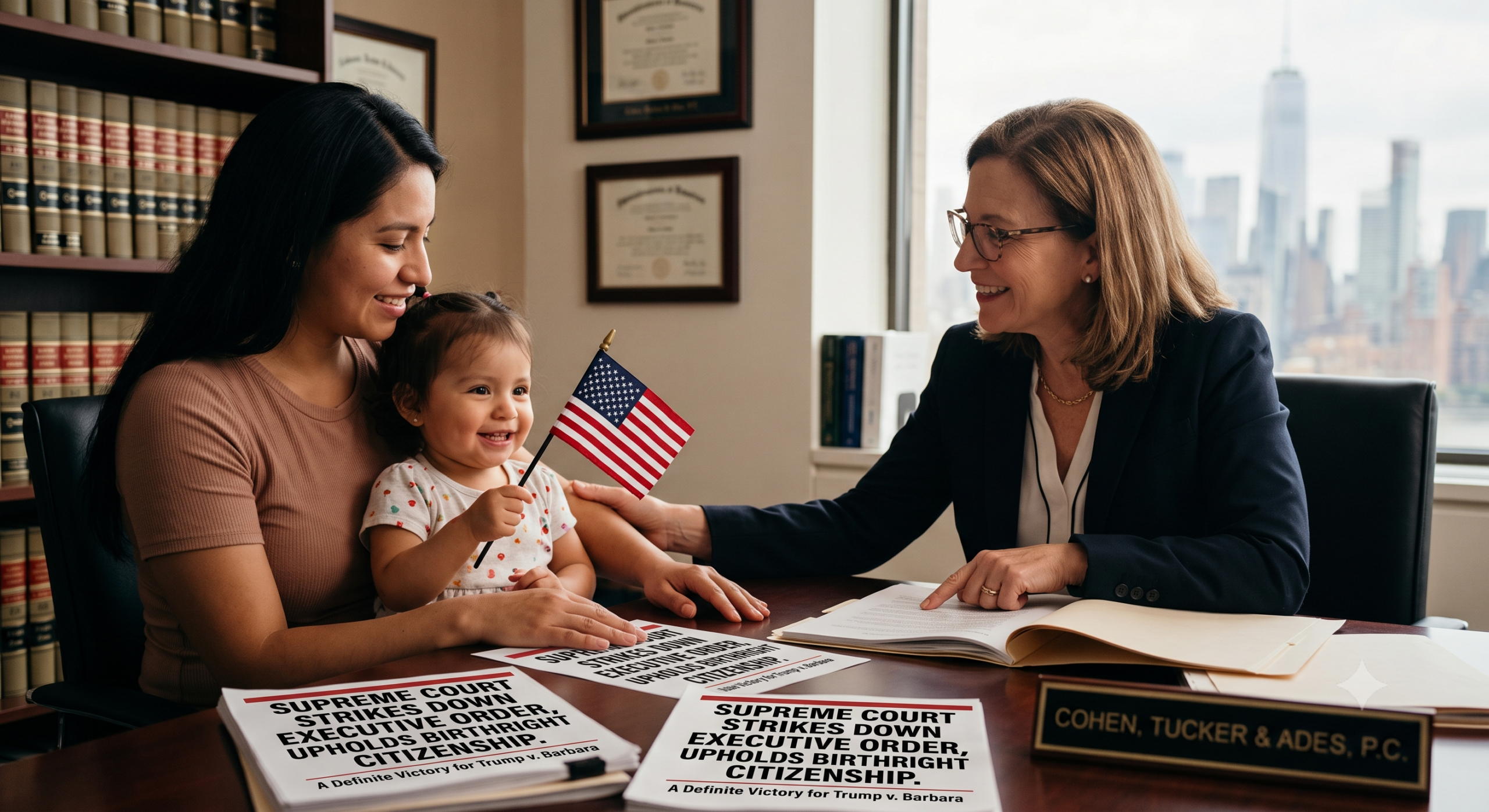
A historic decision has just been handed down by the nation’s highest court. On June 30, 2026, the U.S. Supreme Court issued a monumental 6-3 ruling in Trump v. Barbara, officially striking down the administration’s executive order that sought to limit birthright citizenship.
By rejecting the administration’s challenge, the Supreme Court has firmly upheld more than a century of constitutional precedent, ensuring that automatic citizenship remains protected for children born on American soil.
Since 1964, our team at Cohen, Tucker & Ades, P.C. has stood by immigrant communities in New York and across the country. Because this decision brings immense relief and clarity to millions of families, we have broken down exactly what the Court ruled, the legal reasoning behind it, and what it means for your family’s future.
In a 6-3 decision, the Supreme Court ruled that Executive Order 14160—which attempted to deny automatic citizenship to children born in the U.S. to undocumented immigrants and temporary visa holders—is unconstitutional and unlawful.
“Barbara” was a pseudonym chosen to protect the identity of an asylum seeker from Honduras living in New Hampshire. After arriving in the U.S., she learned she was pregnant shortly after the executive order was signed in January 2025. Represented by civil rights groups, her lawsuit successfully blocked the policy in federal district courts before it reached the Supreme Court.
Yes. The Supreme Court’s ruling explicitly reaffirms the Citizenship Clause of the Fourteenth Amendment, which guarantees that nearly everyone born within the territorial boundaries of the United States is an automatic U.S. citizen at birth.
The administration’s legal argument hinged on a restrictive reinterpretation of the 14th Amendment’s phrase, “subject to the jurisdiction thereof.” The government claimed that the President had the authority to deny citizenship to children of temporary visitors or undocumented immigrants because those parents did not owe permanent allegiance to the U.S.
However, the Supreme Court majority rejected this argument, upholding the landmark 1898 precedent established in United States v. Wong Kim Ark.
Geography Rules (Jus Soli): The Court reaffirmed that the U.S. follows the principle of jus soli (right of the soil). If a child is born within U.S. territory, they are a citizen, regardless of their parents’ legal status.
Narrow Exceptions Stand: The Court reminded the government that the only historical exceptions to birthright citizenship are extraordinarily narrow, such as the children of foreign diplomats or foreign invading armies.
Practical Hurdles: During the proceedings, justices expressed significant skepticism regarding the administrative chaos the executive order would cause, noting that forcing hospitals and federal agencies to vet the legal status of parents immediately following childbirth was logistically unfeasible.
| If your status is… | What the decision means for you: |
| Undocumented / Seeking Asylum | Any child born to you on U.S. soil is automatically, legally, and permanently a U.S. citizen from birth. Your child’s right to a U.S. passport and birth certificate cannot be denied under this executive order. |
| On a Temporary Visa (Student, Tourist, Work) | The concept of “birth tourism” restrictions has been rejected. Children born to parents on temporary visas remain automatic U.S. citizens. |
| Already a Citizen via Birthright | The ruling prevents any prospective or retroactive legal clouds over the status of U.S. citizens born to non-citizen parents. |
This Supreme Court victory provides a vital shield of legal stability for immigrant communities during a period of sweeping policy shifts. It confirms that the fundamental promise of American citizenship cannot be rewritten by an executive order.
The Bottom Line: Birthright citizenship remains the unchallenged law of the land.
While this ruling marks a definitive victory, navigating the U.S. immigration system still requires careful, expert guidance. Whether you are looking to adjust your status, sponsor a family member, secure an employment visa, or protect your family from shifting federal policies, the experienced advocates at Cohen, Tucker & Ades are here to thread the labyrinth with you.
Don’t let changing political landscapes leave you guessing. Schedule a confidential consultation with the trusted NYC immigration lawyers at Cohen, Tucker & Ades today.
Wendy R. Barlow, Esq.is a Partner at Cohen, Tucker + Ades, P.C. with nearly 20 years of experience in high-stakes immigration litigation. A graduate of the Maurice A. Deane School of Law at Hofstra University, Wendy is admitted to practice in New York and New Jersey as well as before the U.S. Supreme Court and multiple Federal Circuit Courts. Wendy is recognized for her ability to handle cases that many consider insurmountable.
Disclaimer: This blog post contains general information and is for informational purposes only. It is not legal advice and does not create an attorney-client relationship between you and Cohen, Tucker + Ades P.C. Immigration laws and fee schedules are subject to frequent change. The information provided herein may not reflect the most current legal developments. You should not act or refrain from acting based on information contained in this post without seeking professional counsel from an attorney licensed in your jurisdiction. Cohen, Tucker + Ades P.C. expressly disclaims all liability in respect to actions taken or not taken based on any or all of the contents of this post.
Sources:
U.S. Supreme Court, Trump v. Barbara.