Immigration Law Blog
Stay up-to-date on the latest immigration law news, with the Cohen, Tucker & Ades team's insights behind the headlines

Quick Summary
Can you file an EB-5 petition if you already have an approved EB-2 or EB-3 I-140?
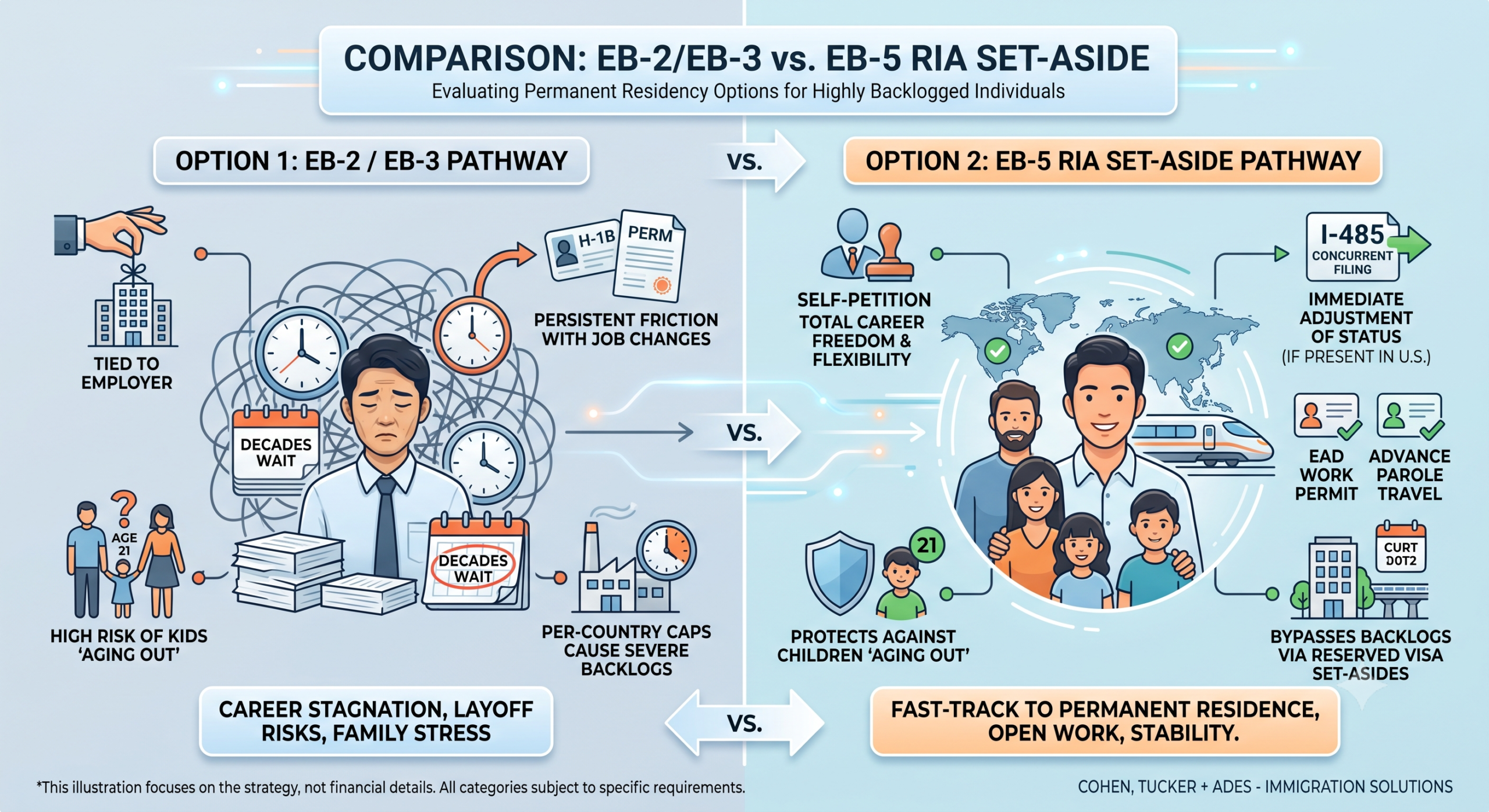
Yes. Holding an approved employment-based immigrant visa petition (such as an I-140) does not preclude you from applying for an EB-5 investor visa. Under the EB-5 Reform and Integrity Act (RIA), high-skilled immigrants stuck in multi-year or multi-decade visa backlogs can utilize EB-5 set-aside categories (Rural, High Unemployment, Infrastructure) to file their Adjustment of Status (Form I-485) concurrently. This provides immediate work authorization (EAD), travel permission (Advance Parole), complete career freedom, and vital protection against children “aging out” of eligibility.
For thousands of foreign professionals living and working in the United States on temporary visas like H-1B, L-1, or O-1, securing an approved Form I-140 (Immigrant Petition for Alien Workers) is a major milestone.
However, an approved I-140 is only half the battle. Due to annual per-country caps, applicants born in high-demand countries—such as India and China—face waiting times that can stretch for decades in the EB-2 and EB-3 preference categories.
While waiting, professionals face persistent friction:
Career Stagnation: Inability to easily change employers, accept promotions, or launch a startup without restarting the PERM labor certification process.
Family Stress: Constant anxiety over children turning 21 (“aging out”) and losing their derivative applicant status.
Layoff Risks: The looming 60-day grace period threat following sudden tech or corporate downsizings.
If you find yourself stuck in this holding pattern, the EB-5 Immigrant Investor Program may be the fastest, most reliable bridge to permanent residence.
Thanks to significant legislative updates under the EB-5 Reform and Integrity Act of 2022 (RIA), the EB-5 visa is no longer just for those starting from scratch—it has become a strategic “fast track” for professionals already living in the U.S.
       [ Standard EB-2/EB-3 Track ]
  Employer-Tied H-1B  -->  Decades Wait  -->  Risk of Aging Out / Layoffs
                                 |
                        (Pivot to EB-5 RIA)
                                 v
       [ EB-5 Reserved Set-Aside Track ]
  Current Visa Bulletin  -->  Concurrent I-485  -->  EAD + AP in Months
The RIA created three specific EB-5 set-aside visa categories:
Rural Projects: 20% reserved (also benefits from priority processing)
High-Unemployment Areas (TEA): 10% reserved
Infrastructure Projects: 2% reserved
Because these set-asides created a brand-new pool of visas, dates in the Department of State Visa Bulletin for these categories have remained current or significantly ahead of standard EB-2/EB-3 dates. This allows investors from backlogged countries to jump ahead of the traditional queue.
If you are lawfully present in the U.S. on a valid nonimmigrant status (e.g., H-1B, L-1, F-1 OPT) and your EB-5 category is “Current” under the Visa Bulletin, you can take advantage of Concurrent Filing.
This means you can file your Form I-526E (Investor Petition) and Form I-485 (Adjustment of Status) at the exact same time.
What does Concurrent Filing give you?
Combo Card Eligibility: You can file for an open Employment Authorization Document (EAD) and Advance Parole (AP) travel permit alongside your I-485.
Total Career Flexibility: Once you receive your EAD, you are no longer tied to an H-1B sponsoring employer. You can switch jobs, take time off, start your own business, or work in any field.
Spousal Work Authorization: Your spouse also receives an unrestricted EAD.
Under U.S. immigration law, unmarried children lose their eligibility as derivative dependents on their parents’ green card application once they turn 21.
While the Child Status Protection Act (CSPA) provides some relief, long preference category backlogs often exceed CSPA protections. By filing an EB-5 set-aside petition concurrently with Form I-485 while a visa is current, you effectively “freeze” your child’s age for immigration purposes, safeguarding their path to a green card.
Applying for an EB-5 visa does not invalidate or cancel your existing I-140 petition. You can maintain your approved I-140 and current H-1B status as a fallback plan while your EB-5 petition is processed. Think of EB-5 as a parallel, accelerated track running alongside your existing petition.
| Strategic Factor | Standard EB-2 / EB-3 Backlog | EB-5 RIA (Set-Aside Category) |
| Visa Availability | Subject to multi-year backlogs (India/China) | Current / Significantly faster availability |
| Employer Dependency | Tied to sponsoring employer / PERM | Self-petitioned; complete job flexibility |
| Adjustment of Status | Must wait years until Priority Date is current | Concurrent I-485 filing available if present in U.S. |
| Work Authorization | Restricted to H-1B employer or AC21 portability | Unrestricted EAD for primary applicant & spouse |
| Child Protection | High risk of kids aging out at 21 | Freezes age upon filing I-485 under CSPA |
While the benefits are significant, an EB-5 investment requires careful financial planning and legal diligence:
Capital Requirement: Minimum investment of $800,000 for Targeted Employment Areas (TEA) or Rural projects, or $1,050,000 for non-TEA projects.
Source of Funds (SOF): You must prove that your investment capital was lawfully derived (e.g., through salary, asset sales, gifts, equity loans, or stock liquidation).
Project Due Diligence: Selecting a reputable Regional Center and project that meets USCIS job creation requirements is essential to securing both your green card and capital return.
Since 1964, Cohen, Tucker + Ades has helped individuals, families, and high-skilled professionals navigate complex U.S. immigration laws. Switching or supplementing your immigration strategy requires a cohesive plan that protects your current status while capitalizing on new opportunities.
Our seasoned team can evaluate your current I-140 priority date, review your child’s aging-out timeline, assist with lawful source-of-funds documentation, and execute a seamless concurrent EB-5 strategy.
Contact the legal team at Cohen, Tucker + Ades today to schedule a confidential consultation.