Immigration Law Blog
Stay up-to-date on the latest immigration law news, with the Cohen, Tucker & Ades team's insights behind the headlines

Direct Answer (TL;DR):
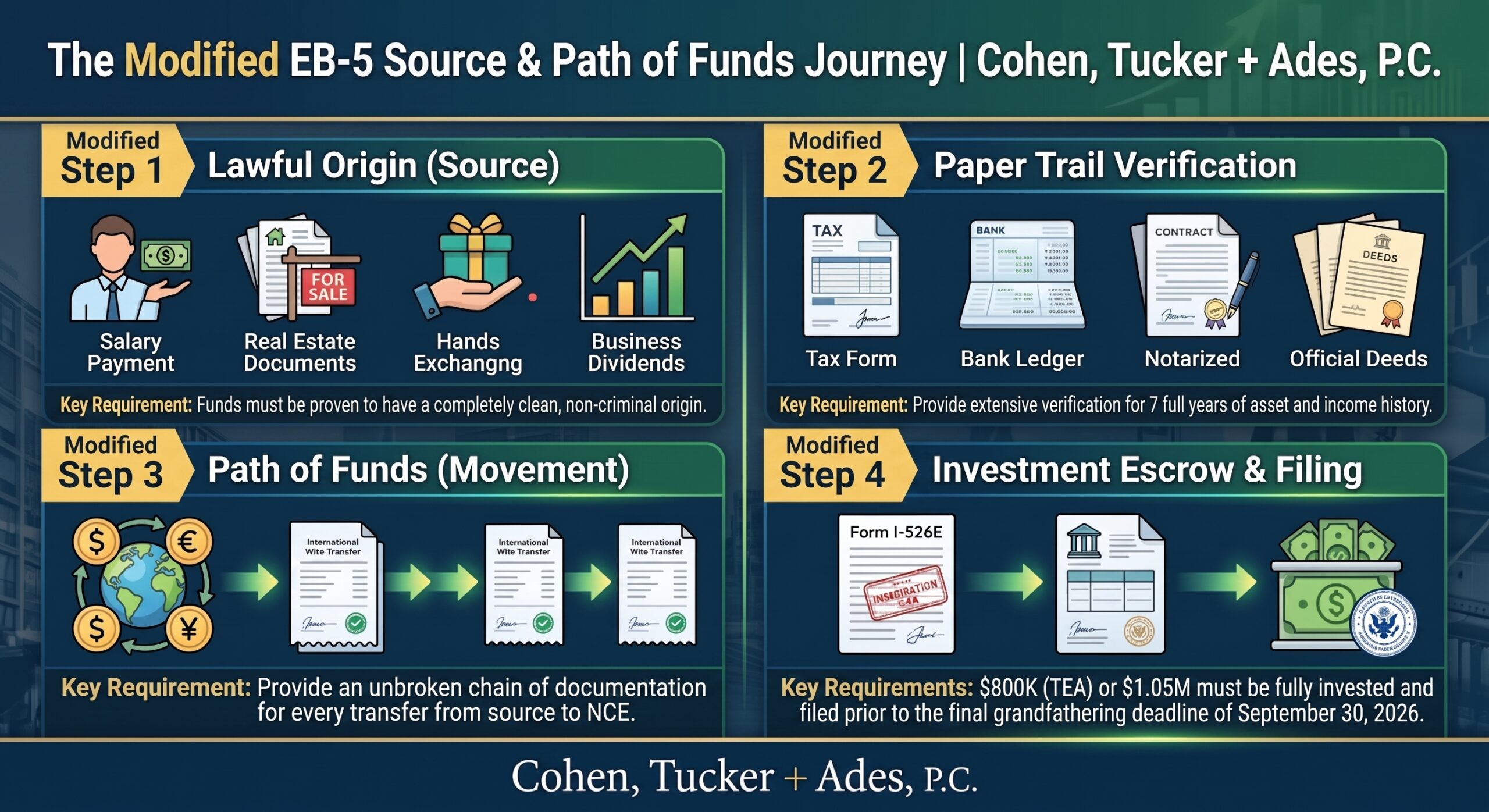
Under U.S. immigration law, EB-5 investors must prove two critical elements regarding their investment capital: Lawful Source (that the money was obtained legally through salary, real estate sales, gifts, business profits, or loans) and Path of Funds (an unbroken paper trail showing the exact route the money took from its origin to the EB-5 project’s account). USCIS requires primary financial records—such as tax returns, bank statements, and wire transfer receipts—to approve Form I-526E.
For foreign investors pursuing permanent residency in the United States through the EB-5 Immigrant Investor Program, securing the required capital ($800,000 for Targeted Employment Areas or $1,050,000 for non-TEAs) is only half the battle.
The most rigorous part of an EB-5 green card application is satisfying United States Citizenship and Immigration Services (USCIS) requirements regarding your Source of Funds (SOF) and Path of Funds (POF).
At Cohen, Tucker + Ades, our immigration team has guided investors through complex compliance standards for decades. Below, we break down where EB-5 capital can come from and how to document it effectively to avoid Requests for Evidence (RFEs) or denials.
USCIS does not mandate that your capital come from a single income stream. However, every dollar invested must originate from a verifiable, legal source. Common acceptable sources include:
Employment Earnings & Savings: Accumulated salary, annual bonuses, or executive compensation saved over time.
Real Estate Sales or Refinancing: Funds generated from selling property or securing a home equity loan.
Business Profits & Equity: Distributions, dividends, or proceeds from selling business shares/ownership.
Gifts & Inheritance: Capital gifted by family members or received through estate settlements. (Note: USCIS requires proof that the donor or deceased earned those funds lawfully as well).
Loans: Loans secured by your personal assets (such as real estate or stocks). Unsecured loans may be permitted, but will likely be more scrutinized.
Stock & Investment Returns: Sales of equities, bonds, mutual funds, or digital assets.
To win approval, your petition must satisfy both parts of the financial audit:
Source of Funds (Lawful Origin): Where did the money come from? You must demonstrate the legal mechanism by which you acquired the wealth.
Path of Funds (Traceability): How did the money move? You must provide a complete, unbroken record showing the physical movement of money from your bank account, through any intermediaries or currency exchanges, and directly into the EB-5 project’s escrow or bank account.
Organizing your documentary evidence early is essential. Depending on your primary funding source, you will need to gather the following:
| Source of Funds Category | Required Documentation |
| Salary / Earnings | 5 years of personal income tax returns, W-2 equivalents, employment verification letters, and 12–24 months of bank statements showing accumulated savings deposits. |
| Property Sale | Original purchase contract, deed of sale, tax records on the capital gain, settlement statements, and bank statements showing receipt of sale funds. |
| Gifts | Signed and notarized Gift Deed, proof of familial relationship (if applicable), bank transfer receipts, PLUS full Source of Funds documentation for the gift donor. |
| Business Profits | Corporate registration documents, 5 years of corporate tax filings, audited financial statements, and board resolutions authorizing dividend distributions. |
| Loans | Loan agreement, proof of ownership for the collateral asset, appraisal reports, and bank statements tracking the loan disbursement. |
USCIS adjudicators scrutinize EB-5 filings for gaps in the financial timeline. Avoid these common traps:
Unexplained Cash Deposits: Sudden, large deposits in your bank accounts without a clear paper trail will trigger an immediate Request for Evidence (RFE).
Currency Control Gaps: If you are moving money out of a country with strict foreign exchange limits, you must document every third-party transfer agent or legal exchange channel used.
Missing Historic Tax Returns: Failing to submit required historical tax filings is one of the most frequent reasons for EB-5 delay.
Because assembling a compliant, bulletproof paper trail often takes months of financial forensic work, starting your planning early is essential.
Under the EB-5 Reform and Integrity Act (RIA), investors must file Form I-526E on or before September 30 to secure mandatory grandfathering protection. Filing prior to this cut-off ensures that your petition remains legally protected and will continue being processed by USCIS even if the Regional Center program experiences future legislative lapses or statutory shifts.
Delaying your file preparation puts your immigration timeline—and your capital—at unnecessary risk.
Proving your Source of Funds isn’t just an accounting exercise—it is a legal strategy. At Cohen, Tucker + Ades, P.C., our veteran New York immigration lawyers work closely with financial experts, forensic accountants, and foreign counsel to construct bulletproof paper trails for EB-5 petitions.
Whether your capital stems from complex corporate structures, international real estate, or family gifts, we ensure your filing meets strict USCIS standards well ahead of statutory cut-offs.
Don’t wait for the deadline to approach.
Contact Cohen, Tucker + Ades today at (212) 840-0050 or visit cohentuckerlaw.com to schedule your confidential EB-5 consultation and secure your grandfathering protections today.