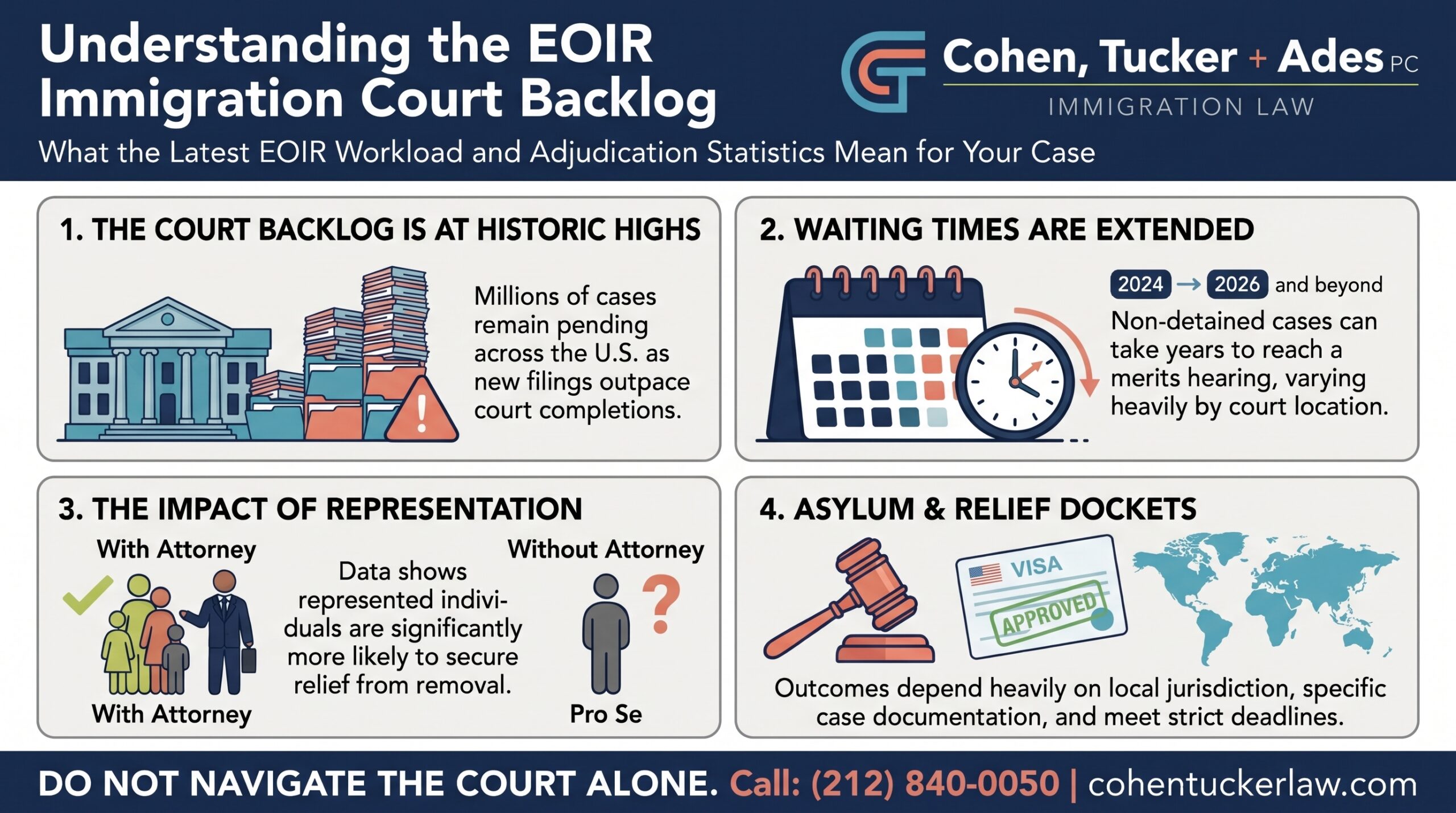
Quick Answer: The Department of Justice’s Executive Office for Immigration Review (EOIR) workload and adjudication statistics track pending cases, completion times, asylum grant/denial rates, and representation metrics across U.S. immigration courts. With active court backlogs remaining in the millions, cases often take years to reach a merits hearing. Representation remains the single most critical factor in court outcomes: immigrants with experienced legal counsel are significantly more likely to secure relief from removal or asylum compared to unrepresented individuals.
The Executive Office for Immigration Review (EOIR)—the division of the U.S. Department of Justice responsible for adjudicating immigration cases—routinely updates its Workload and Adjudication Statistics. For individuals navigating removal proceedings, asylum filings, or administrative appeals, these official reports provide critical insight into the health and speed of the immigration court system.
Below, the legal team at Cohen, Tucker + Ades, P.C. breaks down the core data sets published by EOIR, why these numbers matter, and how proactive legal representation changes the trajectory of a case.
1. The Immigration Court Backlog: Understanding Pending Cases
The centerpiece of EOIR’s reporting is the Pending Cases, New Cases, and Total Completions data. Over recent years, immigration courts nationwide have handled historically high docket volumes, with millions of matters pending before Immigration Judges (IJs).
What drives the backlog?
-
Pace of New Filings vs. Completions: DHS continues to issue
Notices to Appear (NTAs), adding hundreds of thousands of new cases annually that outpace the rate of court closures.
-
Judicial Resources: While EOIR has expanded IJ hiring, docket congestion varies sharply between jurisdictions—meaning courts like New York often face extended wait times for individual merits hearings.
-
Administrative Priorities: Shifting enforcement priorities, prosecutorial discretion guidelines, and recalendaring policies routinely alter how rapidly dockets move.
Strategic Takeaway: A prolonged court schedule is not a passive waiting period. Delays make early evidence gathering, document preservation, and maintaining clean background records vital to presenting a compelling defense when your hearing date arrives.
2. Asylum Decisions and Relief Trends
EOIR’s Asylum Decisions datasets track outcomes for affirmative and defensive asylum applications, withholding of removal, and protection under the Convention Against Torture (CAT).
Key trends highlighted in recent adjudications include:
-
Outcome Variances Across Courts: Approval rates differ significantly depending on the local hearing location, the presiding judge, and the specific country conditions documented in the record.
-
Pre-Hearing Rejections: Incomplete filings or missed deadlines under the one-year asylum filing rule frequently lead to denials before substantive arguments are heard.
-
Strict Evidentiary Burdens: Standardized forms alone are insufficient; applications require corroborating affidavits, country reports, and expert testimony to survive IJ scrutiny.
3. The Power of Legal Representation: The Numbers Speak
Among the most revealing documents on EOIR’s data portal is the report on Current Representation Rates. Across every metric—from defensive asylum hearings to cancellation of removal and bond proceedings—data consistently demonstrates:
| Metric |
Represented Noncitizens |
Unrepresented Noncitizens (Pro Se) |
| Relief Granted |
Substantially higher grant rates across all forms of relief |
High rate of denial or voluntary departure |
| In Absentia Removal Orders |
Rarely ordered removed for missed court appearances |
Substantial risk of removal for failing to appear due to notice errors |
| Motion Filings & Appeals |
Timely motions to suppress, terminate, or reopen filed before the BIA |
Frequent procedural defaults due to complex jurisdictional rules |
Immigration law is recognized as one of the most complex statutory frameworks in the United States. Navigating the Immigration and Nationality Act (INA), local court operating procedures, and the evidentiary requirements of the Executive Office without counsel places respondents at a distinct disadvantage.
4. Key Takeaways for Respondents Facing Court Proceedings
If you or a family member have a case currently pending with EOIR:
-
Verify Your Docket Status Regularly: Changes to hearing dates, times, and courtroom assignments occur frequently. Check the
EOIR Automated Case Information system online or by phone using your Alien Registration Number (A-Number).
-
Never Ignore a Notice of Hearing: Missing a hearing typically results in an automatic in absentia order of removal, which imposes harsh ten-year bars to immigration relief.
-
Notify the Court of Address Changes: If you relocate, you must file
Form EOIR-33/IC within five days of moving to avoid missing court summonses.
-
Build Your Defense Early: Do not wait for your individual calendar (merits) hearing notice to compile your evidence, identity documentation, and witness declarations.
Frequently Asked Questions (FAQ)
What is the EOIR Workload and Adjudication Statistics portal?
The EOIR Workload and Adjudication Statistics portal is an official resource published by the U.S. Department of Justice. It provides public access to data reports regarding case receipts, completions, asylum adjudication trends, immigration judge hiring, and overall court performance.
How long does an immigration court case take to finish?
Completion times depend heavily on whether a person is detained or non-detained, the specific hearing location, and the nature of the application. While detained review cases may resolve in weeks, non-detained cases before high-volume courts often remain pending for several years.
Can an immigration judge dismiss or terminate my case?
Yes. Under current legal frameworks and prosecutorial discretion policies, cases can be terminated or dismissed if DHS fails to meet its burden of proof, if the Notice to Appear (NTA) contains fatal defects, or if the respondent is eligible to seek lawful status through USCIS.
Speak with an Experienced Deportation Defense Attorney
With over six decades of dedicated practice, Cohen, Tucker + Ades, P.C. represents individuals and families across New York and nationwide in complex immigration court hearings, Board of Immigration Appeals (BIA) matters, and federal court litigation.
If you have an upcoming Master Calendar or Individual Merits hearing, do not face the court alone.
Contact our team today to review your case and build an effective defense strategy.
Wendy R. Barlow, Esq.is a Partner at Cohen, Tucker + Ades, P.C. with nearly 20 years of experience in high-stakes immigration litigation. A graduate of the Maurice A. Deane School of Law at Hofstra University, Wendy is admitted to practice in New York and New Jersey as well as before the U.S. Supreme Court and multiple Federal Circuit Courts. Wendy is recognized for her ability to handle cases that many consider insurmountable.
Disclaimer: This blog post contains general information and is for informational purposes only. It is not legal advice and does not create an attorney-client relationship between you and Cohen, Tucker + Ades P.C. Immigration laws and fee schedules are subject to frequent change. The information provided herein may not reflect the most current legal developments. You should not act or refrain from acting based on information contained in this post without seeking professional counsel from an attorney licensed in your jurisdiction. Cohen, Tucker + Ades P.C. expressly disclaims all liability in respect to actions taken or not taken based on any or all of the contents of this post.