Immigration Law Blog
Stay up-to-date on the latest immigration law news, with the Cohen, Tucker & Ades team's insights behind the headlines

The landscape of Special Immigrant Juvenile (SIJ) classification is facing unprecedented scrutiny. On June 2, 2026, James H. Percival II, General Counsel for the U.S. Department of Homeland Security (DHS), issued a stern letter to state court judges nationwide. The message? The SIJ program is under intense review for widespread fraud, and state court judges must fundamentally shift how they adjudicate these cases.
At Cohen, Tucker + Ades, we believe that transparency and rigorous legal preparation are more critical than ever. If you or a loved one are navigating the SIJ process, understanding this federal shift is vital to safeguarding your immigration journey.
The SIJ classification is designed to provide lawful permanent residency to vulnerable immigrants under the age of 21 who have suffered abuse, abandonment, or neglect by one or both parents. However, a recent comprehensive report by the Fraud Detection and National Security Directorate (FDNS) covering fiscal years 2013 through 2025 has triggered major national security and public safety concerns within the DHS.
According to the June 2026 DHS letter, the FDNS report revealed severe vulnerabilities in the program, including:
Criminal Records: Nearly 19,000 SIJ petitioners since FY 2013 were found to have criminal arrest records, including individuals tied to homicide and sex offenses.
Gang Exploitation: Over 500 known or suspected members of MS-13, alongside members of other transnational gangs like Tren de Aragua and the 18th Street gang, successfully obtained approved SIJ status.
Identity and Age Fraud: Rising instances of adult aliens falsifying dates of birth to access the juvenile program.
Because state court judges act as the foundational “gatekeepers” of this status by issuing the initial predicate orders, DHS is urging the judiciary to abandon “pro forma” approvals and implement rigorous, individualized scrutiny.
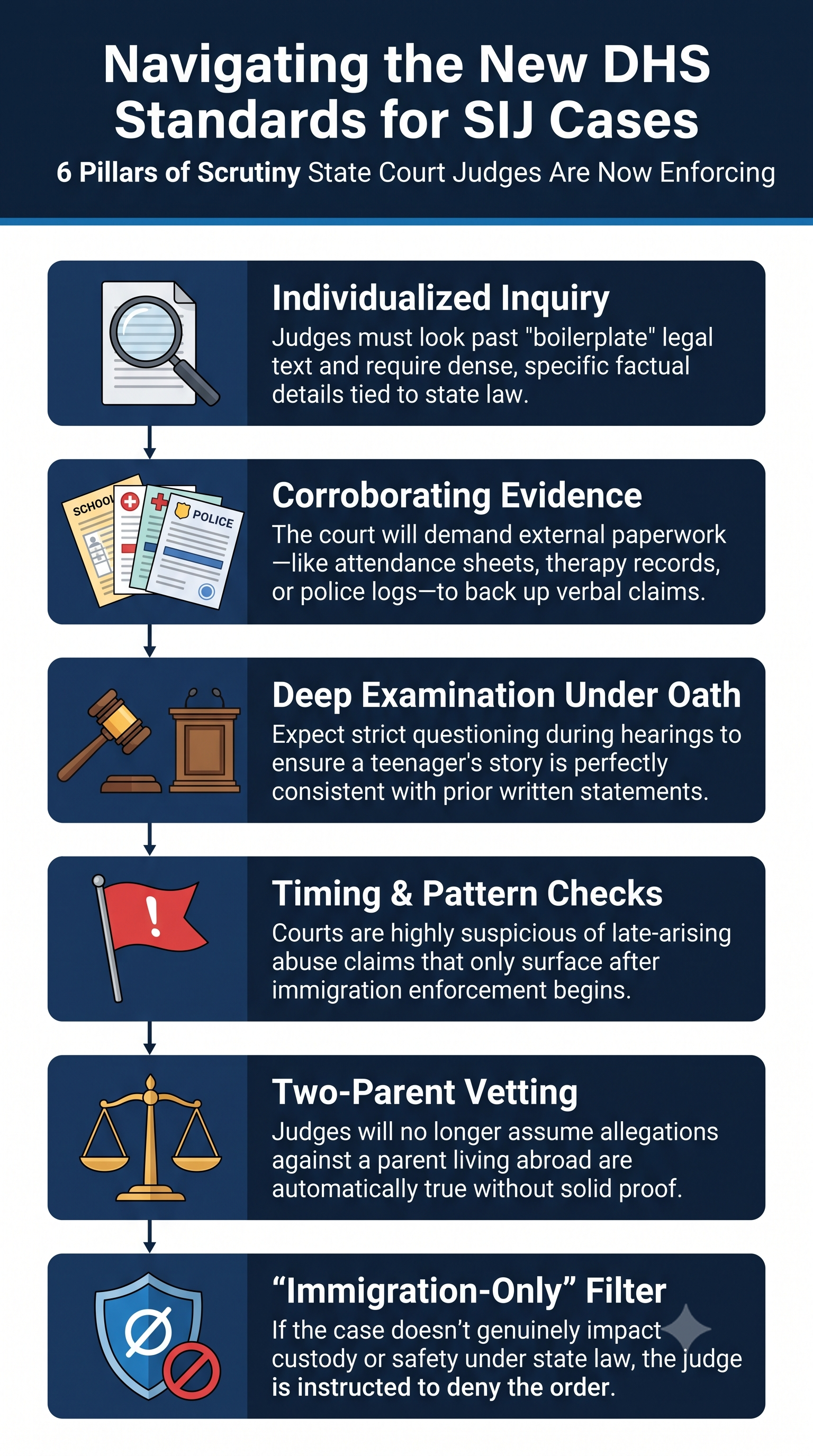
Moving forward, petitioners should expect state family and probate courts to act with heightened skepticism. DHS has officially encouraged judges to apply the following protocols before issuing an SIJ predicate order:
Judges will no longer rely solely on a child’s or guardian’s word. Expect courts to request formal documentation, such as school attendance records, medical/mental health evaluations, and police reports.
Petitioners and witnesses will be probed thoroughly during hearings. Judges are instructed to look closely for internal consistency, verifying that verbal testimony perfectly matches prior written statements and immigration documents.
Courts are on high alert for late-arising claims of abuse or neglect—specifically those that only surface after an individual faces immigration enforcement or removal proceedings. Repeated, identically structured filings from the same representatives will also trigger fraud investigations.
Judges are cautioned not to assume allegations against a parent living abroad are true simply because they fail to appear in a U.S. court.
If a judge believes the sole purpose of the state court filing is to secure a federal immigration benefit—without meaningfully impacting the child’s actual custody, protection, or local services—the order will be denied.
The Takeaway: The SIJ pathway is not closed, but the margin for error is now zero.
For genuinely vulnerable children who truly need protection, these changes mean that boilerplate legal forms and vague testimonies will no longer suffice. If your state court order simply recites statutory language without dense, localized factual details, federal USCIS officers are highly likely to reject or delay the petition downstream.
To win an SIJ case in this new legal environment, your state court petition must be bulletproof, heavily documented, and tailored precisely to state law.
DHS has issued a formal directive urging state court judges to drastically increase scrutiny on SIJ predicate orders. Judges are being trained to spot fraud, demand corroborating third-party evidence, and conduct deep, individualized reviews rather than approving orders automatically.
Yes. The DHS directive explicitly advises state judges to decline issuing predicate orders if the order does not genuinely affect the child’s custody or protection under state law, or if the apparent sole purpose is to facilitate an immigration benefit.
Beyond standard testimonies, you should be prepared to provide corroborating evidence such as medical records, school reports, police filings, or supporting affidavits from teachers, social workers, and extended family members.
The intersection of state family law and federal immigration law has always been complex, but the government’s latest crackdown makes navigating it alone incredibly risky. At Cohen, Tucker + Ades, we have decades of experience guiding families through the evolving complexities of the immigration system. We know how to build comprehensive, fact-driven cases that withstand intense judicial and federal scrutiny.
Don’t let policy shifts derail your future. Contact Cohen, Tucker + Ades today to schedule a comprehensive consultation and ensure your case is prepared the right way.
Wendy R. Barlow, Esq.is a Partner at Cohen, Tucker + Ades, P.C. with nearly 20 years of experience in high-stakes immigration litigation. A graduate of the Maurice A. Deane School of Law at Hofstra University, Wendy is admitted to practice in New York and New Jersey as well as before the U.S. Supreme Court and multiple Federal Circuit Courts. Wendy is recognized for her ability to handle cases that many consider insurmountable.
Disclaimer: This blog post contains general information and is for informational purposes only. It is not legal advice and does not create an attorney-client relationship between you and Cohen, Tucker + Ades P.C. Immigration laws and fee schedules are subject to frequent change. The information provided herein may not reflect the most current legal developments. You should not act or refrain from acting based on information contained in this post without seeking professional counsel from an attorney licensed in your jurisdiction. Cohen, Tucker + Ades P.C. expressly disclaims all liability in respect to actions taken or not taken based on any or all of the contents of this post.
Sources:
General Counsel Percival, Special Immigrant Juvenile Process Letter, June 2, 2026