Immigration Law Blog
Stay up-to-date on the latest immigration law news, with the Cohen, Tucker & Ades team's insights behind the headlines

In our last post, we explained the core differences between Adjustment of Status (AOS) and Consular Processing. For families navigating the immigration system, discovering that a loved one must use Consular Processing (leaving the U.S. for an interview at a U.S. Embassy abroad) often brings a wave of anxiety.
Why? Because of a strict, punitive mechanism in U.S. immigration law known as the three- and ten-year bars.
If you are planning a green card journey, it is vital to understand exactly what these bars are, what triggers them, and why they serve as the foundational hurdle for family-based visa processing.
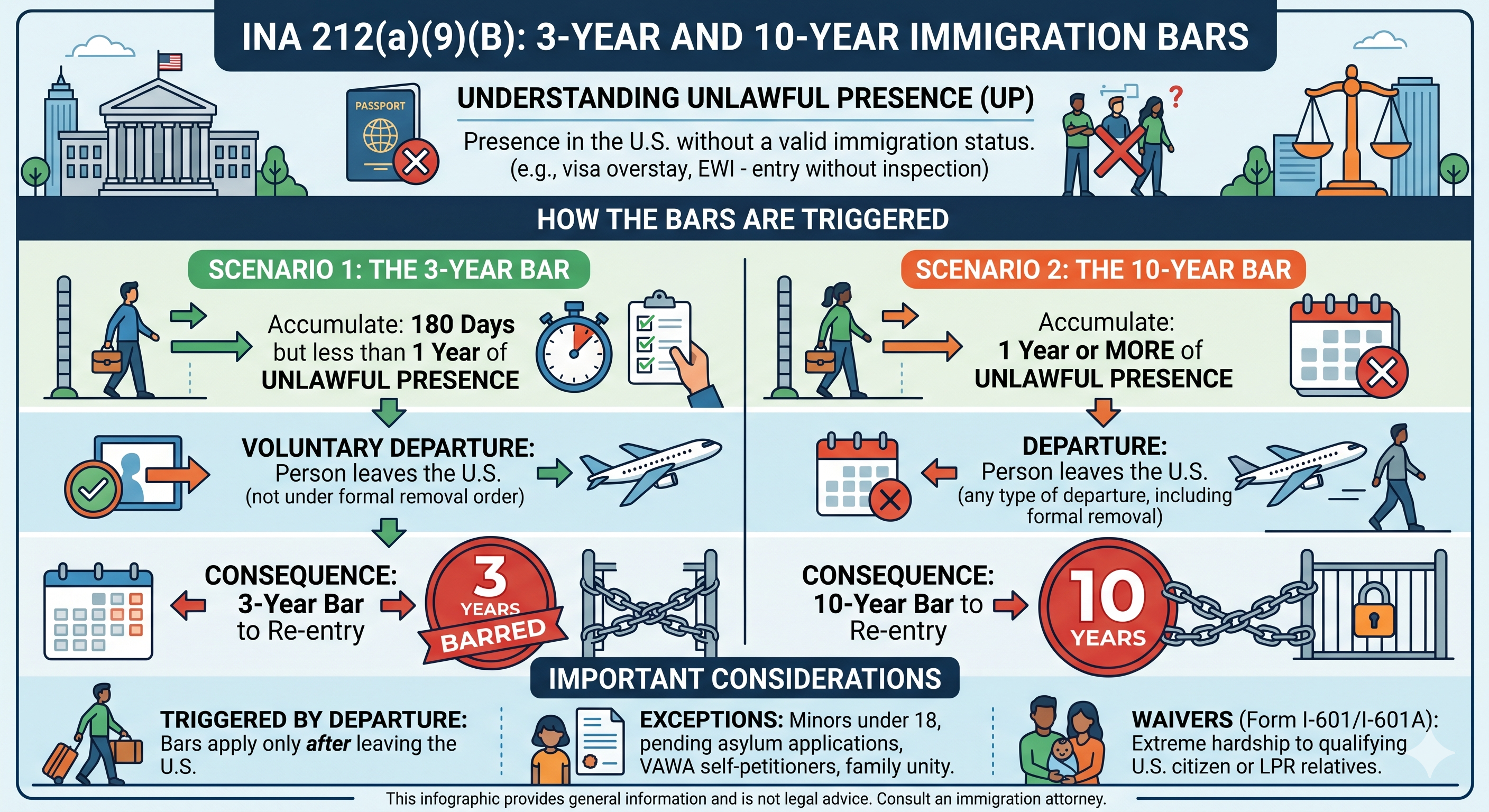
Before looking at the bars themselves, we have to look at what builds them: unlawful presence.
Under INA § 212(a)(9)(B)(ii), an individual accrues unlawful presence if they are present in the United States without being officially admitted or paroled, or if they remain in the country after their authorized period of stay has expired.
The two most common ways a person accrues unlawful presence are:
Entering Without Inspection: Crossing the border into the U.S. without being examined by an immigration officer (undocumented entry).
Visa Overstay: Entering the U.S. legally on a temporary visa (such as a tourist, student, or work visa) but staying past the expiration date listed on your electronic I-94 arrival/departure record.
A common point of confusion is when the penalty actually takes effect.
The Golden Rule of the Bars: Unlawful presence accumulates while you are sitting in the United States, but the three- or ten-year bar is not officially triggered until you physically depart the country.
Someone could live in the United States without legal status for 15 years, but as long as they remain inside the country, the bar has not attached. However, the moment they step across the border or board a flight to attend their mandatory consular green card interview abroad, the trap snaps shut. The law blocks them from legally stepping foot back in the U.S. for years.
The length of time you are banned from re-entering the United States depends entirely on how much continuous unlawful presence you accumulated before leaving.
| Accrued Unlawful Presence | The Legal Penalty (The Re-entry Bar) |
| More than 180 days, but less than 1 year (during a single stay) | 3-Year Bar: You are prohibited from re-entering the U.S. for three years from the date of your departure. |
| 1 continuous year or more (during a single stay) | 10-Year Bar: You are prohibited from re-entering the U.S. for ten years from the date of your departure. |
Yes. U.S. immigration law explicitly states that certain time periods or categories of individuals do not accrue unlawful presence. The clock does not run for:
Minors: Children under the age of 18 do not accumulate unlawful presence.
Asylum Applicants: Time spent while a bona fide asylum application is actively pending generally does not count, provided the applicant did not engage in unauthorized employment.
VAWA Self-Petitioners: Battered spouses and children under the Violence Against Women Act may be exempt if there is a clear connection between the abuse and their unlawful status.
The real danger of these bars lies in the structure of the Consular Processing path.
Many families assume that because they are married to a U.S. citizen, the process will naturally go smoothly. They file the initial paperwork, receive an interview notice from the U.S. Embassy in their home country, and leave the U.S. assuming they will return in a few weeks with a green card.
Instead, they sit down at the consular window abroad, only for the officer to state: “Your visa is approved, but because you lived in the U.S. without status for over a year, you are now banned for 10 years. You cannot return home.“
Thankfully, a consular interview doesn’t have to turn into an automatic decade-long family separation. The law provides a vital mechanism to solve this crisis before you ever book a flight out of the country.
This mechanism is the I-601A Provisional Unlawful Presence Waiver. It allows qualifying family members to ask the U.S. government to forgive their unlawful presence provisionally, giving them an answer before they leave for their interview.
At Cohen, Tucker + Ades, we specialize in conducting deep dives into our clients’ immigration timelines to calculate precisely whether a bar will be triggered and how to secure the necessary waivers to prevent family separation.
In our next post, we will break down exactly how the I-601A waiver works, who qualifies for it, and how to prove the complex legal standard of “extreme hardship.“
Are you planning an immigrant visa application? Don’t risk a multi-year bar. Contact the team at Cohen, Tucker + Ades today for a strategic consultation.
Wendy R. Barlow, Esq.is a Partner at Cohen, Tucker + Ades, P.C. with nearly 20 years of experience in high-stakes immigration litigation. A graduate of the Maurice A. Deane School of Law at Hofstra University, Wendy is admitted to practice in New York and New Jersey as well as before the U.S. Supreme Court and multiple Federal Circuit Courts. Wendy is recognized for her ability to handle cases that many consider insurmountable.
Disclaimer: This blog post contains general information and is for informational purposes only. It is not legal advice and does not create an attorney-client relationship between you and Cohen, Tucker + Ades P.C. Immigration laws and fee schedules are subject to frequent change. The information provided herein may not reflect the most current legal developments. You should not act or refrain from acting based on information contained in this post without seeking professional counsel from an attorney licensed in your jurisdiction. Cohen, Tucker + Ades P.C. expressly disclaims all liability in respect to actions taken or not taken based on any or all of the contents of this post.