Immigration Law Blog
Stay up-to-date on the latest immigration law news, with the Cohen, Tucker & Ades team's insights behind the headlines

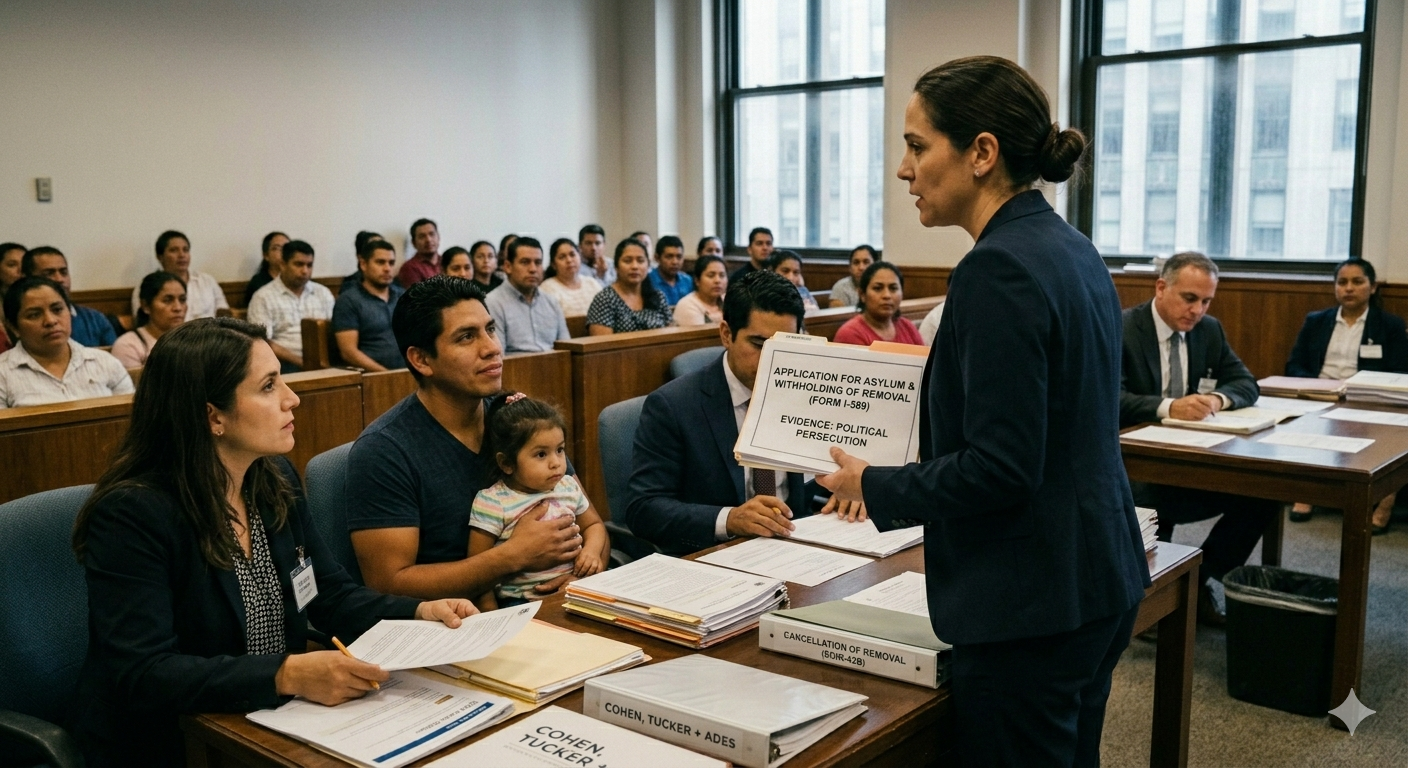
When you are placed in removal proceedings, the government’s goal is to prove you are deportable. However, the law provides multiple pathways—known legally as “relief from removal”—that allow you to defend yourself, stop deportation, and in many cases, secure a lawful permanent resident card (Green Card) or legal status.
At Cohen, Tucker + Ades, we treat immigration defense like a chess match. We don’t just look for one way out; we aggressively pursue every viable avenue of relief simultaneously to protect your future in the United States.
Below is an overview of the most common and powerful legal defenses used in immigration court today.
If you fear returning to your home country because your life or freedom is in danger, you can apply for humanitarian protection. These three forms of relief are filed together on Form I-589, but they carry different legal standards:
The Standard: You must prove you have suffered past persecution, or have a “well-founded fear” of future persecution, based on one of five protected grounds: Race, Religion, Nationality, Political Opinion, or Membership in a Particular Social Group (PSG).
The Benefit: If granted, you receive a path to a Green Card and can eventually apply for U.S. citizenship.
The One-Year Rule: Under the law, you must generally apply for asylum within one year of entering the United States unless you qualify for an extraordinary or changed circumstances exception.
The Fight Over “Particular Social Groups”
In asylum law, a “Particular Social Group” (PSG) is a highly complex legal concept. Following strict, precedent-setting appellate decisions like the Board of Immigration Appeals’ (BIA) rulings in Matter of K-E-S-G- and Matter of V-A-B-, the government has severely restricted broad gender-based and nationality-based definitions. Simply stating “women from El Salvador” is no longer enough to win. Winning a PSG asylum case requires a highly skilled litigator who knows how to narrow your group to immutable, socially distinct traits—such as specific family lines, indigenous identities, or local targeted professions.
If you miss the one-year asylum deadline, you may still qualify for Withholding of Removal. The standard is higher—you must show a “clear probability” (more likely than not) that you will be persecuted. While it stops your deportation and grants a work permit, it does not lead to a Green Card.
CAT is a unique remedy that focuses strictly on preventing torture. You must show it is more likely than not that you would face torture by—or with the acquiescence of—a government official if returned home. Your motive or background does not matter; only the likelihood of torture matters.
Cancellation of removal is a powerful mechanism where an immigration judge completely “erases” your removability and gives you a Green Card—or lets you keep your existing one. It is divided into two distinct categories:
Often colloquially called the “10-year rule,” this defense is for long-term residents who do not currently have a Green Card. To win, you must prove:
10 Years of Continuous Presence: You have lived in the U.S. for at least 10 years before your NTA was issued. (Note: The “stop-time rule” applies here; once a valid NTA is served, your 10-year clock stops ticking).
Good Moral Character: You have maintained an exemplary record over those 10 years.
No Disqualifying Criminal Convictions: Certain offenses will instantly bar you from applying.
Exceptional and Extremely Unusual Hardship: You must prove that your deportation would cause a level of hardship that goes far beyond the normal pain of relocation to a qualifying U.S. citizen or Green Card-holding spouse, parent, or child.
If you already have a Green Card but the government is trying to deport you due to a criminal conviction, you may apply for LPR Cancellation. You must show you have been an LPR for at least 5 years, have lived in the U.S. continuously for 7 years after admission, and have never been convicted of an “aggravated felony”.
If you are currently in immigration court but are married to a U.S. citizen, or have an adult U.S. citizen child over 21, you may be eligible to adjust your status to a Lawful Permanent Resident right in front of the immigration judge.
This pathway often involves coordinating with U.S. Citizenship and Immigration Services (USCIS) to approve an underlying immigrant petition (Form I-130) before asking the judge to grant the final Green Card and dismiss the removal proceedings.
Sometimes, the best defense is a strategic peace agreement. Prosecutorial Discretion (PD) occurs when we negotiate directly with the DHS trial attorneys to ask them to dismiss your immigration court case entirely or pause it indefinitely (Administrative Closure).
The government has limited resources and may prefer to close cases for individuals who are not a threat to public safety, have deep ties to the community, or have alternative immigration applications pending with USCIS. If PD is granted, your case is removed from the judge’s active calendar, allowing you to live peacefully in the U.S. and, in many scenarios, maintain your work authorization.
No two immigration cases are the same. A strategy that wins an asylum case for one person might fail completely for another depending on their specific family structure, criminal background, or date of entry.
When you trust Cohen, Tucker + Ades with your deportation defense, we don’t rely on a single argument. We meticulously analyze your history to stack your defenses. If we can apply for Adjustment of Status and file a backup application for Cancellation of Removal, we do both. We ensure that every procedural tool provided by the law is leveraged to keep you safe and keep your family together.
Q: Can any family member qualify me for the “10-Year Rule” (Cancellation of Removal)? A: No. Under the law, the “exceptional and extremely unusual hardship” must be suffered by a qualifying relative, which is strictly defined as a U.S. citizen or lawful permanent resident spouse, parent, or child (under 21 and unmarried). Hardship to yourself, your siblings, or aunts/uncles does not count for this application.
Q: What is the difference between a crime and an “aggravated felony” in immigration court? A: Immigration law has its own definition of an “aggravated felony,” which often differs from state criminal law. Even some misdemeanors can be classified as aggravated felonies for immigration purposes, creating an absolute bar to many forms of relief. If you have a criminal record, our firm will thoroughly analyze your certificates of disposition before pleading in court.
Q: If my case is administratively closed through Prosecutorial Discretion, do I get a Green Card? A: No. Administrative closure is a pause button, not a permanent status. It stops the immediate threat of deportation and removes you from the active court docket, but you do not receive a Green Card unless you have a separate application path available.
If you or a loved one is facing removal proceedings, don’t guess at your defense. Contact Cohen, Tucker + Ades today to map out an aggressive, legally sound strategy to fight deportation.
Wendy R. Barlow, Esq.is a Partner at Cohen, Tucker + Ades, P.C. with nearly 20 years of experience in high-stakes immigration litigation. A graduate of the Maurice A. Deane School of Law at Hofstra University, Wendy is admitted to practice in New York and New Jersey as well as before the U.S. Supreme Court and multiple Federal Circuit Courts. Wendy is recognized for her ability to handle cases that many consider insurmountable.
Disclaimer: This blog post contains general information and is for informational purposes only. It is not legal advice and does not create an attorney-client relationship between you and Cohen, Tucker + Ades P.C. Immigration laws and fee schedules are subject to frequent change. The information provided herein may not reflect the most current legal developments. You should not act or refrain from acting based on information contained in this post without seeking professional counsel from an attorney licensed in your jurisdiction. Cohen, Tucker + Ades P.C. expressly disclaims all liability in respect to actions taken or not taken based on any or all of the contents of this post.