Immigration Law Blog
Stay up-to-date on the latest immigration law news, with the Cohen, Tucker & Ades team's insights behind the headlines

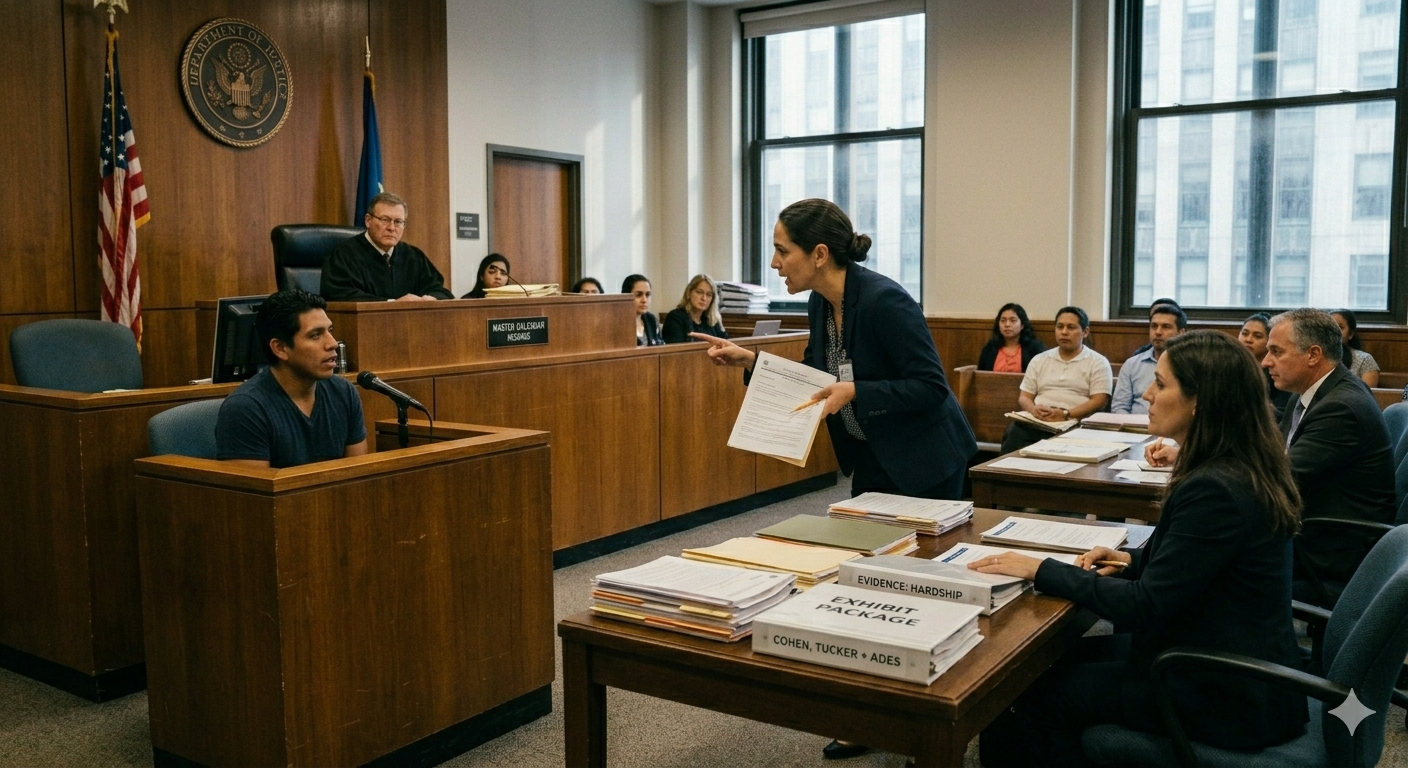
When you stand before an immigration judge at your Individual Calendar Hearing, your entire future in the United States rests on two core pillars: evidence and credibility.
In an immigration system heavily backlogged with complex cases, judges do not make decisions based on sympathy. They make decisions based on a meticulously compiled legal record and whether they believe your testimony is completely truthful. A single contradiction, a missing document, or an uncorroborated statement can sink an otherwise strong application for relief.
At Cohen, Tucker + Ades, we treat the preparation of your evidence and testimony with the intensity of a high-stakes federal trial. Here is a breakdown of how a winning case is systematically built from the ground up.
To win a defense against deportation—whether it is an asylum claim, a cancellation of removal application, or a waiver—your evidence must be divided into two distinct categories: subjective evidence (your personal experience) and objective evidence (independent verification).
According to the EOIR Practice Manual, all supporting documents must be perfectly organized, indexed, page-numbered, and submitted before the court’s strict call-up deadline (typically 30 days prior to your trial).
Your evidentiary package should ideally include:
Detailed Personal Affidavits: A comprehensive, chronological, and deeply personal written statement detailing your life, history, and why you qualify for relief.
Letters of Support: Notarized declarations from family members, employers, religious leaders, and community members verifying your good moral character, rehabilitation, or the extreme hardship your family would face.
Identity and Relationship Documents: Certified copies of birth certificates, marriage certificates, and school records.
Country Conditions Reports: Official documentation from the U.S. Department of State, Amnesty International, or Human Rights Watch to prove that your fears of returning home are objectively reasonable.
Expert Witness Reports: Written evaluations from medical doctors, psychologists (proving trauma or extreme hardship), or academic country-conditions experts.
Official Public Records: Police reports, medical records, or news articles that directly corroborate specific events mentioned in your timeline.
⚠️ Critical Rule: The Certification of Translations
Every single document submitted to the immigration court that is not originally in English must be accompanied by a full English translation. Crucially, the translator must sign a formal Certificate of Translation stating that they are competent to translate and that the translation is accurate. Submitting an untranslated or improperly certified document is an automatic ground for the judge to reject it.
Under the REAL ID Act, an immigration judge can base a credibility determination on the “totality of the circumstances” and all relevant factors. This means the judge can find you “not credible” based on:
Your demeanor or responsiveness on the witness stand.
The consistency between your oral testimony, your written affidavit, and other evidence in the record.
Discrepancies between your current statements and what you told a Customs and Border Protection (CBP) officer years ago at the border.
The law allows a judge to deny your case based on inconsistencies even if they do not go to the heart of your claim. If you say an event happened in June on your written application, but testify under pressure that it happened in August, a government trial attorney will seize on that gap to destroy your credibility.
At Cohen, Tucker + Ades, we know that testifying about trauma, fear, or the potential separation of your family is deeply emotional and intimidating. You are not just expected to remember precise details from years ago; you must do so while being cross-examined by a hostile Department of Homeland Security (DHS) trial attorney.
We minimize this stress through a rigorous preparation framework:
In-Depth File Reviews: We review your entire immigration history—including old border interviews and visa applications—to catch and address potential discrepancies before the trial attorney does.
Mock Cross-Examinations: We conduct realistic practice sessions, asking you the exact types of difficult, aggressive questions the government attorney will ask, training you to remain calm, focused, and precise.
Witness Coordination: We prepare your expert and character witnesses so their oral testimonies align with and support your master case file.
If you are currently in removal proceedings, use this quick checklist to ensure your evidence stands up to court scrutiny:
[ ] Gather Originals: Secure original or certified copies of all vital statistics (birth, marriage, divorce).
[ ] Verify Timelines: Cross-reference every date in your personal statement with your medical, school, or travel records to ensure absolute consistency.
[ ] No Gaps in Taxes/Employment: If applying for Cancellation of Removal, compile certified IRS tax transcripts and employment letters covering the full 10-year period.
[ ] Secure Certified Translations: Ensure a qualified translator signs a formal certificate for every non-English document.
[ ] Respect the Call-Up Date: Finalize and file your entire exhibit package well ahead of your court-mandated deadline.
Q: Can the judge deny my case if I don’t have physical evidence to back up my story?
A: Under the law, the testimony of the applicant may be sufficient to sustain the burden of proof without corroboration—but only if the testimony is believable, consistent, and specific. However, if the judge determines that corroborating evidence should reasonably be available, you must provide it or give a compelling explanation as to why you cannot.
Q: What happens if a government attorney catches me in an honest mistake on the stand?
A: It is common to confuse dates or details under the intense stress of a trial. If you realize you made an error, your attorney can use “redirect examination” to step in, ask clarifying questions, and give you the opportunity to explain the mix-up honestly before the judge closes the record.
Q: Can I use text messages or WhatsApp chats as evidence in my deportation defense?
A: Yes. Digital communication is highly valuable, especially in asylum and marriage-based cases. However, they must be printed clearly, translated into English with a certificate, and properly authenticated to prove who sent them and when.
Do not leave your credibility to chance. Contact Cohen, Tucker + Ades today to schedule a trial preparation consultation and ensure your evidence is built to win.
Wendy R. Barlow, Esq.is a Partner at Cohen, Tucker + Ades, P.C. with nearly 20 years of experience in high-stakes immigration litigation. A graduate of the Maurice A. Deane School of Law at Hofstra University, Wendy is admitted to practice in New York and New Jersey as well as before the U.S. Supreme Court and multiple Federal Circuit Courts. Wendy is recognized for her ability to handle cases that many consider insurmountable.
Disclaimer: This blog post contains general information and is for informational purposes only. It is not legal advice and does not create an attorney-client relationship between you and Cohen, Tucker + Ades P.C. Immigration laws and fee schedules are subject to frequent change. The information provided herein may not reflect the most current legal developments. You should not act or refrain from acting based on information contained in this post without seeking professional counsel from an attorney licensed in your jurisdiction. Cohen, Tucker + Ades P.C. expressly disclaims all liability in respect to actions taken or not taken based on any or all of the contents of this post.