Immigration Law Blog
Stay up-to-date on the latest immigration law news, with the Cohen, Tucker & Ades team's insights behind the headlines

In our last post, we discussed the “trap” of the three- and ten-year bars. For individuals who entered the United States without inspection or overstayed a visa, leaving the country for a green card interview triggers an automatic ban on returning.
Fortunately, you do not have to step blindly into that trap. The Form I-601A Provisional Unlawful Presence Waiver acts as a legal safety bridge. It allows you to apply for forgiveness for your unlawful presence before you leave the United States.
However, getting an I-601A waiver approved is one of the most demanding tasks in immigration law. The entire case hinges on a single, highly scrutinized legal standard: proving “Extreme Hardship.”
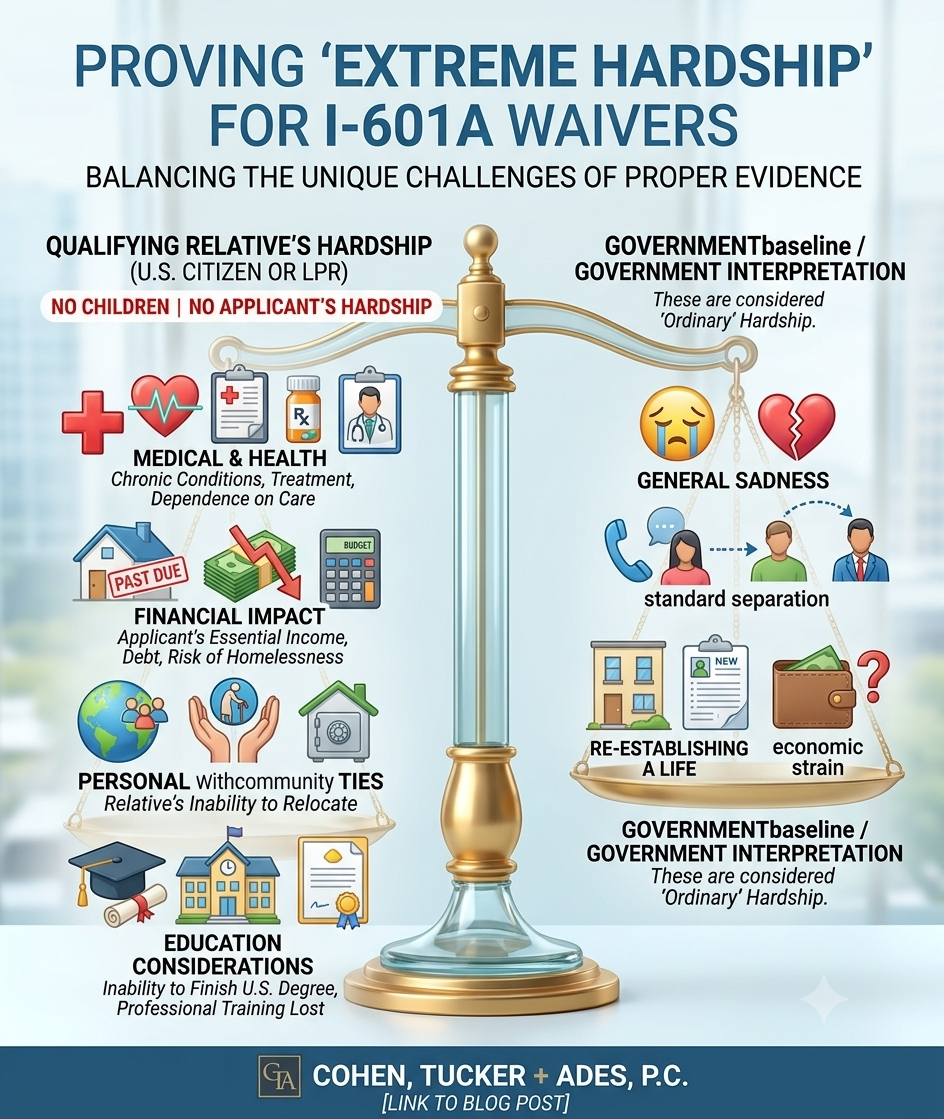
Before analyzing what the hardship is, we must look at who must suffer it. A common and devastating mistake families make is assuming the hardship of the undocumented immigrant matters to the government. It does not.
Under the law, the extreme hardship must be suffered by a Qualifying Relative. For an I-601A waiver, a qualifying relative is strictly limited to a:
U.S. Citizen spouse or parent.
Lawful Permanent Resident (LPR / Green Card holder) spouse or parent.
Crucial Warning: Children are not qualifying relatives for the I-601A waiver. Even if you have five U.S. citizen children who depend on you entirely, you cannot base your waiver application on the hardship they will face. We must show how your absence or relocation would cause extreme hardship to your spouse or parents.
USCIS officers operate under a strict baseline: they assume that family separation or moving to a new country causes stress, financial strain, and sadness. To the government, that is considered “ordinary” hardship.
To win a waiver, you must prove that the hardship your spouse or parent will suffer goes well beyond the ordinary disruptions expected from deportation. You must show that the consequences would be severe, unique, and overwhelming.
USCIS looks at two distinct scenarios to evaluate your claim:
The Separation Scenario: What will happen to your qualifying relative if you are forced to leave the U.S. and they remain behind alone?
The Relocation Scenario: What will happen to your qualifying relative if they are forced to leave their life in the U.S. to move with you to your home country?
To win, your legal team must carefully document and prove extreme hardship under both scenarios.
USCIS evaluates hardship by looking at the total, cumulative picture of a family’s life. A successful case weaves together evidence across five primary categories:
| Hardship Category | Examples of Strong Evidence |
| Medical & Health | Chronic physical or mental health conditions of the relative requiring your daily care, specialized U.S. medical treatment, or psychological evaluations showing severe clinical depression or anxiety caused by separation. |
| Financial Impact | Absolute dependence on the applicant’s income, severe debt, risk of foreclosure or bankruptcy, or the inability of the spouse to work due to childcare or medical limits if left alone. |
| Education | The qualifying relative is currently enrolled in a U.S. degree program or specialized training that would have to be abandoned if they relocated abroad. |
| Country Conditions | High rates of violence, civil unrest, lack of medical care, or economic devastation in your home country that would actively endanger your U.S. citizen or LPR relative if they moved there with you. |
| Personal Considerations | Deep community ties in the U.S., safely caring for elderly family members, or the relative’s inability to speak the native language of your home country. |
An I-601A application is not just about filling out a form and writing a letter saying you love your family. It is an extensive, heavily documented packet that often resembles a book when completed.
When you work with Cohen, Tucker + Ades, we act as investigative biographers for your family. We don’t just state that a spouse has medical issues; we secure comprehensive medical records, expert doctor declarations, and prescriptions. We don’t just say a country is unsafe; we pull detailed Department of State travel advisories and country condition reports to demonstrate the exact risks of relocation.
As we move through 2026, USCIS is managing a massive, historic backlog of pending waiver cases. Average I-601A processing times are currently hovering between 14 to 28 months depending heavily on the service center your case lands in.
Because the wait times are so long, you cannot afford a mistake. If your initial filing lacks robust evidence, USCIS will issue a Request for Evidence (RFE) or a Notice of Intent to Deny (NOID), adding months of delays or destroying your chances entirely. Getting it right the first time is your family’s best defense.
In our next post, we will walk step-by-step through what happens after your waiver is approved—moving from the domestic phase into the high-stakes world of Consular Processing at the U.S. Embassy.
Don’t leave your family’s future to chance. Contact the expert team at Cohen, Tucker + Ades today to structurally build your extreme hardship case.
Wendy R. Barlow, Esq.is a Partner at Cohen, Tucker + Ades, P.C. with nearly 20 years of experience in high-stakes immigration litigation. A graduate of the Maurice A. Deane School of Law at Hofstra University, Wendy is admitted to practice in New York and New Jersey as well as before the U.S. Supreme Court and multiple Federal Circuit Courts. Wendy is recognized for her ability to handle cases that many consider insurmountable.
Disclaimer: This blog post contains general information and is for informational purposes only. It is not legal advice and does not create an attorney-client relationship between you and Cohen, Tucker + Ades P.C. Immigration laws and fee schedules are subject to frequent change. The information provided herein may not reflect the most current legal developments. You should not act or refrain from acting based on information contained in this post without seeking professional counsel from an attorney licensed in your jurisdiction. Cohen, Tucker + Ades P.C. expressly disclaims all liability in respect to actions taken or not taken based on any or all of the contents of this post.