Immigration Law Blog
Stay up-to-date on the latest immigration law news, with the Cohen, Tucker & Ades team's insights behind the headlines

For decades, international couples deciding how to build their lives in the United States had a relatively balanced choice: marry abroad and apply for a CR-1 spousal immigrant visa, or get engaged, bring the foreign partner to the U.S. on a K-1 fiancé visa, and marry stateside.
Historically, although the K-1 visa reunited couples slightly faster, most couples favored the spousal visa because it granted immediate permanent residency (a Green Card) upon arrival.
However, recent shifts in federal policy have turned the traditional immigration playbook upside down. For couples separated by international borders, the K-1 fiancé visa has rapidly transformed from a lifestyle choice into an essential legal workaround.
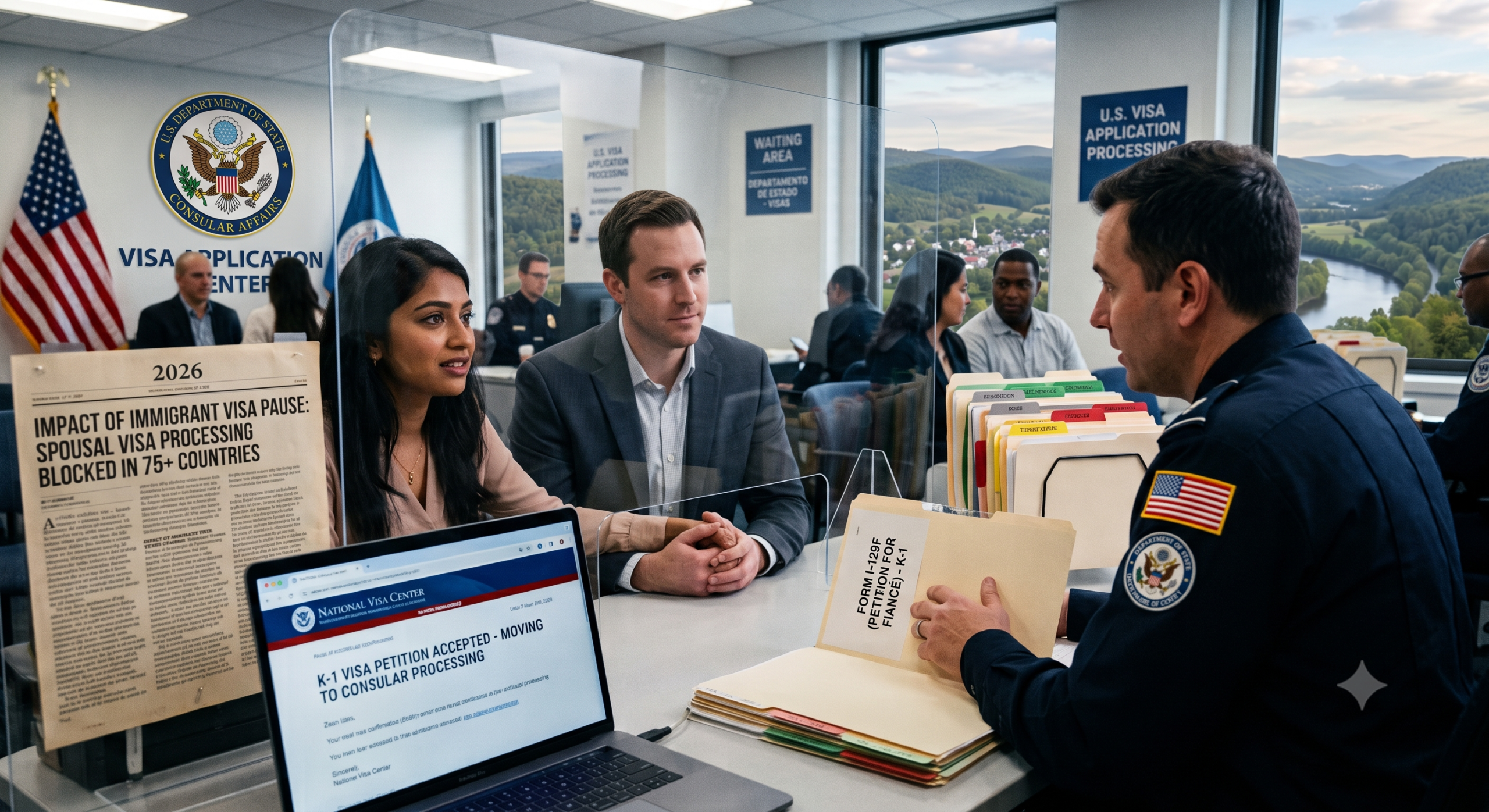
On January 14, 2026, the U.S. Department of State announced an indefinite, sweeping pause on immigrant visa processing for nationals of 75 countries across Africa, Asia, Latin America, the Middle East, and Eastern Europe. The State Department enacted this freeze to give the government time to reassess its screening criteria regarding whether applicants are likely to become financially dependent on the government—commonly known as the “public charge” ground of inadmissibility.
Because CR-1 and IR-1 spousal visas fall under the immigrant visa classification (as they grant immediate permanent residency), this sweeping freeze directly impacts them. For thousands of couples who married abroad, the pause traps their files in indefinite consular limbo at overseas embassies, leaving them with no clear end date in sight.
This is where strategic immigration planning becomes vital. The K-1 fiancé visa occupies a unique legal space. Even though its ultimate purpose is to allow a foreign national to permanently immigrate to the U.S., it is technically classified as a nonimmigrant visa.
The Critical Distinction: The State Department’s 2026 pause explicitly applies only to immigrant visas. Consular processing, interview scheduling, and visa issuances for nonimmigrant visas—including the K-1 fiancé visa—continue to move forward.
Waiting for a spousal visa could mean facing years of separation if your partner is a national of one of the 75 affected countries. Shifting your strategy to a K-1 fiancé petition allows you to completely bypass the consular freeze and bring your partner to U.S. soil.
No. The U.S. Department of State’s pause specifically targets immigrant visas. Because the K-1 fiancé visa is legally processed as a temporary, nonimmigrant visa, it is exempt from the freeze. Consulates are continuing to interview and issue K-1 visas.
If your foreign partner is a national of one of the 75 countries impacted by the public charge review freeze, a spousal visa application will face indefinite delays. In 2026, the K-1 fiancé visa is the most viable and reliable path to bring your partner to the U.S. quickly.
You cannot directly “convert” a petition. To pivot, a U.S. citizen must generally file a new Form I-129F fiancé petition. Navigating this transition requires careful planning to avoid administrative confusion at the National Visa Center (NVC).
While the K-1 visa is currently the fastest way to get your partner across the border, it is important to look at the complete legal timeline before filing.
Bypasses the Freeze: Avoids the multi-country immigrant visa processing halt.
Faster Physical Reunification: Gets your partner to the U.S. months—or potentially years—faster than a frozen spousal visa.
A Wedding at Home: Allows you to celebrate your marriage on U.S. soil with local family and friends.
Delayed Work and Travel Rights: Upon arrival, your fiancé cannot work or travel internationally until they file for an Adjustment of Status (Form I-485) and receive their Employment Authorization and Advance Parole documents (typically a 4-to-6-month wait post-marriage).
Two-Tiered Cost Structure: You will pay initial filing fees for the fiancé visa, followed by green card filing fees once you are married.
Immigration laws have long been recognized by federal courts as second only to the Internal Revenue Code in their complexity. A single administrative mistake on your paperwork can set your timeline back by months or result in an outright denial.
Since 1964, the New York-based law firm of Cohen, Tucker + Ades, P.C. has helped families successfully thread the federal immigration labyrinth. In an environment dictated by sudden consular pauses and shifting international policies, having an experienced advocate ensure your paperwork is legally airtight provides the ultimate peace of mind.
We don’t just fill out forms—we build robust, evidence-backed petitions designed to withstand strict government scrutiny, helping you protect your future and bring your loved one home.
Anxious about how the 2026 State Department visa changes impact your relationship? Let us map out a clear, secure path forward. Schedule a confidential consultation with our NYC immigration attorneys today.
Wendy R. Barlow, Esq.is a Partner at Cohen, Tucker + Ades, P.C. with nearly 20 years of experience in high-stakes immigration litigation. A graduate of the Maurice A. Deane School of Law at Hofstra University, Wendy is admitted to practice in New York and New Jersey as well as before the U.S. Supreme Court and multiple Federal Circuit Courts. Wendy is recognized for her ability to handle cases that many consider insurmountable.
Disclaimer: This blog post contains general information and is for informational purposes only. It is not legal advice and does not create an attorney-client relationship between you and Cohen, Tucker + Ades P.C. Immigration laws and fee schedules are subject to frequent change. The information provided herein may not reflect the most current legal developments. You should not act or refrain from acting based on information contained in this post without seeking professional counsel from an attorney licensed in your jurisdiction. Cohen, Tucker + Ades P.C. expressly disclaims all liability in respect to actions taken or not taken based on any or all of the contents of this post.