Immigration Law Blog
Stay up-to-date on the latest immigration law news, with the Cohen, Tucker & Ades team's insights behind the headlines

The Department of Homeland Security (DHS) and U.S. Citizenship and Immigration Services (USCIS) have officially published a major Notice of Proposed Rulemaking (NPRM) aimed at formalizing, updating, and ensuring the integrity of the Employment-Based Fifth Preference (EB-5) immigrant visa program.
This proposed rule explicitly implements the landmark EB-5 Reform and Integrity Act of 2022 (RIA) while introducing several strict new compliance protocols, procedural reshuffling, and updated economic modeling standards.
For clients of Cohen, Tucker + Ades, navigating these shifting regulatory landscapes is critical to protecting investment capital and securing lawful permanent resident status. Below, we break down the most impactful changes proposed in this comprehensive new rule.
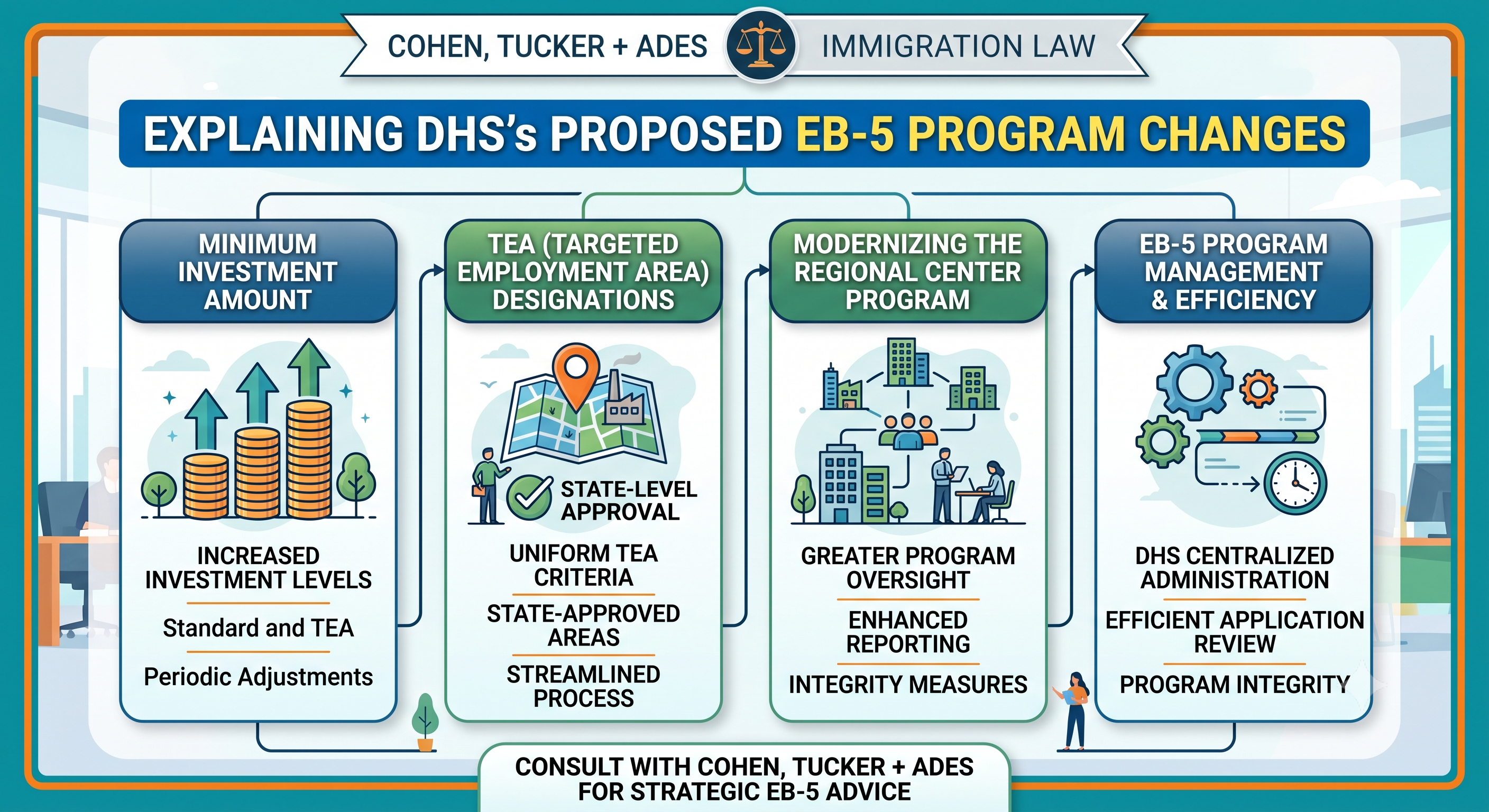
The proposed rule codifies the investment thresholds established under the RIA while exercising new discretionary authority over high-density economic zones:
Standard Minimum Investment: Set at $1,050,000.
Targeted Employment Areas (TEAs) & Infrastructure Projects: Maintained at the reduced threshold of $800,000.
New “High Employment Area” Threshold: Utilizing statutory discretion, DHS proposes a higher investment threshold of $1,400,000 for new commercial enterprises (NCEs) principally doing business in a Metropolitan Statistical Area (MSA) that is not a TEA and experiences unemployment significantly below the national average.
Note on Automatic Adjustments: All of these investment amounts are scheduled to adjust automatically on January 1, 2027, and every 5 years thereafter, based on the Consumer Price Index (CPI-U).
In a major structural shift, DHS is proposing to eliminate the use of bridge financing repaid from EB-5 investment capital as a basis to demonstrate job creation.
Historically, NCEs could claim credit for jobs generated by interim, short-term temporary financing that was later replaced by EB-5 capital. Citing the RIA’s updated language requiring that a project benefit the U.S. economy by creating employment, the government is seeking a much closer, un-attenuated causal link between the immigrant’s funds and the actual jobs.
(Note: The agency is soliciting public comments on alternative restrictions, such as capping bridge financing to a certain percentage of project costs or limiting its maturity dates, in lieu of a total ban).
As USCIS ramps up its transition into electronic filing ecosystems (such as MyUSCIS), a strict new operational deadline has been introduced. If an investor chooses to upload their required initial evidence digitally, all documentation must be submitted within 30 days of filing the petition. Failure to meet this window will result in an automatic denial of the petition, meaning no priority date will be established.
On a supportive note for good-faith immigrant investors, the proposed rule establishes clear pathways to retain priority dates if an NCE or Regional Center experiences program noncompliance.
If an investor’s associated Regional Center is terminated, or their NCE/Job-Creating Entity (JCE) is debarred, the investor has 180 days from notification to amend their petition, associate with a new entity in good standing, or re-invest capital to protect their place in the visa queue. Furthermore, if the capital had already remained invested for at least two years and the requisite 10 jobs were created prior to the termination/debarment notice, an amendment or secondary investment is not required to preserve eligibility.
To root out tenuous economic projections, the proposed rule establishes rigid boundaries on what can be counted toward the 10-job requirement:
Visitor Spending Banned: Regional Centers will no longer be allowed to use economic models that rely on “visitor spending” inputs (such as off-site ancillary restaurant or transportation spending generated by a new hotel project).
Tenant Occupancy Allowed: Explicitly permits the use of statistically valid tenant-occupancy methodologies, provided the jobs are entirely new and not simply relocated from elsewhere.
Job-Sharing Eliminated: DHS is removing job-sharing arrangements from the definition of full-time employment, requiring that a single qualifying employee fill a minimum 35-hour-per-week position.
USCIS is vastly expanding its oversight footprint, planning at least 1,000 site visits annually alongside comprehensive Regional Center audits at least once every 5 years.
Notice Requirements: While Regional Centers are entitled to a 24-hour notice before an audit, USCIS may perform physical site visits to an NCE or JCE at any time, completely unannounced.
Consequences of Non-Cooperation: Any refusal to cooperate with a site visit or clear a database screening can lead to the immediate termination of the Regional Center or debarment of the NCE/JCE.
Because this Notice of Proposed Rulemaking outlines the prospective framework for filings moving forward, both current petitioners and entities planning new projects must review their compliance structures immediately.
Whether you are an individual investor seeking to verify the lawfulness and path of your capital, or a Regional Center adjusting to the strict new monitoring and oversight guidelines, our experienced legal team is here to guide you.
Contact Cohen, Tucker + Ades today to schedule a consultation regarding your EB-5 immigration strategy.
Wendy R. Barlow, Esq.is a Partner at Cohen, Tucker + Ades, P.C. with nearly 20 years of experience in high-stakes immigration litigation. A graduate of the Maurice A. Deane School of Law at Hofstra University, Wendy is admitted to practice in New York and New Jersey as well as before the U.S. Supreme Court and multiple Federal Circuit Courts. Wendy is recognized for her ability to handle cases that many consider insurmountable.
Disclaimer: This blog post contains general information and is for informational purposes only. It is not legal advice and does not create an attorney-client relationship between you and Cohen, Tucker + Ades P.C. Immigration laws and fee schedules are subject to frequent change. The information provided herein may not reflect the most current legal developments. You should not act or refrain from acting based on information contained in this post without seeking professional counsel from an attorney licensed in your jurisdiction. Cohen, Tucker + Ades P.C. expressly disclaims all liability in respect to actions taken or not taken based on any or all of the contents of this post.
Sources: