Immigration Law Blog
Stay up-to-date on the latest immigration law news, with the Cohen, Tucker & Ades team's insights behind the headlines

Understanding the legal roadmap becomes your greatest asset once you select the K-1 fiancé visa as your path forward. While this strategy successfully bypasses the State Department’s immigrant visa processing pause, the application itself demands absolute precision.
Immigration law is famously complex—often cited by federal courts as second only to the U.S. tax code. At Cohen, Tucker + Ades, P.C., we believe that demystifying the timeline empowers couples to move forward with confidence.
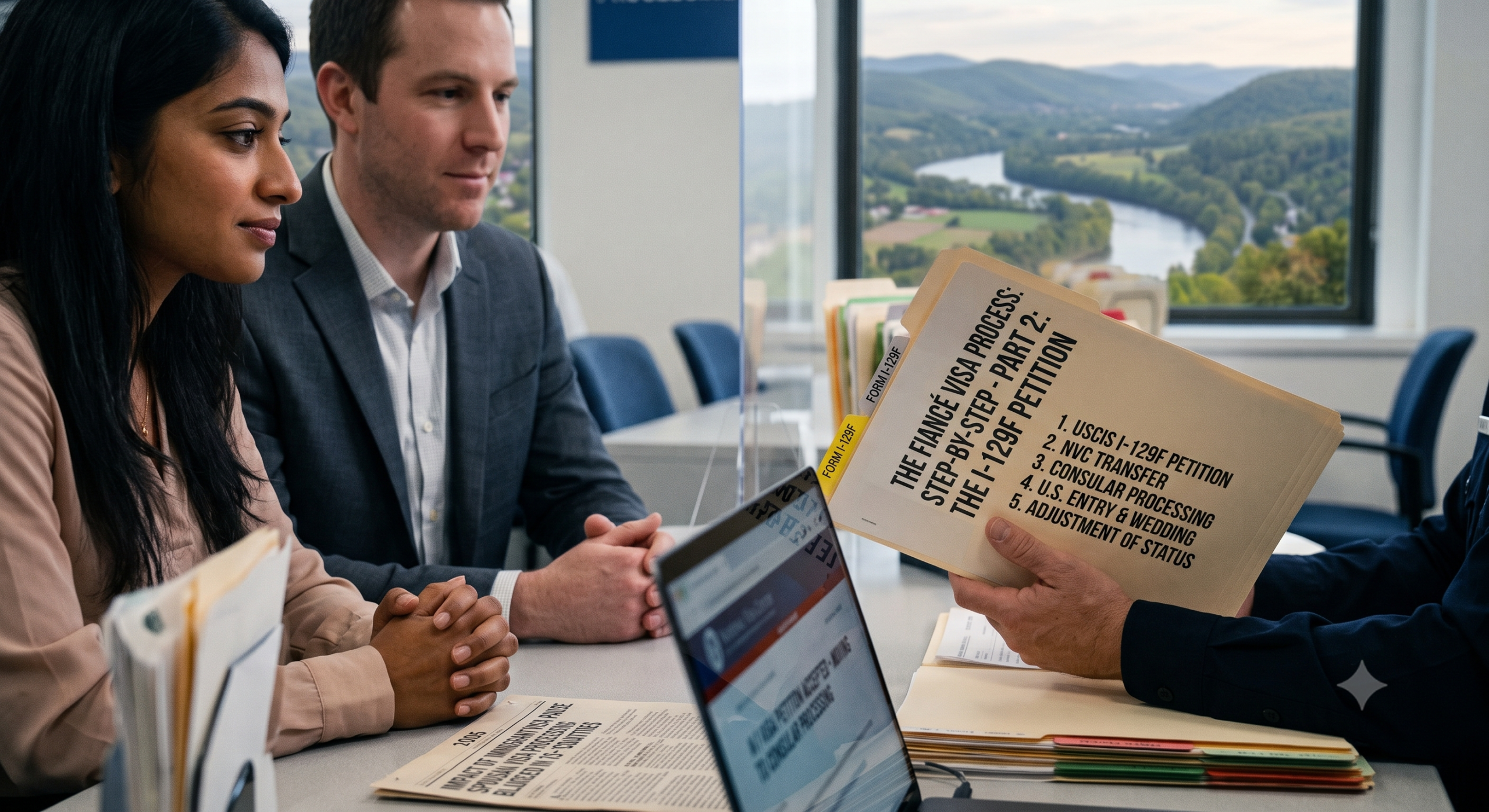
The K-1 visa journey breaks down into five sequential phases. Let’s look at what each step requires.
The journey officially begins on domestic soil. The U.S. citizen sponsor must file Form I-129F (Petition for Alien Fiancé) with U.S. Citizenship and Immigration Services (USCIS).
The primary objective of this phase is to establish your legal eligibility to marry and prove that you share a bona fide relationship. USCIS officers review this initial paperwork with a high degree of scrutiny to root out marriage fraud.
U.S. Citizenship: The petitioner must be a U.S. citizen (Lawful Permanent Residents are not eligible to sponsor a fiancé).
Legal Freedom to Marry: Both partners must be legally single. You must provide official divorce decrees, annulments, or death certificates for any prior marriages.
The Two-Year Meeting Rule: You must prove that you and your fiancé have physically met in person at least once within the two years immediately preceding the filing of the petition.
Evidence Strategy: Simply providing text messages or call logs is not enough. You must anchor your petition with hard evidence: passport admission stamps, flight itineraries, hotel receipts, and photos together taken in front of clear, localized landmarks.
Once USCIS approves your Form I-129F, they forward your case file to the National Visa Center (NVC) in Portsmouth, New Hampshire.
For immigrant spousal visas, the NVC phase can become an extensive bottleneck. However, for the K-1 fiancé visa, the NVC acts primarily as a processing pass-through. The NVC will assign your case a unique file number and quickly route it directly to the U.S. Embassy or Consulate where your foreign fiancé resides. This transfer typically wraps up within 2 to 6 weeks.
Once the overseas U.S. Embassy receives your file, the foreign fiancé takes the lead. This phase functions entirely outside the scope of the domestic immigrant visa freeze, allowing your application to advance steadily.
[Complete Form DS-160] ➔ [Schedule Approved Medical Exam] ➔ [Attend Consular Interview]
The foreign partner must complete the online DS-160 nonimmigrant visa application, gather civil documents (such as police clearance certificates), and undergo a medical examination conducted by an embassy-approved panel physician.
The process culminates in an in-person interview at the consulate. The consular officer will interview your fiancé to verify the authenticity of the relationship and confirm that they are not legally inadmissible to the United States.
Upon a successful interview, the embassy issues the K-1 visa. This visa is typically valid for a single entry into the U.S. within six months of its issuance date.
The moment your fiancé passes through a U.S. port of entry and clears Customs and Border Protection (CBP), a strict federal countdown begins: the 90-day marriage rule.
By law, you must marry within 90 days of your fiancé’s arrival. This timeline is absolute. The K-1 visa cannot be extended, and your fiancé cannot change status to a different nonimmigrant visa (like a student or tourist visa) if the wedding does not take place.
Saying “I do” completes your K-1 visa requirements, but it does not automatically grant permanent residency. The final legal phase is filing for an Adjustment of Status (Form I-485).
This application requests that USCIS transition your partner’s legal status from a temporary fiancé visa holder to a Lawful Permanent Resident. Along with the green card application, couples typically file for temporary Employment Authorization (Form I-765) and Advance Parole travel documents (Form I-131), allowing the foreign spouse to work and travel internationally while the green card is pending.
| Phase | Est. Timeline | Government Fees | Key Target |
| 1. USCIS I-129F Petition | 8 – 14 Months | $675 | Prove a bona fide relationship & 2-year meeting rule. |
| 2. NVC Transfer | 2 – 6 Weeks | $0 | Document transfer to the overseas U.S. Embassy. |
| 3. Consular Processing | 1 – 4 Months | $265 | Complete DS-160, medical exam, and interview. |
| 4. U.S. Entry & Wedding | Must occur within 90 days | Varies | Legal marriage stateside. |
| 5. Adjustment of Status | 8 – 14 Months | $1,440 | Transition to a Lawful Permanent Resident (Green Card). |
The 90-day window is a strict statutory deadline. If you do not marry within 90 days of U.S. entry, your fiancé’s legal status expires, and they must leave the country. Failing to marry within this timeframe bars them from adjusting status through any other means.
No. A K-1 visa does not grant immediate work authorization upon arrival. Your spouse can legally work only after marrying, filing an Adjustment of Status application, and receiving an approved Employment Authorization Document (EAD) from USCIS.
Yes. During the consular interview stage, the U.S. citizen sponsor files Form I-134 (Affidavit of Support), which generally requires proving an income of at least 100% of the Federal Poverty Guidelines. However, during the final Adjustment of Status stage, you must file the more stringent Form I-864, raising the requirement to 125%.
A single missing document, an incorrectly calculated fee, or an incomplete translation can trigger a Request for Evidence (RFE), instantly adding months of delay to your case. When policy changes make every month apart critical, you cannot afford administrative mistakes.
Since 1964, our team at Cohen, Tucker + Ades, P.C. has helped couples navigate the intricacies of federal immigration tracking. We handle the logistical complexities and assemble airtight evidentiary files, so you can focus on planning your future together.
Ready to start your I-129F petition with confidence? Contact our New York office today to schedule a comprehensive case evaluation.
Wendy R. Barlow, Esq.is a Partner at Cohen, Tucker + Ades, P.C. with nearly 20 years of experience in high-stakes immigration litigation. A graduate of the Maurice A. Deane School of Law at Hofstra University, Wendy is admitted to practice in New York and New Jersey as well as before the U.S. Supreme Court and multiple Federal Circuit Courts. Wendy is recognized for her ability to handle cases that many consider insurmountable.
Disclaimer: This blog post contains general information and is for informational purposes only. It is not legal advice and does not create an attorney-client relationship between you and Cohen, Tucker + Ades P.C. Immigration laws and fee schedules are subject to frequent change. The information provided herein may not reflect the most current legal developments. You should not act or refrain from acting based on information contained in this post without seeking professional counsel from an attorney licensed in your jurisdiction. Cohen, Tucker + Ades P.C. expressly disclaims all liability in respect to actions taken or not taken based on any or all of the contents of this post.