Immigration Law Blog
Stay up-to-date on the latest immigration law news, with the Cohen, Tucker & Ades team's insights behind the headlines

By Wendy R. Barlow, Esq. | Partner at Cohen, Tucker + Ades Specializing in Complex Immigration Matters
When your future in the United States is on the line, every second in court matters. For decades, many believed that presenting a final “closing argument” was a guaranteed part of a fair trial. However, a landmark decision from the Board of Immigration Appeals (BIA) has clarified exactly where that right stands—and what it means for your due process.
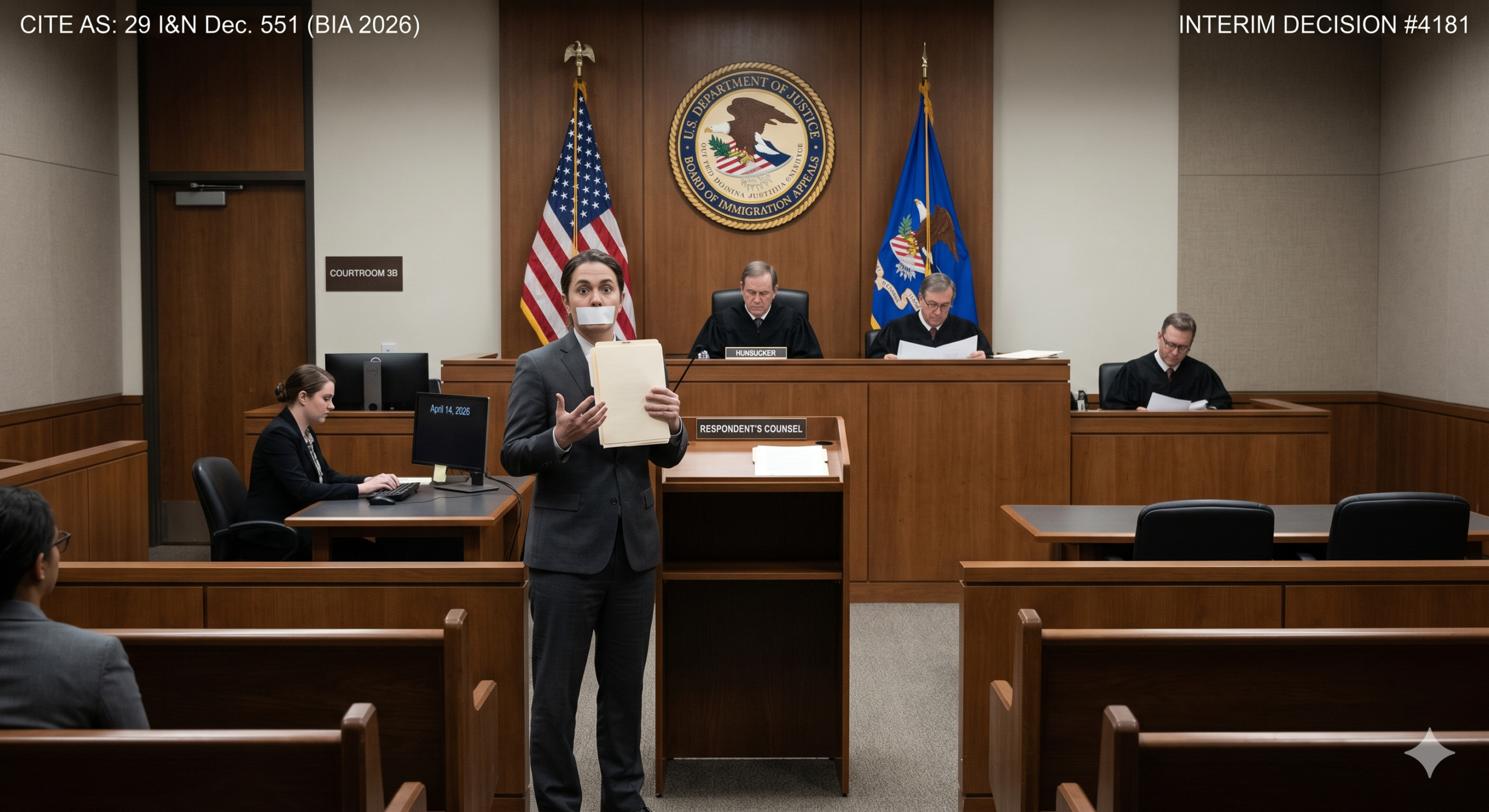
On April 14, 2026, the BIA issued a significant ruling in Matter of A-M-Z-F-. The case involved a Coptic Christian from Egypt who sought asylum due to threats from extremists. During his hearing, the Immigration Judge (IJ) denied his counsel the opportunity to give a closing argument.
The respondent appealed, arguing this denial violated his Fifth Amendment right to due process.
The BIA ultimately held that parties in Immigration Court have no absolute right to give a closing argument. Instead, the ruling established that:
Broad Discretion: Immigration Judges have the authority to control the course of a hearing.
Standard of Fundamental Fairness: A closing argument is only required if its denial would make the hearing fundamentally unfair.
The Burden of Prejudice: To win an appeal on these grounds, a respondent must prove they were “prejudiced”—meaning the lack of a closing argument actually affected the outcome of their case.
In this specific case, the Board found that because the attorney only intended to highlight general country conditions that wouldn’t have changed the judge’s mind, there was no due process violation.
Due process is a constitutional safeguard meant to ensure the government treats you fairly before taking away your liberty. While the BIA ruled that closing arguments aren’t always required, you still have several essential rights in removal proceedings:
Right to Notice: You must be informed of the charges against you and the time/place of your hearing.
Right to Counsel: You have the right to be represented by an attorney (at your own expense).
Opportunity to Present Evidence: You must have a reasonable chance to present your own evidence and cross-examine the government’s witnesses.
Interpretation Services: If you do not speak English fluently, you are entitled to a competent interpreter at no cost.
Despite these protections, many immigrants face significant hurdles that can lead to due process violations. At Cohen, Tucker + Ades, we frequently see cases where rights are threatened by:
Inadequate Time to Prepare: Rushed “expedited” dockets often give respondents little time to find a lawyer or gather evidence from their home countries.
Language Barriers: If an interpreter is not provided or speaks a different dialect, a respondent cannot truly participate in their own defense.
Lack of Legal Representation: Statistics show that immigrants with lawyers are significantly more likely to succeed in their cases.
Database and Notice Errors: Failures by the government to properly update addresses or track detained individuals can lead to “in absentia” deportation orders without the person ever knowing they had a court date.
The ruling in Matter of A-M-Z-F- highlights a critical truth: Immigration Judges have immense power to “regulate the course of the hearing”. If your judge decides to skip closing arguments, your attorney must be prepared to make every other part of the trial—the testimony, the evidence, and the legal briefs—count.
If you believe your rights were violated during a hearing, or if you are facing removal and need a vigorous defense, Cohen, Tucker + Ades is here to help. We have been navigating the “labyrinth” of immigration law since 1964.
Contact us today to protect your future.
Wendy R. Barlow, Esq.is a Partner at Cohen, Tucker + Ades, P.C. with nearly 20 years of experience in high-stakes immigration litigation. A graduate of the Maurice A. Deane School of Law at Hofstra University, Wendy is admitted to practice in New York and New Jersey as well as before the U.S. Supreme Court and multiple Federal Circuit Courts. Wendy is recognized for her ability to handle cases that many consider insurmountable.
Disclaimer: This blog post contains general information and is for informational purposes only. It is not legal advice and does not create an attorney-client relationship between you and Cohen, Tucker + Ades P.C. Immigration laws and fee schedules are subject to frequent change. The information provided herein may not reflect the most current legal developments. You should not act or refrain from acting based on information contained in this post without seeking professional counsel from an attorney licensed in your jurisdiction. Cohen, Tucker + Ades P.C. expressly disclaims all liability in respect to actions taken or not taken based on any or all of the contents of this post.
Sources: