An EB-5 Regional Center equity project is an immigrant investment structure in which pooled investor capital is deployed as an ownership stake—rather than a fixed-term loan—into a Job-Creating Entity (JCE). While
loan-based offerings have historically dominated the
EB-5 marketplace, equity models offer higher financial upside and direct alignment with project performance, balanced against subordinate repayment priority and variable exit timelines.
For prospective immigrant investors, understanding the mechanics of an equity offering is critical to protecting both your family’s green card petition and your capital. Below, the immigration legal team at Cohen, Tucker + Ades, P.C. breaks down what EB-5 equity projects are, how they operate under the EB-5 Reform and Integrity Act (RIA), and the key risks and rewards to weigh during due diligence.
What Is an EB-5 Regional Center Equity Project?
In the EB-5 Immigrant Investor Program, capital invested through a USCIS-designated Regional Center flows through two primary legal entities:
-
The New Commercial Enterprise (NCE): The fund or limited partnership that pools capital from individual EB-5 investors.
-
The Job-Creating Entity (JCE): The operating business or real estate developer that uses the pooled capital to execute the project and generate the required 10 full-time U.S. jobs per investor.
In a loan model, the NCE lends the pooled funds to the JCE at a fixed interest rate with a set maturity date. In an equity model, the NCE purchases an ownership interest—typically preferred equity or common equity—in the JCE. Instead of acting as a lender collecting fixed interest, the NCE becomes a co-owner participating in the project’s cash flow, appreciation, and exit proceeds.
How Do EB-5 Equity Projects Work?
To satisfy U.S. Citizenship and Immigration Services (USCIS) requirements under 8 CFR § 204.6(j), every EB-5 investment must remain genuinely “at risk” throughout the investor’s conditional residency period. Equity structures fulfill this requirement natively, moving through four distinct phases:
-
Capital Pooling & Subscription: Investors contribute the statutory minimum investment ($800,000 for Targeted Employment Areas or infrastructure projects; $1,050,000 for standard projects) into the NCE and file Form I-526E.
-
Equity Deployment: Rather than issuing a promissory note, the NCE contributes capital directly into the JCE in exchange for membership units or shares, governed by an Operating Agreement or Joint Venture Agreement.
-
Job Creation Execution: The JCE deploys the equity toward construction, development, or business operations. Because the investment is made through a Regional Center, up to 90% of the required 10 jobs per investor can be satisfied through indirect and induced jobs calculated via accepted economic models.
-
Exit & Capital Return: Unlike a loan with a fixed maturity date, an equity investment is liquidated upon a capital event—such as the sale of the stabilized property, a commercial refinancing, or a buyout triggered after investors complete their Form I-829 sustainment and petition process.
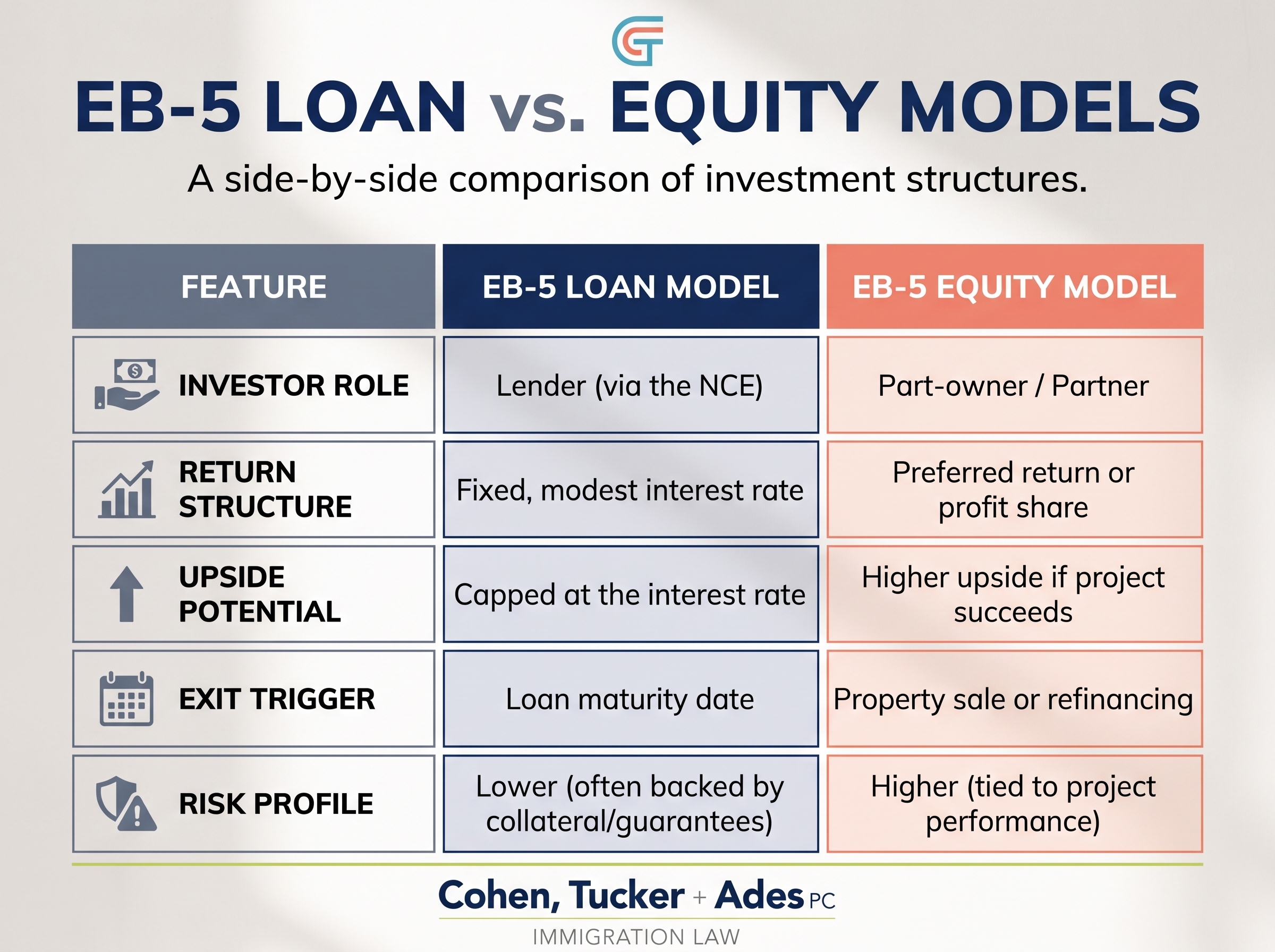
Equity Model vs. Loan Model at a Glance
| Feature |
EB-5 Equity Model |
EB-5 Loan Model |
| Role of the NCE |
Co-owner / Preferred or Common Equity Partner |
Creditor / Lender |
| Return Profile |
Variable; tied to project profits, preferred dividends, and asset appreciation |
Fixed; low annual interest payments (typically 0.25%–2%) |
| Capital Stack Position |
Subordinate to senior bank loans and mezzanine debt |
Typically senior or mezzanine, ahead of developer equity |
| Exit Mechanism |
Sale of the asset, refinancing, or operational buyout |
Loan maturity date and principal repayment |
| Primary Advantage |
Stronger “at-risk” compliance and higher financial upside |
More predictable repayment timeline and collateral backing |
Rewards of EB-5 Regional Center Equity Projects
1. Higher Potential Financial Return
Most EB-5 loan projects offer minimal annual yield because the primary objective is immigration rather than profit. Equity offerings—particularly preferred equity structures—often provide investors with a higher preferred annual return (sometimes 4% to 8%+) plus a share of profits upon the sale or refinancing of the asset.
2. Clear Alignment with USCIS “At-Risk” Rules
USCIS strictly prohibits any guarantee of capital return or contractual redemption rights that insulate an investor from loss. Because true equity ownership inherently carries market risk and lacks a guaranteed maturity payout, well-structured equity offerings face fewer regulatory challenges regarding whether capital is legitimately “at risk”.
3. Strong Developer Alignment
In many equity joint ventures, the Regional Center and developer share long-term operational incentives. When structured with a fair waterfall distribution—where EB-5 preferred equity holders are paid before the developer takes common equity profits—both parties are motivated to maximize the project’s long-term value.
Risks of EB-5 Regional Center Equity Projects
1. Subordinate Position in the Capital Stack
In commercial real estate and infrastructure finance, equity sits below senior construction loans and mezzanine debt in the capital stack (the order of repayment). If a project experiences severe cost overruns or a market downturn, senior lenders are repaid first, meaning equity investors absorb losses before debt holders.
2. Uncertain Exit Timelines
A loan has a contractual maturity date. An equity investment relies on market conditions for an exit. If interest rates spike or real estate valuations soften when your immigration process concludes, the JCE may delay selling or refinancing the asset to avoid locking in a loss—extending the time your capital remains tied up.
3. Fewer Hard Collateral Protections
Unlike senior debt holders who can foreclose on physical real estate in the event of default, equity holders own shares in the entity rather than a lien on the underlying property. Investor protections depend heavily on governance rights, reporting transparency, and preferred return waterfalls written into the Operating Agreement.
4. Related-Party Conflicts of Interest
In integrated equity deals where the Regional Center and the developer are affiliated entities, internal checks and balances can be weaker. Independent legal review is essential to verify that management fees, construction budgets, and profit distributions do not favor the developer at the expense of EB-5 investors.
Frequently Asked Questions (FAQ)
Are EB-5 equity projects riskier than EB-5 loan projects?
Financially, equity projects generally carry higher risk because they sit lower in the capital stack and lack fixed maturity dates or foreclosure rights. However, from an immigration standpoint, genuine equity structures align cleanly with USCIS “at-risk” regulations, provided the project creates a healthy buffer above the required 10 jobs per investor.
What is preferred equity in an EB-5 project?
Preferred equity is a hybrid structure where EB-5 investors hold an ownership stake that grants priority over the developer’s common equity for both ongoing cash distributions and capital repayment upon exit, while still remaining subordinate to senior bank lenders.
How do I evaluate an EB-5 equity offering before investing?
Before signing a subscription agreement, investors should verify the Regional Center’s active RIA compliance, confirm whether Form I-956F has been filed or approved, review the Private Placement Memorandum (PPM) for developer equity skin-in-the-game, and retain independent immigration counsel to review both immigration viability and offering terms.
Protect Your Family’s Immigration Strategy with Independent Counsel
Regional Centers and project developers retain their own corporate attorneys to draft offering documents—those attorneys represent the project, not you. Whether you are evaluating an EB-5 preferred equity offering or a traditional loan structure, having an independent legal advocate examine your source of funds, project job-creation cushion, and RIA compliance protections is vital.