Immigration Law Blog
Stay up-to-date on the latest immigration law news, with the Cohen, Tucker & Ades team's insights behind the headlines

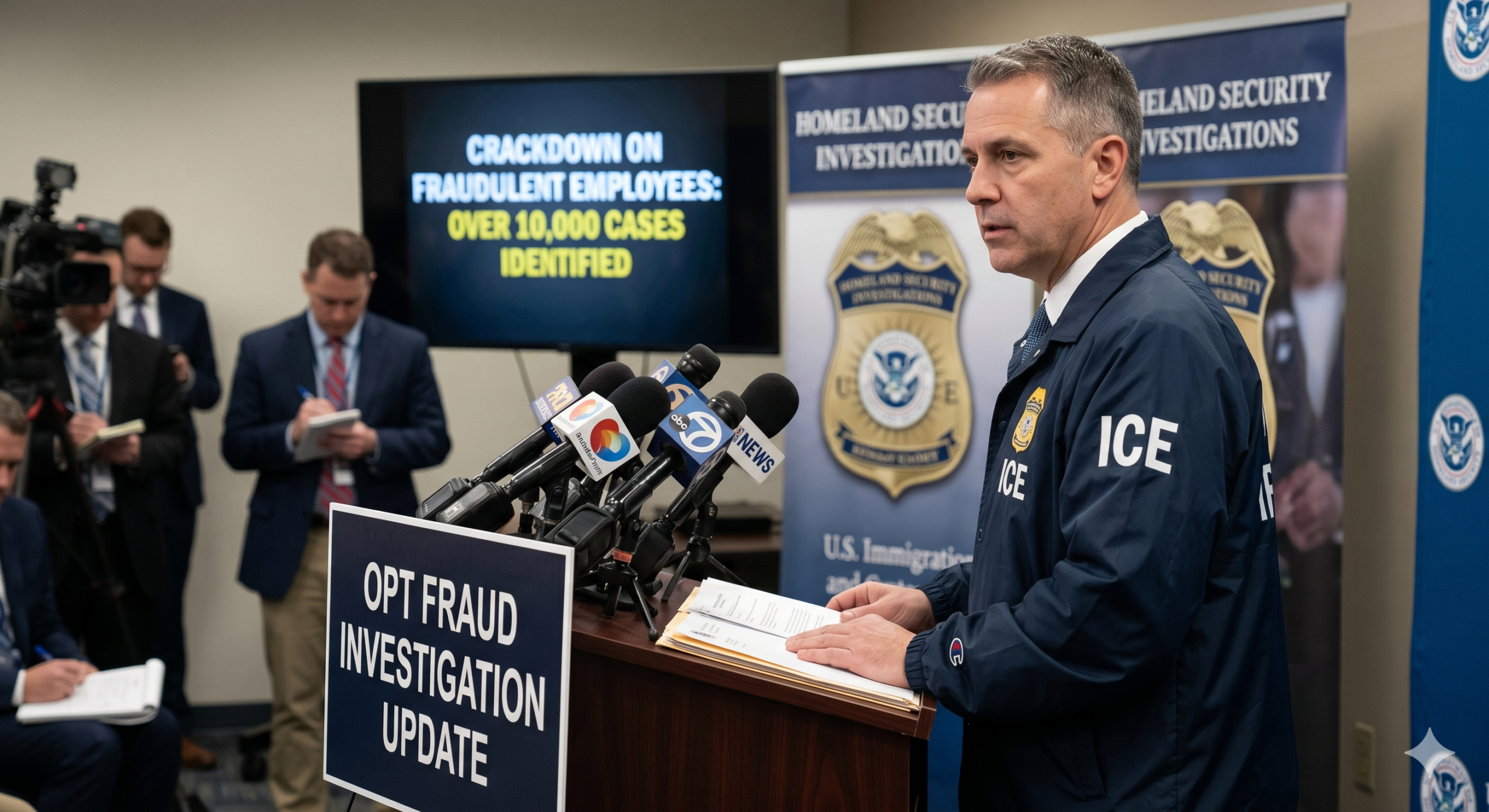
On May 12, 2026, U.S. Immigration and Customs Enforcement (ICE) and Homeland Security Investigations (HSI) launched a nationwide investigation into the Optional Practical Training (OPT) program. Authorities have flagged over 10,000 international students for suspected fraud linked to “shell companies” and “ghost offices.” This crackdown marks a major shift toward aggressive enforcement of F-1 student work authorization rules.
According to Politico, the investigation focuses on “integrity in the student visa system.” Federal agents identified thousands of students claiming employment at addresses that turned out to be residential homes, empty warehouses, or businesses that exist only on paper.
Key investigation findings include:
Pay-to-Stay Schemes: Students allegedly paying “employers” to report work hours they never actually performed.
Undisclosed Remote Work: Employment reported at U.S. addresses while the student was actually living abroad.
Unsupervised STEM OPT: Lack of genuine training or oversight as required by the Form I-983.
AI-driven audits are now flagging specific patterns that trigger ICE site visits. If your employer matches these descriptions, your immigration status could be at risk:
Multiple Students, Zero Footprint: Companies listing hundreds of OPT employees but having no physical office or active business operations.
Generic Job Descriptions: Training plans that use “copy-paste” language rather than specific duties related to the student’s degree.
Vague Supervision: Failure to identify a specific manager who provides regular, on-site, or structured remote oversight.
For the vast majority of F-1 students and U.S. companies who follow the rules, an aggressive enforcement environment can still create “collateral consequences.” Increased site visits, more rigorous audits of Form I-983, and a higher level of scrutiny during H-1B lottery filings or green card applications are now expected.
If you are an international student, the burden of proof often falls on you to show that your employment is bona fide and directly related to your field of study. For employers, the lack of a formal “petition” for standard OPT (unlike the H-1B) makes the program a “soft target” for ICE scrutiny, meaning your internal documentation must be flawless.
To navigate this period of heightened scrutiny, both students and employers should focus on transparency and meticulous record-keeping.
Conduct an Internal Inventory: Review all F-1 students currently on staff. Ensure you have copies of their EAD cards, employment offer letters, and job descriptions on file.
Verify Supervision for STEM OPT: For students on the 24-month STEM extension, ensure the Form I-983 (Training Plan) is accurate. ICE is focusing on whether students are receiving genuine on-site supervision and if the training matches what was promised.
Prepare for Site Visits: Ensure your reception or HR staff knows how to handle a surprise visit from HSI. Have a designated point of contact and keep your employment records organized and accessible.
Maintain Your Relationship with your DSO: Always report changes in your employment, address, or supervisor to your Designated School Official (DSO) within 10 days.
Document Your Daily Tasks: Keep a “work diary” or copies of project work that prove you are performing duties related to your degree.
Avoid “Resume Padding” Employers: If a company offers to provide employment verification for a fee without requiring actual work, it is likely a fraudulent operation. Engaging with these entities can lead to permanent bars from the United States.
What is the penalty for OPT fraud?
Students found to have engaged in OPT fraud face immediate visa revocation, deportation, and a potential permanent bar from re-entering the United States for “material misrepresentation.”
Can ICE visit my workplace during OPT?
Yes. ICE and HSI have the authority to conduct “site visits” for students on the 24-month STEM OPT extension to verify the training plan (Form I-983) and ensure the employer is providing proper supervision.
Does this crackdown affect H-1B applications?
Yes. If ICE flags an OPT period as fraudulent, any subsequent H-1B petition or Green Card application will likely be denied due to the underlying status violation.
The “light-touch” era of OPT oversight is over. Whether you are an international student or a U.S. company, meticulous record-keeping is your best defense. If you suspect your employer may not be compliant, consult with an immigration attorney immediately to rectify your status before ICE knocks.
Caught in the ICE OPT Investigation? Since 1964, Cohen, Tucker + Ades has been the premier choice for deportation defense and federal immigration litigation. If your visa is at risk due to the recent fraud crackdown, experience is your best defense.
Contact Cohen, Tucker + Ades for Immediate Legal Assistance
Wendy R. Barlow, Esq.is a Partner at Cohen, Tucker + Ades, P.C. with nearly 20 years of experience in high-stakes immigration litigation. A graduate of the Maurice A. Deane School of Law at Hofstra University, Wendy is admitted to practice in New York and New Jersey as well as before the U.S. Supreme Court and multiple Federal Circuit Courts. Wendy is recognized for her ability to handle cases that many consider insurmountable.
Disclaimer: This blog post contains general information and is for informational purposes only. It is not legal advice and does not create an attorney-client relationship between you and Cohen, Tucker + Ades P.C. Immigration laws and fee schedules are subject to frequent change. The information provided herein may not reflect the most current legal developments. You should not act or refrain from acting based on information contained in this post without seeking professional counsel from an attorney licensed in your jurisdiction. Cohen, Tucker + Ades P.C. expressly disclaims all liability in respect to actions taken or not taken based on any or all of the contents of this post.
Sources:
Politico, ICE: More than 10,000 potential fraud cases related to student job program