Immigration Law Blog
Stay up-to-date on the latest immigration law news, with the Cohen, Tucker & Ades team's insights behind the headlines

By Wendy R. Barlow, Esq. | Partner at Cohen, Tucker + Ades Specializing in Complex Immigration Matters
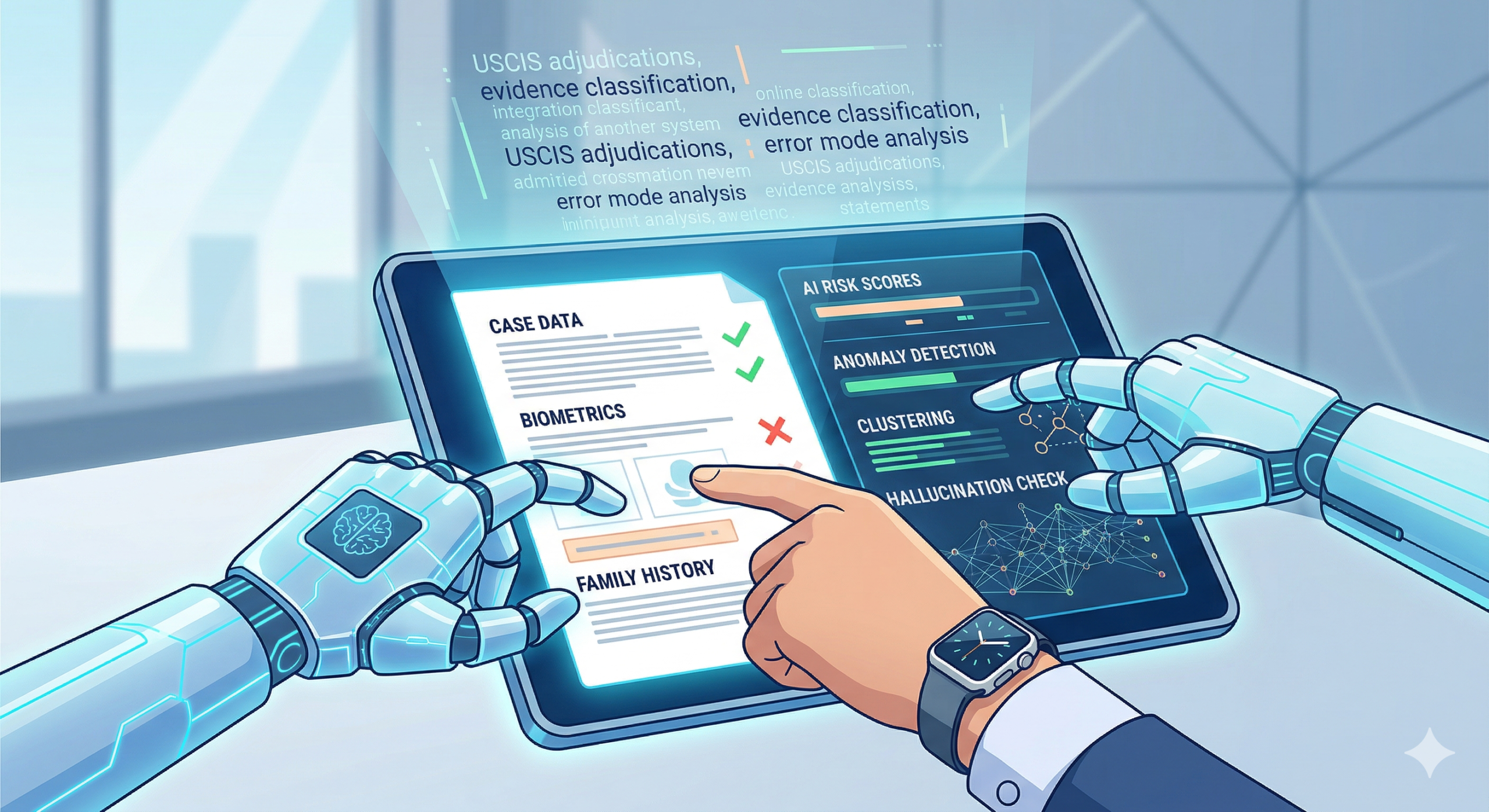
At Cohen, Tucker + Ades, we have spent decades helping individuals and corporations navigate the complexities of the U.S. immigration system. As technology evolves, so does the way the government processes your applications. USCIS is increasingly using Artificial Intelligence (AI) to assist in adjudications.
While USCIS maintains that human officers make the final decisions, AI tools now shape the information those officers see. For applicants, this means “automated errors” could be the hidden reason behind a confusing RFE (Request for Evidence), NOID (Notice of Intent to Deny), or a denial.
According to the Department of Homeland Security (DHS), AI is currently used in several key areas of the immigration process:
Evidence Classification: Sorting through documents in the Electronic Immigration System (ELIS).
Identity Matching: Using algorithms to pair biometric data and biographic profiles.
Text Analytics: Detecting similarities across narrative submissions, such as asylum applications.
Biometric Quality Control: Screening fingerprints and photos for technical standards.
AI is not infallible. It can introduce “predictable error modes” that a human might not naturally make. We are seeing cases where AI-driven errors lead to:
Misidentification: A client being mistaken for another individual with a similar name.
False Associations: Incorrectly linking a client to unrelated family members.
Hallucinations: In the context of automated text generation, “hallucinations” occur when the system generates factual assertions that are completely unsupported by the actual record.
If your case is denied or delayed for reasons that don’t make logical sense, it may be due to an algorithmic error. Our team is prepared to challenge these “breakdowns in reasoned decision-making” by:
Identifying Patterns: We look for adjudications that are internally inconsistent or detached from the evidence you actually submitted.
Using AI Analyzers: We can use specialized tools to detect if a decision appears formulaic or was likely generated by automated text tools.
Record Development: We utilize FOIA (Freedom of Information Act) requests to seek adjudicator notes and records of automated processing to see exactly where the error occurred.
Step-by-Step Advocacy: When we file appeals or motions, we provide a rigorous, evidence-based analysis to “re-inform” the system and correct erroneous assumptions.
Immigration law is second only to tax law in its complexity. In an era of automated vetting, having an experienced advocate is more important than ever. If you believe your case has been affected by an unfair or incorrect automated decision, Cohen, Tucker + Ades is here to help you thread the labyrinth.
Contact us today to schedule a consultation and ensure your American dream isn’t stalled by a technical glitch.
Wendy R. Barlow, Esq. is a Partner at Cohen, Tucker + Ades, P.C. with nearly 20 years of experience in high-stakes immigration litigation. A graduate of the Maurice A. Deane School of Law at Hofstra University, Wendy is admitted to practice in New York and New Jersey as well as before the U.S. Supreme Court and multiple Federal Circuit Courts. Wendy is recognized for her ability to handle cases that many consider insurmountable.
Disclaimer: This blog post contains general information and is for informational purposes only. It is not legal advice and does not create an attorney-client relationship between you and Cohen, Tucker + Ades P.C. Immigration laws and fee schedules are subject to frequent change. The information provided herein may not reflect the most current legal developments. You should not act or refrain from acting based on information contained in this post without seeking professional counsel from an attorney licensed in your jurisdiction. Cohen, Tucker + Ades P.C. expressly disclaims all liability in respect to actions taken or not taken based on any or all of the contents of this post.