Immigration Law Blog
Stay up-to-date on the latest immigration law news, with the Cohen, Tucker & Ades team's insights behind the headlines

The landscape of employment-based immigration is facing a major shift. On March 27, 2026, the U.S. Department of Labor (DOL) published a Notice of Proposed Rulemaking (NPRM) that aims to fundamentally change how prevailing wages are calculated for the H-1B, H-1B1, E-3, and PERM labor certification programs.
For employers who rely on high-skilled foreign talent, these changes could mean substantial increases in required salary levels—in some cases, upwards of 30%. At Cohen, Tucker + Ades, we are closely monitoring these developments to ensure our clients are prepared for the potential impact on their workforce and bottom line.
The proposed rule, titled “Improving Wage Protections for the Temporary and Permanent Employment of Certain Foreign Nationals in the United States,” seeks to adjust the four-tiered wage structure used by the Occupational Employment and Wage Statistics (OEWS).
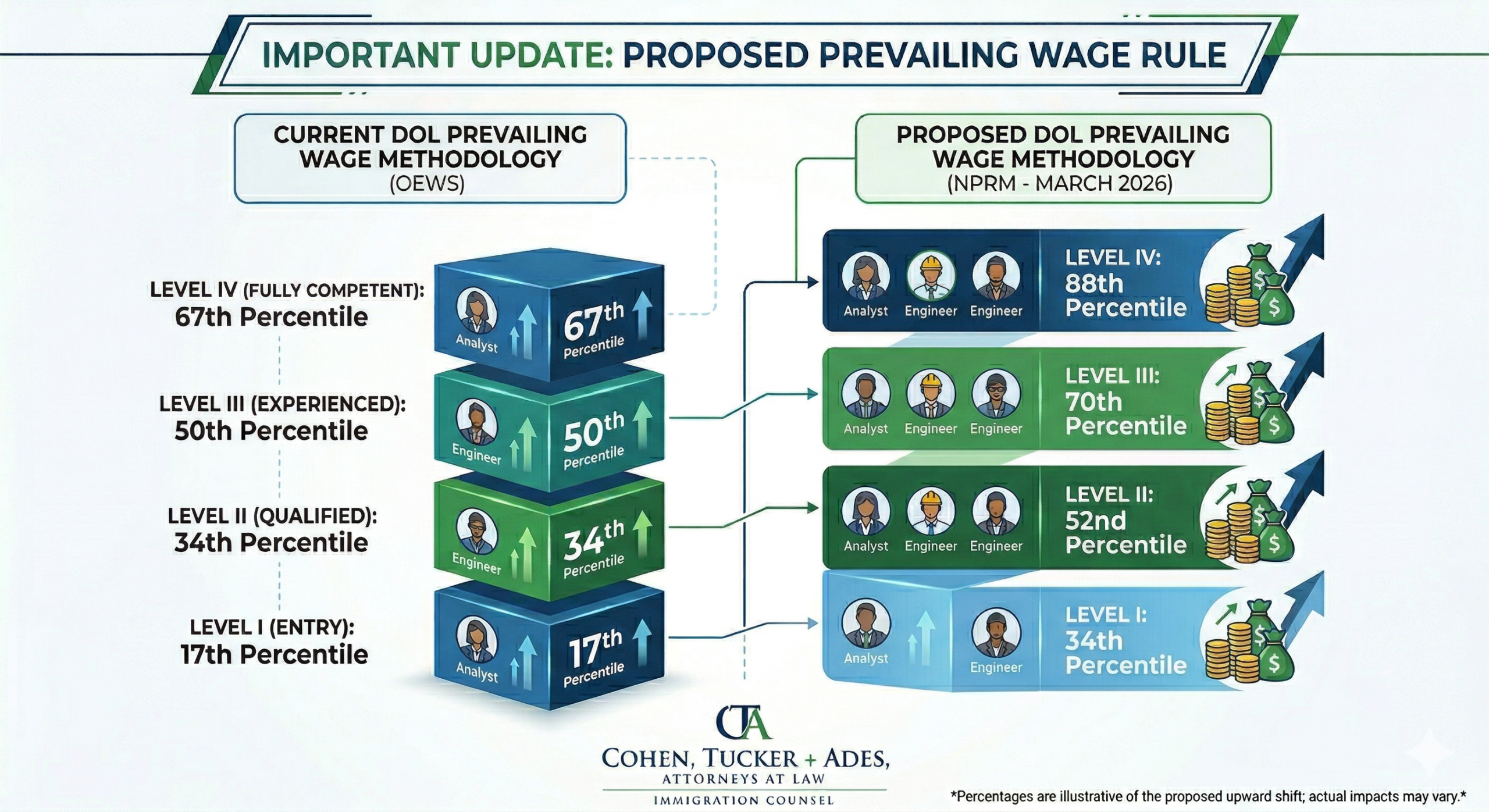
The goal of the DOL is to align foreign worker wages more closely with those of similarly employed U.S. workers. If finalized, the percentile levels for each wage tier would shift as follows:
| Wage Level | Current Percentile | Proposed Percentile |
| Level I (Entry) | 17th Percentile | 34th Percentile |
| Level II (Qualified) | 34th Percentile | 52nd Percentile |
| Level III (Experienced) | 50th Percentile | 70th Percentile |
| Level IV (Fully Competent) | 67th Percentile | 88th Percentile |
Essentially, the new “Entry Level” (Level I) would be set at the same percentile where Level II currently sits. This “upward shift” is designed to reduce the incentive for employers to hire foreign workers at lower costs than domestic counterparts.
Increased Sponsorship Costs: The DOL estimates that the average certified wage could increase by approximately $14,000 to $20,000 per year per worker. Small businesses and startups may feel this burden most acutely.
Impact on H-1B Extensions & PERM: While the rule is intended to be prospective (applying to new filings), it will affect H-1B extensions and new PERM applications filed after the effective date.
Private Wage Surveys Remain an Option: Importantly, the proposed rule does not eliminate the use of private, independent wage surveys. Employers may still be able to use alternative data sources to establish a prevailing wage, provided they meet DOL standards.
Public Comment Period: The public has 60 days (until May 26, 2026) to submit comments on the proposal. We encourage stakeholders to voice their concerns regarding the economic impact of these changes.
Navigating the complexities of Department of Labor regulations requires a proactive legal strategy. Our firm specializes in employment-based immigration, and we are ready to assist you in the following ways:
Wage Level Analysis: We can review your current and planned H-1B and PERM cases to determine how the new percentiles will affect your required salary offers.
Alternative Wage Survey Strategy: If the OEWS data becomes prohibitively high, our team can help you identify and submit acceptable private wage surveys to maintain compliance while managing costs.
Strategic Workforce Planning: We provide counsel on the timing of your filings to mitigate the impact of the rule before it is finalized and implemented.
Compliance & Litigation Support: With extensive experience in federal litigation and DOL appeals, we are prepared to challenge erroneous wage determinations and advocate for your business interests.
The path to securing talent in the U.S. is becoming more expensive and complex. Don’t wait for the final rule to take effect.
Contact Cohen, Tucker + Ades today to schedule a consultation and ensure your immigration program remains robust in the face of these regulatory changes.
Disclaimer: This blog post contains general information and is for informational purposes only. It is not legal advice and does not create an attorney-client relationship between you and Cohen, Tucker + Ades P.C. Immigration laws and fee schedules are subject to frequent change. The information provided herein may not reflect the most current legal developments. You should not act or refrain from acting based on information contained in this post without seeking professional counsel from an attorney licensed in your jurisdiction. Cohen, Tucker + Ades P.C. expressly disclaims all liability in respect to actions taken or not taken based on any or all of the contents of this post.
Sources: