Immigration Law Blog
Stay up-to-date on the latest immigration law news, with the Cohen, Tucker & Ades team's insights behind the headlines

When most people think of family-based immigration, they focus heavily on the non-citizen beneficiary—their background, eligibility, and legal status. However, U.S. immigration laws place severe, unrelenting scrutiny on the U.S. citizen or Lawful Permanent Resident (LPR) sponsor as well.
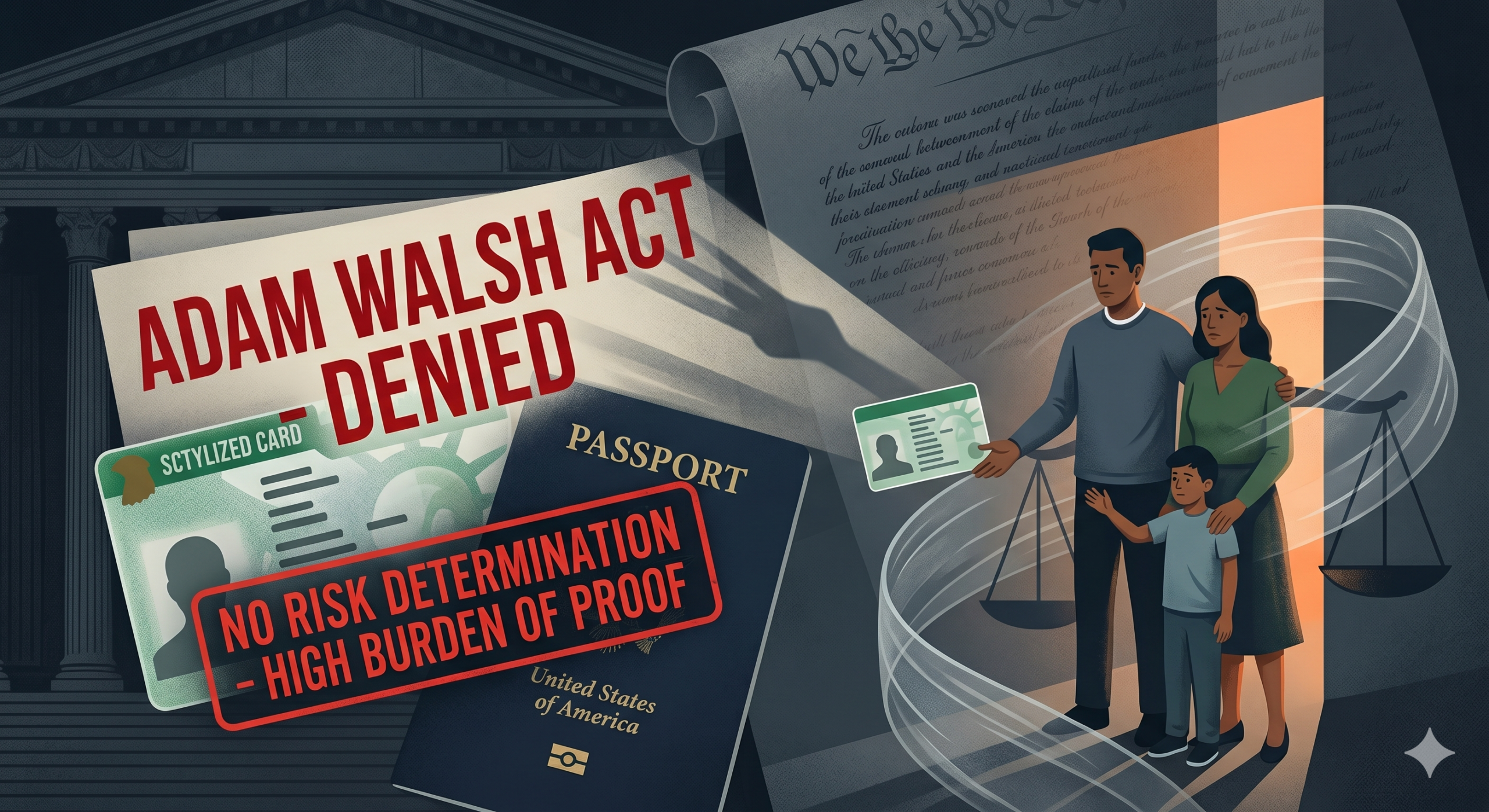
One of the most rigid and challenging hurdles a petitioner can face is the Adam Walsh Child Protection and Safety Act (AWA). If you are a sponsor with a past criminal record, a conviction from years or even decades ago could completely derail your family’s dream of building a life together in the United States.
Filing a Form I-130 (Petition for Alien Relative) or Form I-129F (Fiancé Petition) with a triggering record will instantly result in a aggressive Notice of Intent to Deny (NOID) or Request for Evidence (RFE) from U.S. Citizenship and Immigration Services (USCIS). Overcoming it requires an advanced legal approach.
The Adam Walsh Act was signed into law in 2006 to protect minors from exploitation and abuse. While it primarily governs sex offender registration systems, Title IV of the Act directly amended the Immigration and Nationality Act (INA).
The Core Rule: Any U.S. citizen or Lawful Permanent Resident who has been convicted of a “specified offense against a minor” is entirely barred from petitioning for any family-based or fiancé immigrant visa, unless they can prove they pose “no risk” to the beneficiary.
Crucially, this bar applies regardless of the age of the family member you are sponsoring. If you have a triggering conviction, you cannot sponsor an adult spouse, a sibling, or a parent unless you overcome the Adam Walsh Act restrictions.
For the purposes of immigration law, a “minor” is defined as any individual under the age of 18. Under the INA, a “specified offense” includes, but is not limited to:
Kidnapping or false imprisonment (except by a parent/guardian).
Solicitation to engage in sexual conduct or prostitution.
Possession, production, or distribution of child pornography.
Video voyeurism.
Criminal sexual conduct involving a minor (including internet-facilitated attempts).
Unlike standard immigration waivers that rely on a “preponderance of evidence” or a showing of “extreme hardship” to a relative, the Adam Walsh Act operates under a completely different framework.
To overcome the automatic bar, the petitioner must secure a favorable “No Risk” determination. Legally, the petitioner bears the astronomical burden of proving beyond a reasonable doubt that they pose absolutely no risk of harm to the sponsored beneficiary (or any derivative children joining them).
Historically, this judgment has been heavily insulated from the court system. However, evolving federal jurisprudence has changed the playing field. In the landmark case Castaneira v. Noem, the U.S. Court of Appeals for the D.C. Circuit clarified that while USCIS’s ultimate, predictive “no risk” judgment remains discretionary, the underlying legal framework—such as the agency’s strict application of evidentiary standards—is subject to federal judicial review under the Administrative Procedure Act (APA). This opening makes an flawless, legally precise initial response more critical than ever.
A USCIS NOID under the Adam Walsh Act typically allows only 30 days for a response. Because a denial cannot be traditionally appealed to the Board of Immigration Appeals (BIA), your initial submission is the definitive battlefield for your case.
A winning strategy must combine strict statutory arguments with extensive clinical and personal evidence:
While a U.S. citizen faces the heartbreak of a petition denial, a Lawful Permanent Resident (LPR) faces a far more dangerous trap.
When an LPR files a Form I-130, USCIS actively reviews their entire background. If your past conviction triggers the Adam Walsh Act, it may simultaneously constitute an independent ground of deportability (such as an aggravated felony or a crime involving moral turpitude).
Instead of just denying your family member’s green card, the government can place you directly into removal (deportation) proceedings. LPRs must have their criminal records comprehensively vetted by defense counsel before submitting any paperwork to USCIS.
Because the government holds vast discretion over Adam Walsh Act cases, a single unpolished statement or missing document can permanently bar your loved one from entering the U.S., or place your own legal status at risk.
At Cohen, Tucker + Ades, our experienced New York immigration defense team understands how to dismantle overly broad statutory classifications, coordinate with premier forensic experts, and assemble the bulletproof evidence packets required to meet the government’s high standard of proof.
If you have a past conviction and want to sponsor a family member, or if you have already received a Notice of Intent to Deny from USCIS, protect your family’s future. Contact us today to schedule a confidential legal consultation.
Wendy R. Barlow, Esq.is a Partner at Cohen, Tucker + Ades, P.C. with nearly 20 years of experience in high-stakes immigration litigation. A graduate of the Maurice A. Deane School of Law at Hofstra University, Wendy is admitted to practice in New York and New Jersey as well as before the U.S. Supreme Court and multiple Federal Circuit Courts. Wendy is recognized for her ability to handle cases that many consider insurmountable.
Disclaimer: This blog post contains general information and is for informational purposes only. It is not legal advice and does not create an attorney-client relationship between you and Cohen, Tucker + Ades P.C. Immigration laws and fee schedules are subject to frequent change. The information provided herein may not reflect the most current legal developments. You should not act or refrain from acting based on information contained in this post without seeking professional counsel from an attorney licensed in your jurisdiction. Cohen, Tucker + Ades P.C. expressly disclaims all liability in respect to actions taken or not taken based on any or all of the contents of this post.