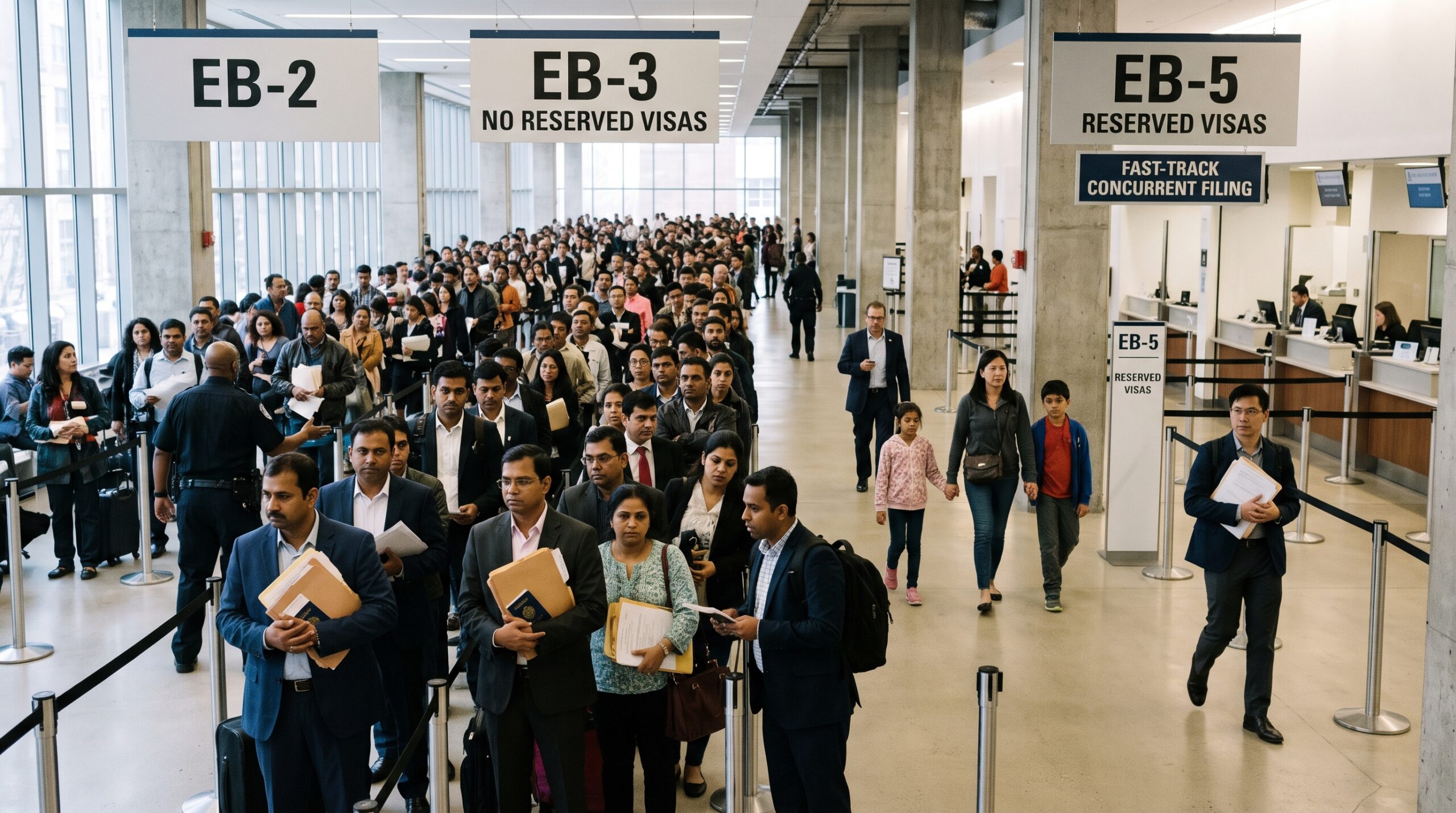
For skilled professionals on H-1B or L-1 visas from countries facing severe visa retrogression—most notably India and China—the American dream often feels suspended in regulatory gridlock. With statutory per-country visa ceilings, professionals in the EB-2 and EB-3 preference queues frequently confront wait times exceeding a decade.
This reality creates systemic career vulnerability: tied work authorization, constant threat of the 60-day grace period during layoffs, and chronic anxiety over aging-out dependent children.
The EB-5 Reform and Integrity Act of 2022 (RIA) created a statutory pathway out of this holding pattern: the combination of Reserved Visas (Set-Asides) and Concurrent Adjustment of Status Filing (Form I-485).
This strategy allows qualified foreign nationals already in the United States to unlock independent open-market work authorization and unrestricted international travel permission in a matter of months, completely bypassing the employer-sponsored backlog.
The Core Problem: Decades-Long EB-2 and EB-3 Retrogression
The U.S. immigration system caps employment-based immigrant visas at 7% per country of chargeability each fiscal year. For Indian and Chinese nationals, annual demand dwarfs supply, creating compounding waitlists:
-
Employer Lock-In: Your permanent residency remains contingent on your petitioner company, complicating career promotions, job changes, or entrepreneurial ventures.
-
The “Age-Out” Danger: Unmarried children lose eligibility for derivative permanent residency once they turn 21, forcing them into temporary F-1 student status with no clear immigrant path.
-
Layoff Exposure: In fluctuating job markets, an unexpected termination triggers a strict 60-day nonimmigrant grace period to secure a transfer, change status, or depart the United States.
Filing an
EB-5 immigrant investor petition does not disrupt or invalidate a pending
EB-2 or
EB-3 process. Under federal law, immigrant petitions are not mutually exclusive; pursuing an EB-5 investor petition runs in parallel with existing employment-based filings.
The Post-RIA Solution: EB-5 Reserved Visas
The RIA restructured the EB-5 program by carving out 32% of the annual EB-5 visa allocation into three reserved (“set-aside”) categories:
-
Rural Areas (20% set-aside): Projects located outside a Metropolitan Statistical Area (MSA) and towns with populations over 20,000. These receive statutory priority processing from USCIS.
-
High-Unemployment Areas (10% set-aside): Projects in designated Targeted Employment Areas (TEAs) experiencing unemployment of at least 150% of the national average.
-
Infrastructure Projects (2% set-aside): Projects administered by a public agency or governmental entity.
Why Set-Asides Matter
Because these reserved pools are independent categories under the Department of State’s monthly Visa Bulletin, their priority dates remained distinct from legacy “unreserved” pools. Investing in a qualifying rural or TEA project ($800,000 minimum threshold) grants access to an open allocation pool, permitting immediate adjustment filings.
The Power of Concurrent Filing (Form I-526E + Form I-485)
Prior to the RIA, an EB-5 investor physically present in the U.S. had to wait years for USCIS to approve Form I-526 before they could file for Adjustment of Status (AOS).
Under the modernized INA § 245(k) & (c) framework, if an investor’s visa category is marked “Current” on the Visa Bulletin (Chart A or Chart B, depending on USCIS guidance for that month), they are entitled to file Form I-526E (Regional Center Investor Petition) and Form I-485 (Application to Adjust Status) simultaneously.
Filing this concurrent package secures several key protections:
1. Authorized Period of Stay
Upon USCIS issuing the I-485 Receipt Notice, you and your derivatives enter a legally recognized
period of stay authorized by the Attorney General. Even if your underlying
H-1B,
L-1, or
O-1 visa expires or your employment ends, you are protected from accruing unlawful presence while the green card is pending.
2. Employment Authorization Document (EAD)
Form I-765 grants an open-market Work Authorization Document (typically issued within 3 to 7 months). You are no longer restricted to a single employer, specialty occupation parameters, or LCA geographic requirements. You can start a business, transition into consulting, or change industries entirely.
3. Advance Parole (AP) Travel Document
Form I-131 allows international travel without visiting a U.S. Consulate abroad for visa stamp renewals, avoiding the risk of administrative processing delays (221(g)).
4. Freezing Age-Out Risks Under the CSPA
Filing Form I-485 while a reserved visa is current helps protect dependent children under the
Child Status Protection Act (CSPA), reducing the threat of aging out at age 21 during long administrative delays.
EB-2/EB-3 Backlog vs. EB-5 Concurrent Filing
| Strategic Factor |
Standard EB-2 / EB-3 Route |
EB-5 Reserved Visa (Concurrent) |
| Visa Availability |
Significant retrogression (years-long backlog) |
Reserved pools maintain dedicated annual allocations |
| Work Authorization |
Tied to sponsoring employer (H-1B/L-1) |
Open-market, unrestricted EAD |
| Employer Dependency |
High (layoff triggers 60-day departure clock) |
Zero; petition is self-funded |
| Time to Interim Benefits |
Years (cannot file I-485 until priority date is current) |
Months (I-765/I-131 issued while I-526E adjudicates) |
| Capital Requirement |
None (employer sponsored) |
$800,000 (TEA/Rural) or $1,050,000 (Standard) |
Critical Legal Nuances & Strategic Considerations
While concurrent filing is a powerful procedural tool, it requires rigorous legal planning before submission:
-
Maintaining Dual Intent & Valid Status: It is crucial to remain in lawful nonimmigrant status (e.g., H-1B or L-1 dual intent) up to the day of filing. Navigating travel during the bridge period between filing and receiving Advance Parole requires careful coordination to prevent USCIS from deeming the adjustment application abandoned.
-
Preserving H-1B Underlying Status: In many cases, it is advantageous to maintain underlying H-1B status even after receiving an EB-5 EAD. Maintaining dual nonimmigrant status provides an essential safety net if the EB-5 project encounters unexpected operational or regional center delays.
-
Source of Funds (SOF) Compliance: The capital requirement ($800,000 in a TEA) must be traced through exhaustive documentation. USCIS demands complete transactional accounting for every link in the capital chain, including stock sales, real estate equity, overseas remittances, and gifted assets.
-
Project Due Diligence: The immigration benefit depends on the project successfully deploying capital and generating at least 10 direct or indirect full-time jobs per investor. Legal oversight is critical to review project loan agreements, escrow releases, and regional center compliance track records.
Taking Control of Your Immigration Timeline
The post-RIA EB-5 landscape transformed the program from a passive investment vehicle into an immediate procedural shield for foreign professionals currently living in the United States. For professionals facing prolonged employment-based backlogs, concurrent filing can offer freedom from visa bondage, protect family members from aging out, and provide true career mobility.
Navigating concurrent filing, source-of-funds verification, and project compliance requires counsel experienced in complex immigration filings and federal agency oversight.
Frequently Asked Questions (FAQ)
Can I apply for an EB-5 visa if I already have an approved I-140 in EB-2 or EB-3?
Yes. U.S. immigration law does not prohibit pursuing multiple immigrant visa paths concurrently. Filing an EB-5 petition (Form I-526E) does not jeopardize or cancel your existing Form I-140 approval or your original priority date under EB-2 or EB-3. Whichever category becomes available and fully adjudicates first can be used to obtain your permanent green card.
What happens if I get laid off while my EB-5 concurrent filing is pending?
If you have concurrently filed Form I-485 with USCIS, you are in an “authorized period of stay”. While a layoff ends your H-1B nonimmigrant status, you do not face the standard 60-day requirement to depart the country, provided your I-485 remains properly pending. Once your EB-5 EAD card arrives, you can work for any U.S. employer without employer visa sponsorship.
What is the difference between Rural and High Unemployment Area (TEA) set-asides?
Both qualify for the lower $800,000 investment minimum. However, rural projects receive 20% of the total annual EB-5 visa pool and are granted statutory priority processing by USCIS, often resulting in faster petition review. High unemployment areas receive 10% of the annual allocation.