Immigration Law Blog
Stay up-to-date on the latest immigration law news, with the Cohen, Tucker & Ades team's insights behind the headlines

Speed or Stability? Navigating the Rural vs. Urban EB-5 Decision in 2026
For most investors, the choice between a Rural or Urban project comes down to one question: How fast do you need your Green Card?
| Feature | Rural TEA Project | Urban (High Unemployment) TEA |
| Min. Investment | $800,000 | $800,000 |
| Visa Set-Aside | 20% (Highest Allocation) | 10% |
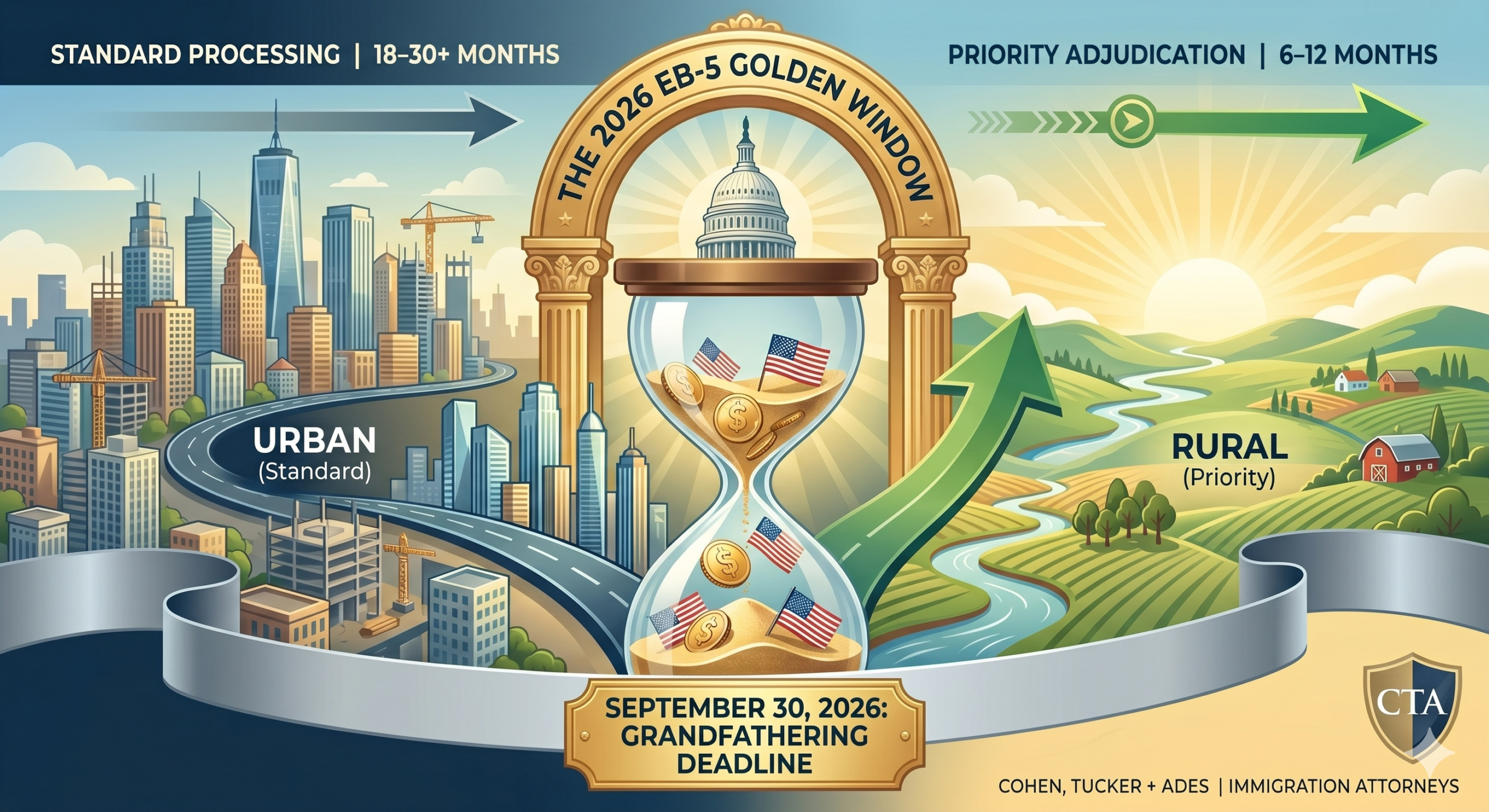
| Processing Speed | Priority Adjudication (6–12 months) | Standard Adjudication (18–30+ months) |
| Best For | Families facing “Age-Out” or backlogs. | Investors seeking established markets. |
Under the Reform and Integrity Act (RIA), Rural projects aren’t just a different category—they are a different speed class. USCIS is statutorily mandated to provide Priority Processing for Rural petitions.
The Reality of 2026: While standard urban petitions may take 2–3 years for I-526E approval, our team at Cohen, Tucker + Ades is seeing Rural approvals in record time, sometimes in under 10 months.
The “Age-Out” Shield: For investors with children near age 21, every month matters. Rural priority processing is the most effective tool to freeze a child’s age under the Child Status Protection Act (CSPA) before they “age out” of your application.
Backlog Bypass: For investors from China or India, the 20% Rural set-aside remains “Current” on the 2026 Visa Bulletin, meaning you bypass decade-long waits.
Urban Targeted Employment Areas (TEAs) are typically located in metropolitan areas with high unemployment rates.
Market Familiarity: Many investors feel more comfortable with a high-rise in Miami or a mixed-use development in New York City than a resort in a rural mountain town.
Exit Strategy: Urban projects often have more diverse refinancing options or secondary markets, which can be an important factor for your eventual capital return.
The Trade-off: While the $800,000 investment remains the same, you trade the “Priority Processing” of a rural project for the perceived stability of a metropolitan market.
Whether you choose the speed of Rural or the familiarity of Urban, the “Targeted Employment Area” designation is only half the battle. The project must still create 10 full-time American jobs to secure your permanent Green Card (I-829).
At Cohen, Tucker + Ades, we assist you in evaluating:
TEA Qualification: Ensuring the project’s location data is ironclad so your $800,000 investment isn’t rejected by USCIS.
Job Creation Buffers: We look for projects that aim to create more than 10 jobs per investor to protect your immigration status if economic conditions shift.
Regional Center Track Record: We vet the entities managing your capital to ensure they have successfully navigated the I-829 removal of conditions in the past.
While the EB-5 Regional Center program is technically authorized through September 2027, the Grandfathering Provision expires exactly one year earlier. Filing before this cutoff is the single most important step to “future-proof” your residency.
Statutory Protection: Under the 2022 Reform and Integrity Act (RIA), any petition filed on or before September 30, 2026, is legally “grandfathered.” This means even if Congress allows the program to lapse in 2027, USCIS is mandated by law to continue adjudicating your case.
Avoiding the “Lapse” Trap: Many investors remember the 2021 program lapse, where petitions were frozen in limbo for nine months. Grandfathering ensures that your family is never stuck in a legal “freeze” again, regardless of political shifts in Washington.
Locking in Today’s Rules: Filing now protects you from potential future changes, such as increased investment thresholds (inflation adjustments are expected by 2027) or stricter “Targeted Employment Area” (TEA) definitions.
Is a Rural project’s speed right for your family, or does an Urban project align better with your financial goals? Contact the CTA team for a personalized EB-5 strategy session.
Wendy R. Barlow, Esq.is a Partner at Cohen, Tucker + Ades, P.C. with nearly 20 years of experience in high-stakes immigration litigation. A graduate of the Maurice A. Deane School of Law at Hofstra University, Wendy is admitted to practice in New York and New Jersey as well as before the U.S. Supreme Court and multiple Federal Circuit Courts. Wendy is recognized for her ability to handle cases that many consider insurmountable.
Disclaimer: This blog post contains general information and is for informational purposes only. It is not legal advice and does not create an attorney-client relationship between you and Cohen, Tucker + Ades P.C. Immigration laws and fee schedules are subject to frequent change. The information provided herein may not reflect the most current legal developments. You should not act or refrain from acting based on information contained in this post without seeking professional counsel from an attorney licensed in your jurisdiction. Cohen, Tucker + Ades P.C. expressly disclaims all liability in respect to actions taken or not taken based on any or all of the contents of this post.
Sources:
U.S. Congress, EB-5 Reform and Integrity Act of 2022
USCIS, EB-5 Questions and Answers: EB-5 Reform and Integrity Act of 2022 (updated April 2022)