Immigration Law Blog
Stay up-to-date on the latest immigration law news, with the Cohen, Tucker & Ades team's insights behind the headlines

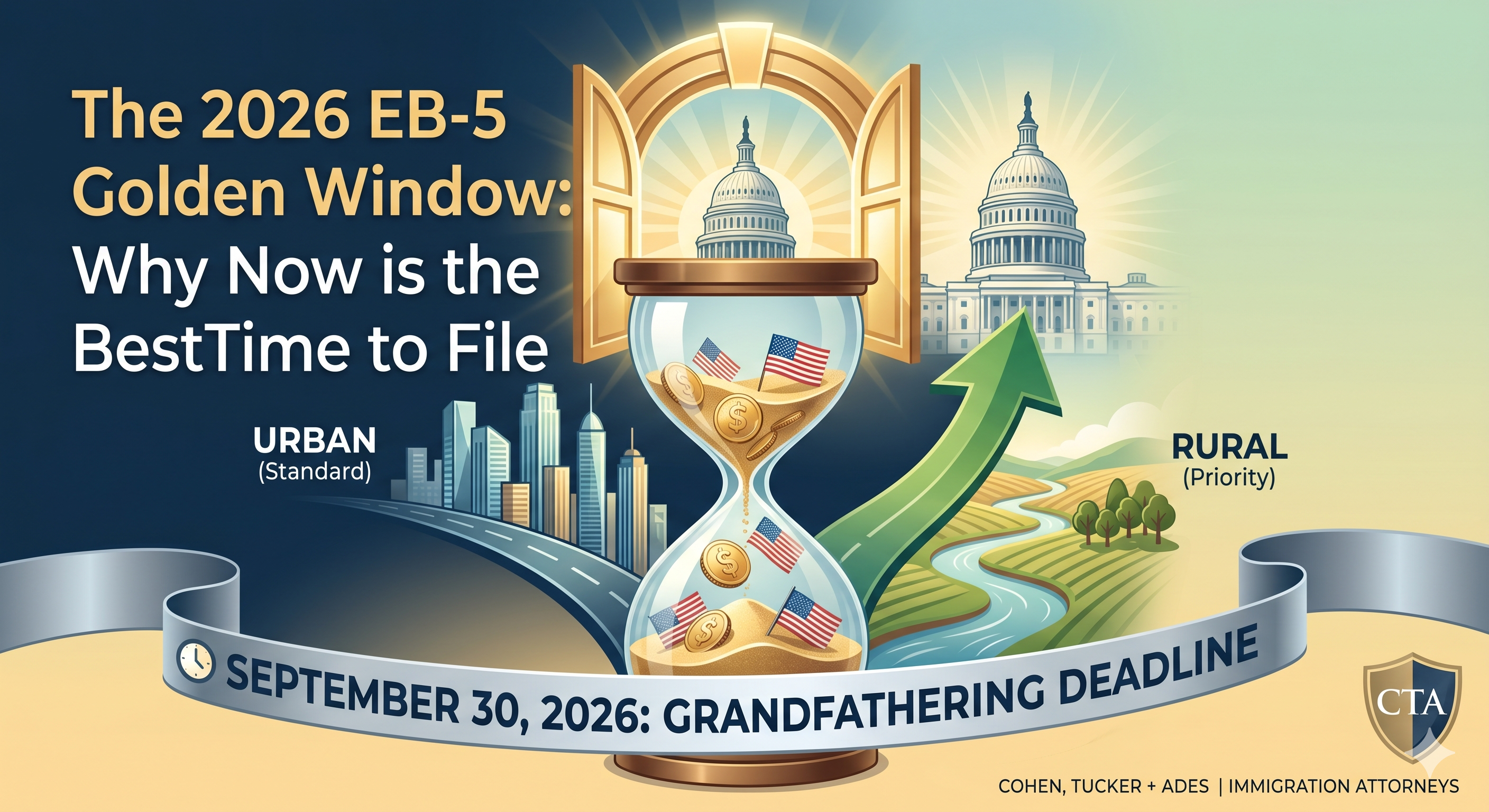
Many prospective investors ask, “Why the rush?” The reality of the 2026 EB-5 landscape is that three separate timelines are converging. Waiting until 2027 could mean paying more for less protection.
Under the Reform and Integrity Act (RIA), EB-5 investment amounts are tied to inflation and scheduled for a mandatory adjustment every five years.
Current Rate: $800,000 (TEA/Rural) or $1,050,000 (Non-TEA).
Projected 2027 Rate: Due to cumulative inflation from 2022–2027, the minimum is expected to jump to $900,000–$950,000 for Targeted Employment Areas (TEAs) and while the minimum investmenr for non-TEA projects may rise to over $1.2 million.
By filing in 2026, you lock in the lower entry point, effectively saving your family nearly a quarter-million dollars in capital commitment.
This is the most critical legal date in a decade. The RIA includes a provision that “grandfathers” any petition filed on or before September 30, 2026.
The Benefit: If you file by this date, your petition must be adjudicated by USCIS even if Congress fails to reauthorize the Regional Center program in the future.
The Risk: Those who file after this date are exposed to “legislative whiplash”—if the program lapses, your money and your application could be frozen indefinitely.
The 2026 “Golden Window” isn’t just about avoiding risks; it’s about seizing new speed records.
If you invest in a Rural TEA, you aren’t just in a different category; you’re in a different “lane.”
Rural Processing: 6–12 months for I-526E approval.
Urban/Standard Processing: 18–36+ months.
For families with children approaching age 21, Rural projects are the most effective tool to “freeze” a child’s age and prevent them from “aging out” of the application.
For those already in the U.S. on H-1B, L-1, or F-1 visas, you can file your I-485 (Adjustment of Status) simultaneously with your EB-5 petition.
Employment Authorization (EAD): Work for any employer (or yourself) without needing H-1B sponsorship.
Advance Parole (Travel Document): Travel internationally without needing a stamped visa from a consulate.
Navigating the 2026 landscape requires more than just a lawyer; it requires a navigator. At Cohen, Tucker + Ades, we provide:
Source of Funds Forensic Auditing: We identify potential “red flags” in your capital path before USCIS does.
Project Vetting: We analyze the job-creation models of Regional Centers to ensure your permanent Green Card (I-829) is secure.
High-Touch Service: You aren’t a case number; you are a family whose American Dream is in our hands.
What is the minimum EB-5 investment in 2026? $800,000 for Targeted Employment Areas (TEA) and $1,050,000 for non-TEA projects.
When is the next EB-5 deadline? September 30, 2026, is the deadline for statutory grandfathering protection.
How long does EB-5 take in 2026? Rural projects take 6–12 months for initial approval; urban projects take 18–36 months.
Ready to lock in your priority date before the September deadline? Schedule a Consultation with our EB-5 Experts Today.
Wendy R. Barlow, Esq.is a Partner at Cohen, Tucker + Ades, P.C. with nearly 20 years of experience in high-stakes immigration litigation. A graduate of the Maurice A. Deane School of Law at Hofstra University, Wendy is admitted to practice in New York and New Jersey as well as before the U.S. Supreme Court and multiple Federal Circuit Courts. Wendy is recognized for her ability to handle cases that many consider insurmountable.
Disclaimer: This blog post contains general information and is for informational purposes only. It is not legal advice and does not create an attorney-client relationship between you and Cohen, Tucker + Ades P.C. Immigration laws and fee schedules are subject to frequent change. The information provided herein may not reflect the most current legal developments. You should not act or refrain from acting based on information contained in this post without seeking professional counsel from an attorney licensed in your jurisdiction. Cohen, Tucker + Ades P.C. expressly disclaims all liability in respect to actions taken or not taken based on any or all of the contents of this post.
Sources:
U.S. Congress, EB-5 Reform and Integrity Act of 2022
USCIS, EB-5 Questions and Answers: EB-5 Reform and Integrity Act of 2022 (updated April 2022)