Immigration Law Blog
Stay up-to-date on the latest immigration law news, with the Cohen, Tucker & Ades team's insights behind the headlines

If you have received a Notice to Appear (NTA), your case is officially under the jurisdiction of the Executive Office for Immigration Review (EOIR)—the U.S. immigration court system. For many individuals facing removal proceedings, the court process can feel like a labyrinth.
One of the most vital concepts to understand early on is that immigration court does not happen all at once. Your case will be divided into two entirely different types of proceedings: Master Calendar Hearings (MCH) and Individual Calendar Hearings (ICH).
At Cohen, Tucker + Ades, we believe that demystifying these stages is the key to reducing anxiety and building a winning defense. Knowing what to expect at each stage ensures you do not inadvertently waive your rights or miss a critical deadline.
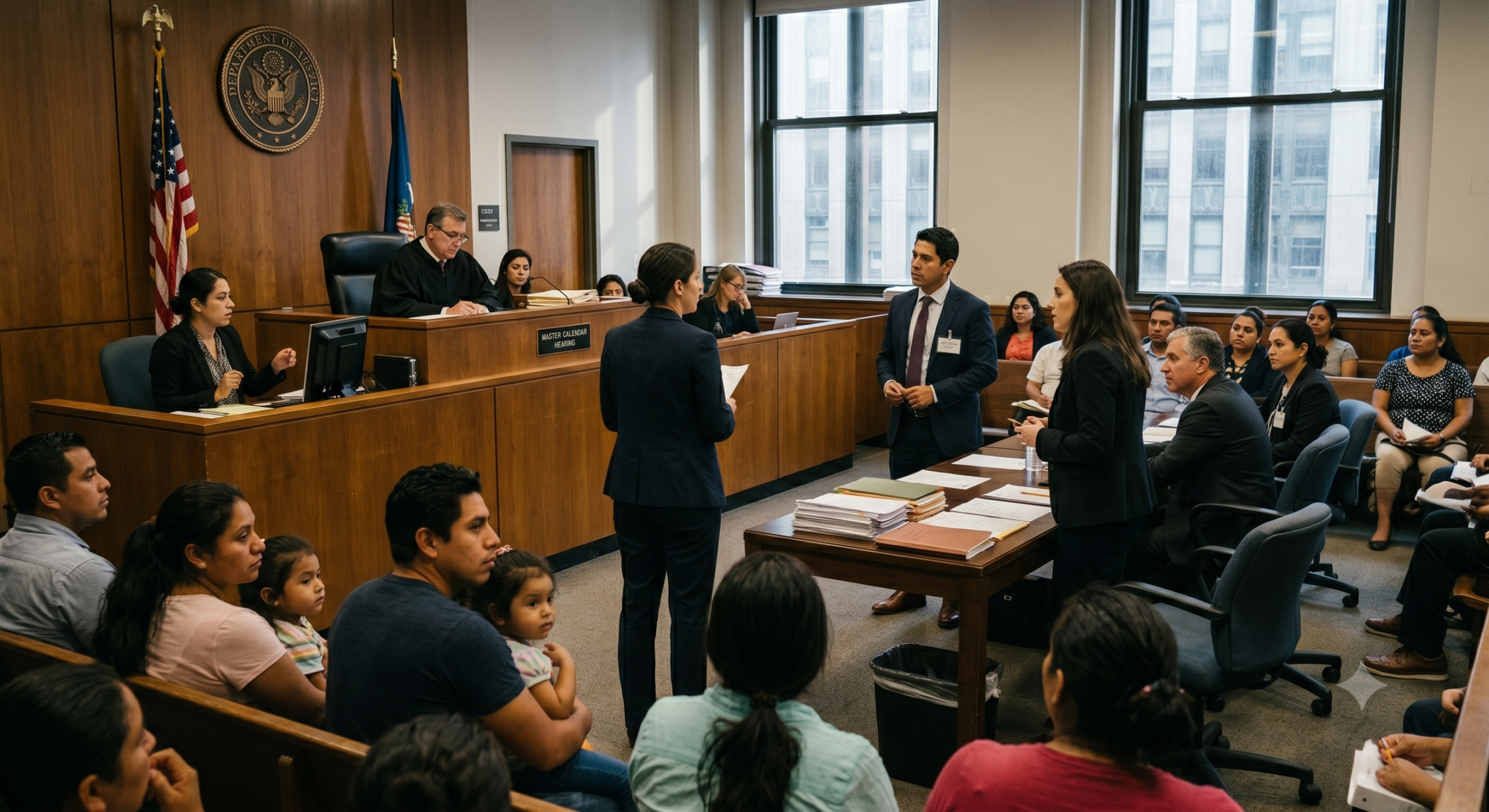
The Master Calendar Hearing is your very first appearance before an immigration judge. Think of it as a preliminary, administrative check-in. It is a public hearing where you, your attorney, and a Department of Homeland Security (DHS) trial attorney will sit in a courtroom alongside dozens of other respondents scheduled for the same time block.
An MCH is typically brief—often lasting just 10 to 15 minutes—but its procedural significance cannot be overstated. During this hearing, the court will:
Verify Personal Details: The judge will confirm your name, spoken language, and current address.
Take Pleadings: Your attorney will formally respond to the factual allegations and legal charges listed on your NTA, admitting or denying each line.
Designate a Country of Removal: The court will ask you to name the country you would be sent to if ordered deported (your attorney will usually decline to designate one to preserve tactical flexibility).
Identify Forms of Relief: Your defense team will state exactly how you intend to fight deportation (e.g., via asylum, cancellation of removal, or adjustment of status).
Set Strict Filing Deadlines: The judge will establish “call-up dates” by which all your substantive legal applications and initial evidence must be filed.
⚠️ Can you be deported at a Master Calendar Hearing?
Yes, under specific circumstances. While an MCH is procedural, a judge can issue a final order of removal at this stage if you fail to show up (resulting in an in absentia deportation order) or if you state that you have no defense and wish to accept voluntary departure or deportation. This is why attending with an experienced attorney is critical.
If the Master Calendar Hearing is the “pre-trial,” the Individual Calendar Hearing (also known as a Merits Hearing) is the actual trial. This hearing is private and entirely dedicated to your specific case.
There are no other respondents in the courtroom—just you, your legal team from Cohen, Tucker + Ades, the DHS prosecutor, the immigration judge, and a court interpreter.
An Individual Hearing can last several hours or even span multiple days. It is a high-stakes evidentiary trial where the judge decides whether to grant your application for legal status or order your removal.
Testimony Under Oath: You will take the stand to testify about your life, your history, and why you qualify for relief.
Witness Presentations: Your attorney can call family members, employers, medical professionals, or country-conditions experts to testify on your behalf.
Cross-Examination: The DHS attorney will cross-examine you and your witnesses, actively searching for discrepancies, omissions, or credibility flaws in your claim.
Closing Arguments: Both your defense attorney and the government attorney will deliver final statements summarizing why the law supports their respective positions.
The Decision: The judge will either issue an oral ruling immediately at the end of the hearing or take the case under advisement to send a written decision later.
To visualize how these two hearings differ, consider this breakdown:
| Feature | Master Calendar Hearing (MCH) | Individual Hearing (ICH) |
| Primary Purpose | Pleadings, scheduling, and setting strict deadlines | Full evidentiary trial on the merits of your defense |
| Duration | Very short (typically 5 to 15 minutes) | Extensive (several hours to multiple days) |
| Courtroom Environment | Public, crowded, fast-paced procedural docket | Private, formal, focused strictly on your case file |
| Role of Witnesses | None | Crucial (expert and lay witnesses provide testimony) |
| The Primary Goal | Securing time to prepare and safely scheduling the trial | Winning the case and securing legal residency or asylum |
Immigration courts heavily utilize hybrid models. Depending on your specific jurisdiction and the nature of your defense, hearings may be conducted in person, via Webex (video hearings), or occasionally by phone.
Furthermore, the Executive Office for Immigration Review (EOIR) maintains incredibly rigid filing guidelines. Under standard practice manual rules, represented individuals must submit all supporting trial evidence, witness lists, and certified translations at least 30 days in advance of an Individual Calendar Hearing. Missing this deadline by even 24 hours can result in your evidence being permanently excluded from the record.
The transition from a quick Master Calendar appearance to a high-stakes Individual trial requires meticulous preparation. Our litigation team protects your rights at both stages:
Strategic Pleadings: At the MCH, we aggressively screen the government’s charging documents for flaws, ensuring we don’t concede to incorrect facts that could damage your long-term eligibility for a green card or asylum.
Exhaustive Trial Preparation: Before you step foot into your Individual Hearing, we conduct comprehensive preparation sessions. We run through rigorous mock cross-examinations so you know exactly how to handle high-pressure questioning from government prosecutors.
Flawless Evidentiary Submission: We compile, index, and submit your documentation perfectly in line with court guidelines well before the 30-day deadline hits, ensuring your story is backed by undeniable proof.
Immigration laws are second only to the Internal Revenue Code in complexity. Trying to navigate these distinct court stages alone puts your future in the United States at risk.
Q: Do I have to attend the Master Calendar Hearing if I already hired an attorney? A: Yes, unless the court explicitly vacates the hearing due to a pre-filed motion, you must physically or virtually appear alongside your attorney. Failing to show up will result in an immediate deportation order.
Q: How much time passes between a Master Calendar Hearing and an Individual Hearing? A: It varies wildly depending on the court’s backlog. It can range from several months to a few years. Our firm utilizes this window to intensely investigate your case, gather evidence, and fortify your defense.
Q: What happens if the government files a “Motion to Pretermit” my case before the trial? A: This means the DHS prosecutor is arguing that you are legally ineligible for relief even if everything you say is true. If this happens, our firm will immediately file a formal legal response to defeat their motion and preserve your right to a full trial.
Facing an upcoming court date in removal proceedings? Contact Cohen, Tucker + Ades today to have a proven litigation team stand by your side.
Wendy R. Barlow, Esq.is a Partner at Cohen, Tucker + Ades, P.C. with nearly 20 years of experience in high-stakes immigration litigation. A graduate of the Maurice A. Deane School of Law at Hofstra University, Wendy is admitted to practice in New York and New Jersey as well as before the U.S. Supreme Court and multiple Federal Circuit Courts. Wendy is recognized for her ability to handle cases that many consider insurmountable.
Disclaimer: This blog post contains general information and is for informational purposes only. It is not legal advice and does not create an attorney-client relationship between you and Cohen, Tucker + Ades P.C. Immigration laws and fee schedules are subject to frequent change. The information provided herein may not reflect the most current legal developments. You should not act or refrain from acting based on information contained in this post without seeking professional counsel from an attorney licensed in your jurisdiction. Cohen, Tucker + Ades P.C. expressly disclaims all liability in respect to actions taken or not taken based on any or all of the contents of this post.