Immigration Law Blog
Stay up-to-date on the latest immigration law news, with the Cohen, Tucker & Ades team's insights behind the headlines

When prospective parents look at a child living in an overseas orphanage or foster care system, they see a son or daughter waiting for a family. However, U.S. Citizenship and Immigration Services (USCIS) looks at that same child through a highly rigid statutory lens.
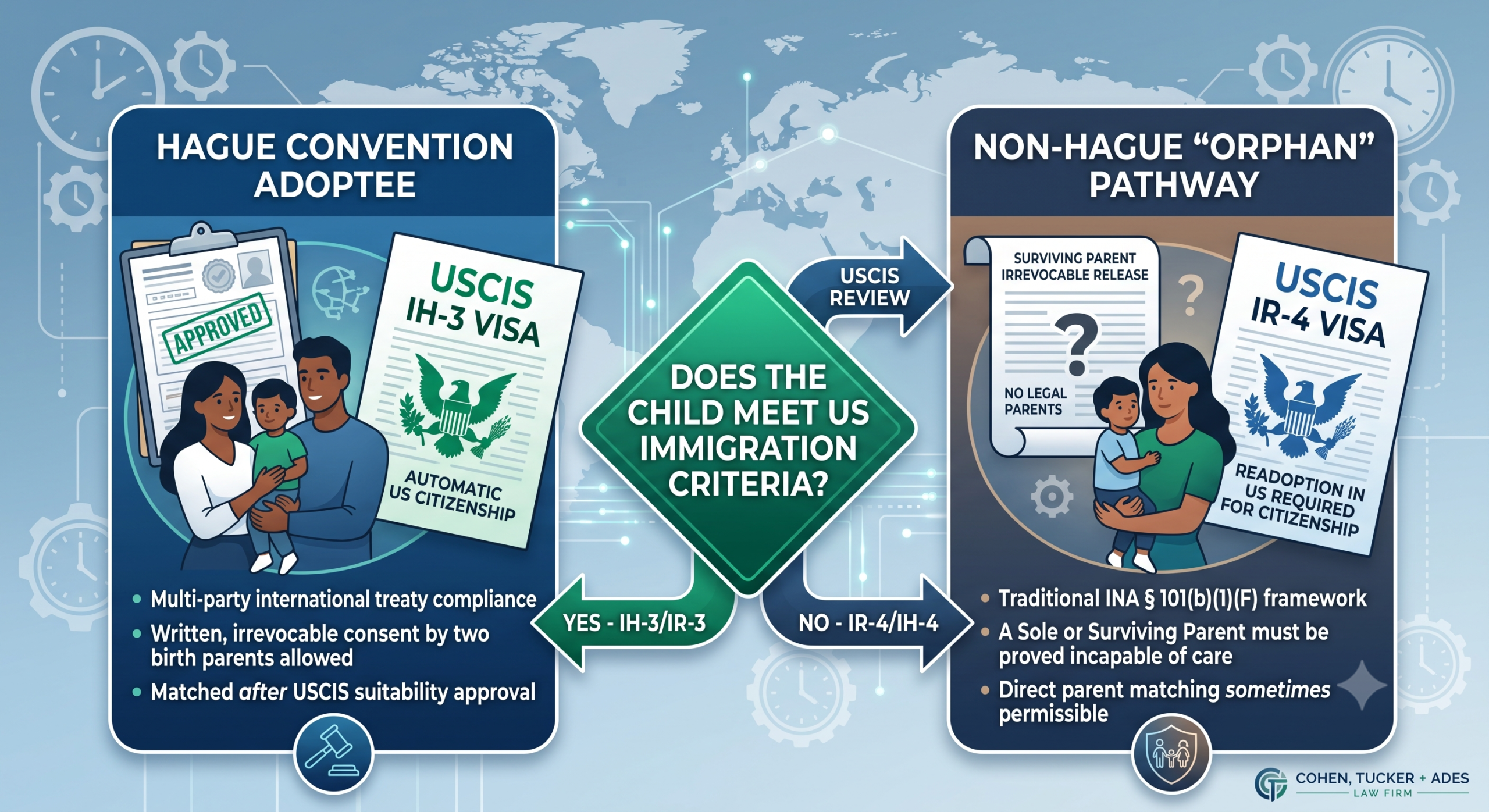
Under the Immigration and Nationality Act (INA), a child cannot simply be issued an immigrant visa because an adoption has taken place. The child must independently fit into one of two strict legal definitions defined by federal law: a Convention Adoptee or an Orphan.
Assuming a child automatically qualifies without verifying these definitions is one of the most common reasons families experience devastating visa denials at the end of their adoption journey. Here is how U.S. immigration law draws the line between these two critical classifications.
The stark divergence between an “orphan” and a “convention adoptee” stems from the Hague Convention on Protection of Children and Co-operation in Respect of Intercountry Adoption. Concluded in 1993, this multilateral international treaty was designed to establish uniform, ethical standards across international borders. Its primary objectives are to ensure that intercountry adoptions always serve the best interests of the child and to prevent severe abuses such as child trafficking, abduction, or illicit financial gain. For U.S. citizens, any adoption from a country that has ratified this treaty must strictly adhere to the central oversight rules of the convention. If a country has not signed or ratified the treaty, federal law defaults back to traditional, pre-treaty U.S. immigration frameworks.
If you are adopting from a Non-Hague Convention country (such as Nigeria or Jamaica), your child must meet the strict, traditional definition of an “orphan” under U.S. immigration law.
To satisfy USCIS, you must legally prove that the child has:
No legal parents due to death, disappearance, abandonment, desertion, permanent separation, or total loss; OR
A sole or surviving parent who is completely incapable of providing proper care according to the local standards of that country, and who has irrevocably released the child for emigration and adoption in writing.
The Orphan Trap: If a child is living with two birth parents who simply wish to place the child for adoption due to extreme financial hardship, the child does not qualify as an orphan under U.S. immigration law. In the orphan process, a child cannot have two living legal parents at the time of the petition.
If you are adopting from a Hague Convention country (such as Colombia, India, or the Philippines), the “orphan” definition does not apply. Instead, the child must qualify as a “Convention Adoptee”.
The Hague framework provides a slightly broader, more modern legal standard:
The child’s birth parents (or legal custodians) must have freely given their written, irrevocable consent to terminate their legal parental relationship.
Two living birth parents can legally consent to the adoption under this framework, provided the child is permanently relinquished to an authorized orphanage or institution.
If the birth parents release the child directly to you (a private adoption placement), you must still prove they are incapable of providing proper care due to extreme circumstances.
| Legal Requirement | Non-Hague “Orphan” Track | Hague “Convention Adoptee” Track |
| Statutory Authority | INA § 101(b)(1)(F) | INA § 101(b)(1)(G) |
| Can 2 Living Parents Consent? | No. (Unless there is permanent, total legal separation/loss) | Yes. (Through unconditional relinquishment to an authorized institution) |
| Age Limit at Filing | Must file before the child’s 16th birthday (18th birthday for birth siblings) | Must file before the child’s 16th birthday (18th birthday for birth siblings) |
| Central Authority Check | No. USCIS conducts an independent overseas investigation. | Yes. The foreign country’s Central Authority must officially declare the child eligible. |
Under the Non-Hague “Orphan” Track, the U.S. government does not just take foreign birth certificates or relinquishment decrees at face value. Before an immigrant visa is issued, an I-604 Report of Overseas Investigation is conducted by the local U.S. Embassy or USCIS field office.
This investigation actively verifies that the child’s legal background matches the paperwork submitted. If the investigation reveals that a birth parent is actually still in the picture, or that money was improperly exchanged to secure a relinquishment, the visa will be denied—even if a foreign court has already declared you the legal parents.
In Hague countries, the adoption process is overseen by central authorities and is designed to ensure protections earlier in the process. Therefore, a separate Form I-604 investigation is generally not required, as the legal sufficiency of the child’s eligibility for adoption is established through the processing of Form I-800.
The legal definitions of an “orphan” or a “convention adoptee” are entirely separate from local foreign adoption decrees. Navigating the rigid criteria of INA § 101(b)(1) requires absolute procedural precision long before you arrive at a U.S. Embassy for a visa interview. A single misstep can stall your adoption journey or completely block your child’s entry into the United States.
At Cohen, Tucker + Ades, we provide experienced, meticulous immigration counsel to ensure your family’s international adoption is fully compliant with federal frameworks from day one. Let us handle the complex federal bureaucracy so you can focus on welcoming your child home.
Schedule a Consultation with Our International Adoption Team Today.