Immigration Law Blog
Stay up-to-date on the latest immigration law news, with the Cohen, Tucker & Ades team's insights behind the headlines

For families growing through international adoption, the path to bringing a child home is paved with federal paperwork. Before you can request an immigrant visa for a specific child, you must first prove to the U.S. government that you are suitable, stable, and legally qualified to become an adoptive parent.
This critical first step is handled by U.S. Citizenship and Immigration Services (USCIS). However, families often stumble at the very first hurdle: determining whether they need to file Form I-800A or Form I-600A.
Filing the wrong form will result in immediate rejection, lost fees, and months of unnecessary delays. The correct application depends entirely on whether you are adopting from a Hague Convention country or a Non-Hague country.
The fundamental distinction between these two forms rests on international treaty law.
                          ┌───────────────────────────┐
                          │    International Route    │
                          └─────────────┬─────────────┘
                                        │
                 Is the country part of the Hague Convention?
                                        │
                    ┌───────────────────┴───────────────────┐
                   YES                                     NO
                    │                                       │
         ▼──────────▼──────────▼                 ▼──────────▼──────────▼
         │     FORM I-800A     │                 │     FORM I-600A     │
         │  (Hague Convention) │                 │ (Non-Hague Orphan)  │
         └─────────────────────┘                 └─────────────────────┘
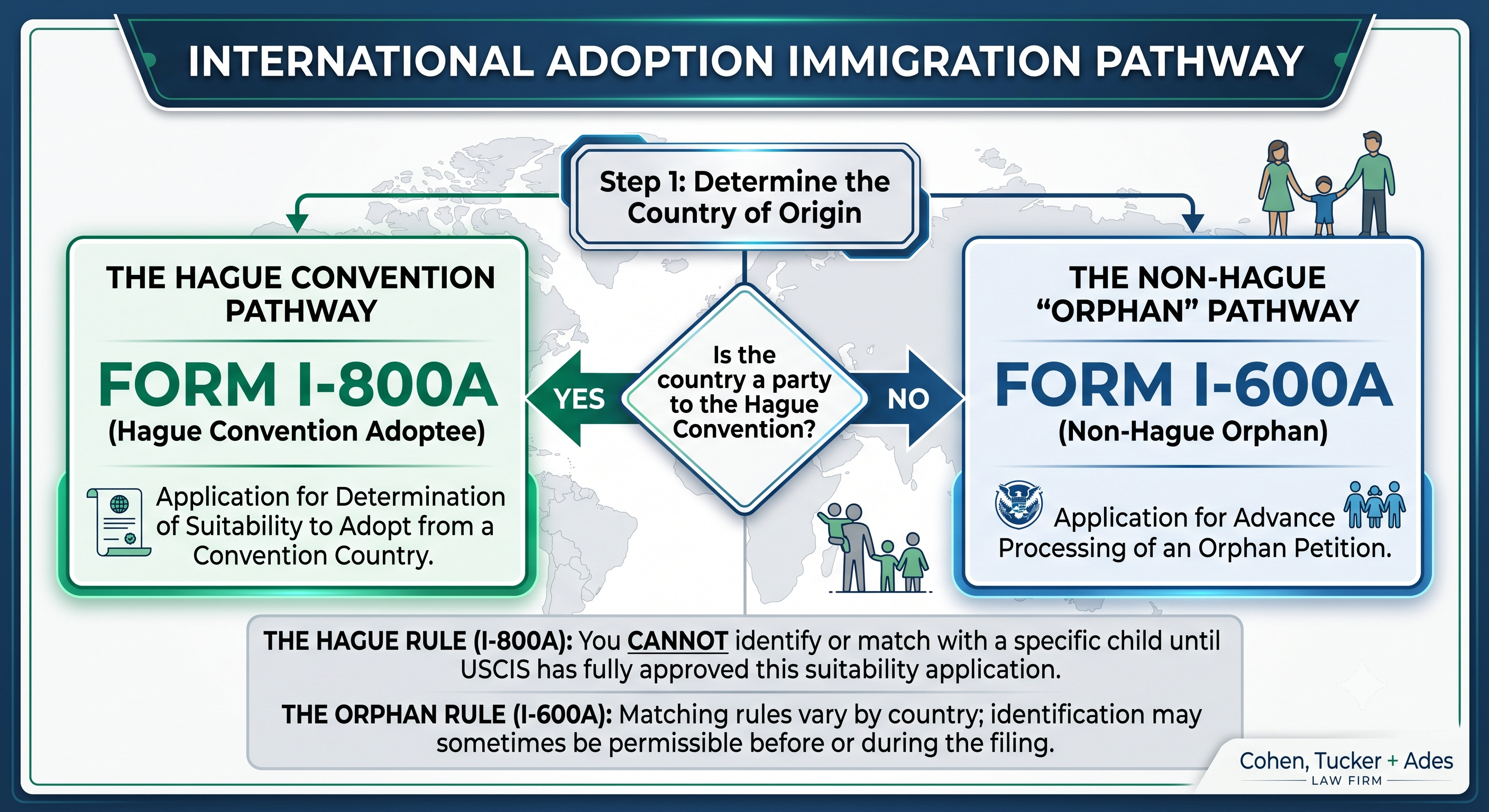
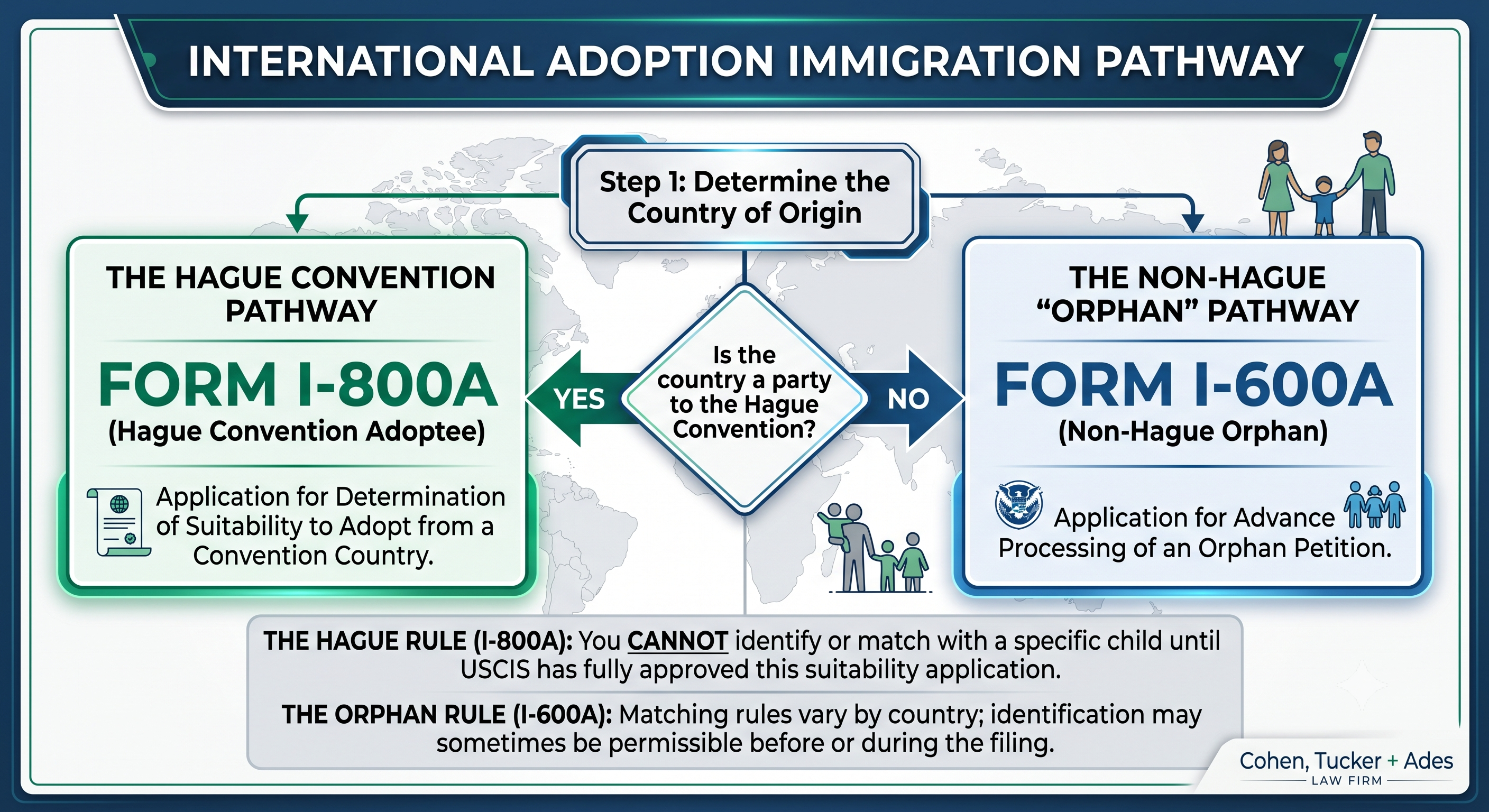
Purpose: Application for Determination of Suitability to Adopt a Child from a Convention Country.
When to use: You must file Form I-800A if you intend to adopt a child who habitually resides in a country that is a party to the Hague Adoption Convention (e.g., Colombia, India, South Korea).
The Golden Rule: Under the Hague process, you cannot identify, contact, or match with a specific child until USCIS has fully approved your Form I-800A and your primary adoption agency has approved your home study.
Purpose: Application for Advance Processing of an Orphan Petition.
When to use: You file Form I-600A if you are adopting from a country that has not ratified the Hague Convention (e.g., Nigeria, Jamaica, South Korea for certain non-Hague tracks).
The Key Distinction: This pathway utilizes the traditional U.S. legal framework for an “orphan” adoption. Unlike the Hague track, it is sometimes permissible to identify a specific child before or during the filing process.
| Legal Feature | Form I-800A (Hague) | Form I-600A (Non-Hague) |
| Target Country | Hague Convention Signatory | Non-Hague Signatory |
| Home Study Provider | Must be a Hague-accredited agency | Must meet Universal Accreditation Act (UAA) rules |
| Approval Validity | 15 months from the approval date | 15 months from the approval date |
| Matching Restraint | No matching allowed before approval | Matching rules vary by country |
| Concurrent Filing | Not allowed; suitability must come first | Allowed (can file I-600 suitability and petition together) |
Both Form I-800A and Form I-600A approvals expire exactly 15 months from the date USCIS issues the approval notice. Because international adoption timelines frequently stretch beyond a year, you must closely monitor this calendar.
Pro Tip: If your approval is nearing expiration and a child has not yet immigrated, you must file Supplement 3 (for either form) alongside an updated home study to request an extension. This must be submitted no earlier than 90 days before expiration, but before the actual expiration date.
USCIS frequently updates form editions, changing everything from biometrics tracking to background check data consistency. If you submit a version of the form that is even slightly outdated, USCIS will reject the entire packet. Always check the current accepted edition date on the USCIS website immediately before mailing.
Your home study is the backbone of your USCIS application. If your home study recommends you for a single child between the ages of 1 and 3, your Form I-800A or I-600A approval will specify those exact parameters. If you later intend to adopt a child outside of those parameters, or a sibling group, you must file an amended application with USCIS before proceeding.
The choice between the Hague and Non-Hague pathways dictates every legal step that follows, including the eventual immigrant visa type (IH-3/IH-4 vs. IR-3/IR-4). A mistake at this initial stage cascades through the entire process, risking administrative rejections at the exact moment you are preparing to bring your child home.
If you are beginning your international adoption journey and want to ensure your federal immigration strategy is legally sound from day one, contact the experienced team at Cohen, Tucker + Ades for an in-depth consultation.