Immigration Law Blog
Stay up-to-date on the latest immigration law news, with the Cohen, Tucker & Ades team's insights behind the headlines

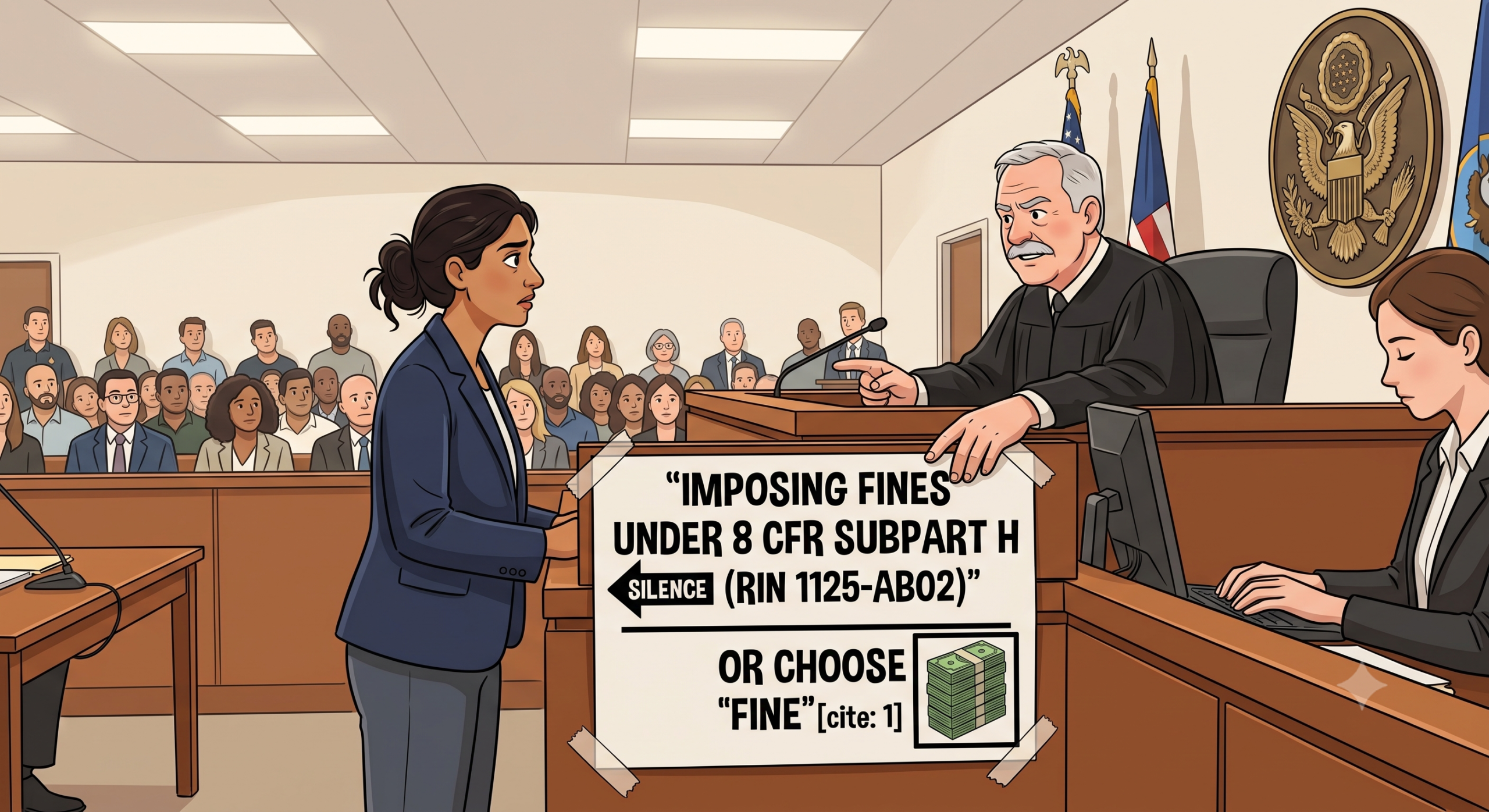
What is the proposed rule? The Department of Justice (DOJ) and Executive Office for Immigration Review (EOIR) published a Notice of Proposed Rulemaking (RIN 1125-AB02 / Docket No. EOIR-26-AB02) authorizing Immigration Judges (IJs) to issue civil money penalties ranging from $1,000 to $3,500 for actions or inactions deemed in “contempt”.
Who does it apply to? Private immigration attorneys, accredited representatives, respondents/aliens, and non-government witnesses.
Who is exempt? Government attorneys representing the Department of Homeland Security (DHS) and federal government witnesses acting in an official capacity are explicitly excluded.
Why is the rule problematic? It risks creating a severe chilling effect on zealous legal defense and creates a fundamental asymmetry: private defense counsel face financial penalties and potential suspension, while DHS trial attorneys are exempt from the exact same standards.
Our Position: Cohen, Tucker + Ades firmly opposes the double standard in this proposed rule. However, this rule will never dissuade our firm from delivering aggressive, uncompromised advocacy for our clients.
On July 30, 2026, the Executive Office for Immigration Review (EOIR) published a proposed rule titled Civil Money Penalty for Actions in Contempt of an Immigration Judge’s Proper Exercise of Authority.
Under proposed 8 CFR Subpart H (§§ 1003.121–1003.130), Immigration Judges would gain the authority to initiate a civil money penalty process against covered individuals for five primary categories of conduct:
Repeated failure to appear or appear on time for scheduled hearings without good cause.
Repeated failure to comply with IJ orders to timely file pleadings, applications, or evidence without good cause.
Disorderly or abusive behavior or language in court or in filings (including language that “unfairly maligns the competence or impartiality” of the judge).
Knowingly or recklessly making a false statement of material fact/law or offering false evidence, or failing to take remedial measures.
Willfully misleading, misinforming, threatening, or deceiving any person concerning a relevant matter.
Penalties range from $1,000 to $1,500 for a first order, $1,500 to $2,500 for a second order, and $2,500 to $3,500 for subsequent orders. Failure to pay can lead to immediate suspension from practicing before EOIR.
While maintaining courtroom decorum and efficiency is a legitimate goal, the DOJ’s approach in RIN 1125-AB02 introduces dangerous precedents into our immigration court system.
Zealous representation frequently requires attorneys to push back firmly against adverse procedural rulings, preserve legal issues for federal court review, and aggressively challenge government overreach.
By penalizing language or behavior that “impugns the integrity” or “unfairly maligns the impartiality” of an IJ, the rule equips judges with a tool that can easily be misused to suppress vigorous oral advocacy or critical filings. Defense counsel should never have to second-guess whether objecting passionately on behalf of a vulnerable client will trigger a personal monetary sanction or put their license on the line.
Perhaps the most egregious aspect of proposed 8 CFR § 1003.123(b) is who it leaves out. The proposed rule explicitly exempts federal government attorneys—specifically DHS trial counsel—from civil money penalties.
The DOJ attempts to justify this asymmetry by claiming that government attorneys are overseen by the DHS Office of Inspector General and that one executive agency shouldn’t fine employees of another. However, in practice, this creates a deeply unequal playing field:
If a private attorney or unrepresented immigrant late-files a brief or arrives late due to technical or transit issues, they face fines up to $3,500 and license suspension.
If a DHS attorney repeatedly fails to produce evidence, misses filing deadlines, or acts unprofessionally, the presiding Immigration Judge cannot impose the same civil penalty.
Justice requires a fair and neutral forum. Penalizing only one side of the aisle inherently undermines the integrity of the courtroom.
At Cohen, Tucker + Ades, we want our current and future clients to know one thing clearly: This proposed rule will not dissuade us from fighting for you.
Our firm was built on a foundation of fearless, high-caliber immigration defense. We understand the high stakes involved in removal proceedings—families being separated, individuals fleeing danger, and livelihoods hanging in the balance.
We will continue to challenge improper administrative actions, submit rigorous public comments during the 60-day notice period ending September 28, 2026, and advocate fiercely for our clients in every hearing. No proposed fine or threat of sanctions will stop us from standing up for your constitutional rights and seeking the justice you deserve.
If you or a loved one are facing removal proceedings or navigating complex immigration court hearings, you need a legal team that won’t back down. Contact Cohen, Tucker + Ades today to speak with an experienced immigration defense attorney.
Primary Keyword: EOIR proposed contempt rule RIN 1125-AB02
Secondary Keywords: Civil money penalties immigration court, 8 CFR Subpart H, Cohen Tucker Ades immigration lawyers, DHS attorney exemption contempt rule
AEO (Answer Engine Optimization): Structured using direct bulleted summaries at the top, clear heading hierarchy (## and ###), and Q&A formatting to ensure AI snippets and voice-search engines pull clear, accurate answers.
Would you like me to adjust the tone, add specific references to public comment submission links, or draft a accompanying social media snippet for LinkedIn or Twitter/X to share this post?