By Wendy R. Barlow, Esq. | Partner at Cohen, Tucker + Ades Specializing in Complex Immigration Matters
Selecting the right
EB-5 Regional Center project is one of the most critical decisions a foreign investor will ever make. While the EB-5 Reform and Integrity Act of 2022 (RIA) brought enhanced transparency and security to the program, the underlying financial and immigration risks remain high.
An investment of $800,000 (in a Targeted Employment Area) or $1,050,000 carries a dual burden: securing a green card and preserving capital.Navigating the ocean of private placement offerings can feel overwhelming. To protect your family’s immigration future and financial interests, evaluating a Regional Center requires rigorous, independent due diligence.
What Should You Look For in an EB-5 Regional Center?
Before examining specific projects, evaluate the Regional Center managing the offering. A strong Regional Center acts as a trustee of your immigration compliance and investment capital.
Key criteria include:
-
Track Record of Approvals: Look for a proven history of I-526E approvals and I-829 condition removals across multiple economic cycles.
-
Capital Repayment History: Confirm whether the Regional Center has a successful record of returning capital to investors upon loan maturity.
-
Active Status & RIA Compliance: Ensure the entity is fully compliant with USCIS Form I-956 requirements and Integrity Fund fee obligations.
-
Third-Party Fund Administration: Look for Regional Centers that utilize independent third-party fund managers or escrow agents to oversee capital deployment.
5 Major EB-5 Red Flags to Avoid
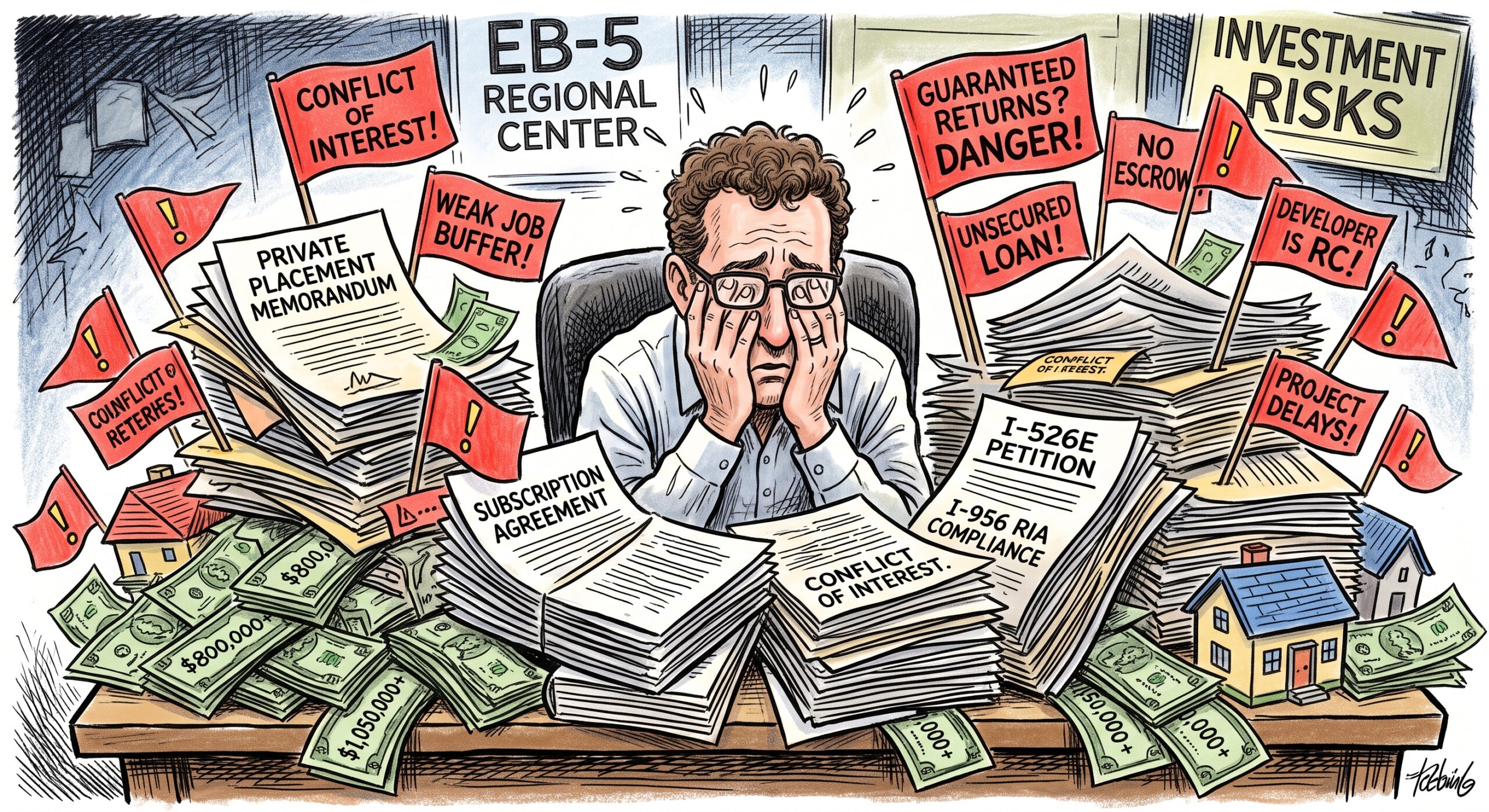
When reviewing a Private Placement Memorandum (PPM) or marketing materials, the presence of any of the following red flags should prompt immediate caution:
1. The Regional Center and Developer Are the Same Entity
The Risk: A severe conflict of interest.
If the Regional Center operator is also the project developer, there is no independent oversight. If the construction budget runs over or project delays occur, an independent Regional Center will step in, hold the developer accountable, or file legal action to protect investors. A self-dealing Regional Center rarely holds itself accountable.
2. Tight Job Creation Margins (Below a 20% Buffer)
The Risk: Failure to meet the mandatory 10-job requirement per investor.
USCIS requires that each EB-5 investment create at least 10 full-time jobs for U.S. workers. If a project’s economic model projects exactly 10 jobs per investor (or a negligible cushion like 10.2 jobs), any minor construction delay or cost adjustment could destroy your eligibility for permanent residency at the I-829 stage. Look for projects offering a 20% to 30%+ job cushion derived strictly from construction expenditures.
3. Reliance on Unfunded Senior Debt or Equity
The Risk: Capital stack failure and construction stalls.
EB-5 capital should ideally be the “last money in,” filling a small gap in a fully committed capital stack. If a project relies heavily on EB-5 funds to secure its primary bank financing or expects senior debt that isn’t yet committed, construction may stall—risking both your job creation requirements and your money.
4. Promises or Guarantees of Financial Return
The Risk: Instant USCIS denial.
Under federal regulations (8 CFR § 204.6(j)), all EB-5 capital must remain fully “at risk” throughout the conditional residency period. Any Regional Center offering a “guaranteed return,” buyback clause without conditions, or low-risk promise is violating USCIS rules. Guaranteeing a financial payout invalidates your petition.
5. Lack of Standard Escrow or Conditional Release Terms
The Risk: Mismanaged funds before petition approval.
Best-practice EB-5 projects hold capital in escrow until the investor’s Form I-526E is formally filed or approved, or they utilize strict early-release mechanisms tied to robust completion guarantees. Be wary of projects where capital is immediately released into an operating account without audit protections or third-party administration.
Regional Center vs. Direct EB-5: Quick Comparison
| Feature |
Regional Center Investment |
Direct EB-5 Investment |
| Job Creation Type |
Direct, Indirect, and Induced jobs |
Direct W-2 jobs only |
| Management Role |
Passive (Limited Partner) |
Active involvement |
| Capital Stack Structure |
Pooled funds, often structured as loans |
Equity in a single operating business |
| Best Suited For |
Investors prioritized on immigration certainty |
Hands-on entrepreneurs |
Frequently Asked Questions (FAQs)
What is the minimum investment for an EB-5 Regional Center project?
The current minimum investment amount is $800,000 for projects located in a Targeted Employment Area (TEA)—which includes high-unemployment or rural areas—or $1,050,000 for non-TEA projects.
Does USCIS approve the financial viability of Regional Center projects?
No. USCIS reviews projects solely for compliance with immigration law, job creation models, and capital sourcing regulations. USCIS designation is not an endorsement of a project’s safety, financial health, or return potential.
Why do I need an independent immigration attorney to review a Regional Center project?
Regional Centers provide their own legal counsel to draft project documents, but those attorneys represent the project, not you. An independent immigration attorney evaluates the PPM, subscription agreement, and source of funds to ensure your personal immigration goals are protected.
Protect Your Investment and Your Green Card
Due diligence on an EB-5 Regional Center requires evaluating both immigration law compliance and financial structure. Before committing your capital, consult with an experienced immigration legal team.
At Cohen, Tucker + Ades, P.C., we have guided foreign investors through complex employment-based and investment immigration matters for decades.