By Wendy R. Barlow, Esq. | Partner at Cohen, Tucker + Ades Specializing in Complex Immigration Matters
📌 Executive Summary (TL;DR)
-
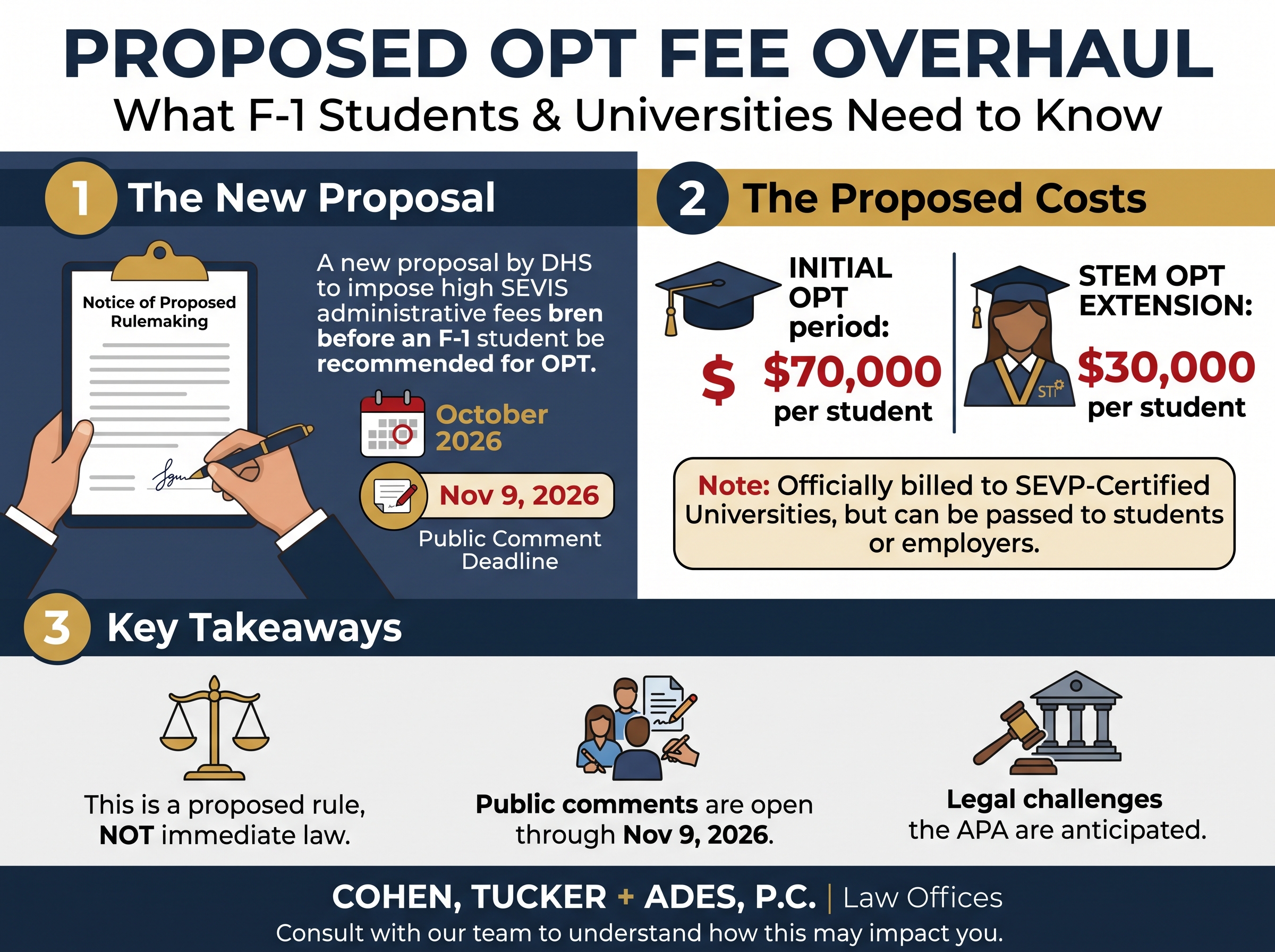
The Proposal: On October 8, 2026, the Department of Homeland Security (DHS) published a Notice of Proposed Rule-making (NPRM) that would require a $70,000 fee for initial Optional Practical Training (OPT) recommendations and a $30,000 fee for subsequent OPT periods (including STEM OPT extensions).
-
Who Pays? SEVP-certified universities are designated as the paying party before entering recommendations into SEVIS, but DHS explicitly permits schools to pass these costs onto international students or hiring employers.
-
Current Status: This is a proposed rule, NOT immediate law. Public comments are open through November 9, 2026. Legal challenges under the Administrative Procedure Act (APA) are expected if the rule is finalized.
-
What You Should Do: Current F-1 students, university designated school officials (DSOs), and corporate legal teams should assess upcoming OPT timelines and consult an experienced immigration attorney.
What is the New DHS Proposal to Charge for OPT?
The U.S. Department of Homeland Security (DHS) has officially published a proposed regulation aimed at overhauling the financial structure of the Optional Practical Training (OPT) program.
Under the proposed rule, universities certified by the Student and Exchange Visitor Program (SEVP) would be required to pay substantial administrative fees before a Designated School Official (DSO) can endorse an F-1 student’s OPT recommendation in the SEVIS database:
-
Initial OPT Period: A proposed $70,000 fee per student recommendation.
-
Subsequent OPT/STEM OPT Extension: A proposed $30,000 fee for each extension.
DHS cites anti-fraud measures and program integrity as the rationale behind the fee structure, asserting that the financial barrier will deter universities from endorsing unqualified candidates. However, higher education institutions, immigration advocates, and industry leaders warn that these drastic fees could severely disrupt the U.S. higher education pipeline and skilled workforce.
Breakdown of the Proposed OPT Fee Structure
| Category |
Proposed Fee |
Primary Responsible Party |
Fee Shift Allowed? |
| Initial OPT Endorsement |
$70,000 |
SEVP-Certified University |
Yes (Can be billed to student or employer) |
| STEM OPT Extension |
$30,000 |
SEVP-Certified University |
Yes (Can be billed to student or employer) |
| Total Full Cycle (OPT + STEM) |
$100,000 |
SEVP-Certified University |
Yes (Can be billed to student or employer) |
(Note: Standard USCIS Form I-765 filing fees still apply separately.)
Key Questions Answered
Can universities shift the $70,000 OPT fee to international students?
Yes. While the regulation places the legal obligation on SEVP-certified institutions to make the payment prior to issuing a SEVIS recommendation, the proposal explicitly notes that universities may mitigate their budgetary exposure by passing the cost on to international students or their future employers.
Is the $70,000 OPT fee in effect right now?
No. The proposed rule is currently in the public notice-and-comment period, which runs through November 9, 2026. No fee will take effect until DHS reviews public feedback, drafts a final rule, and sets an effective implementation date (typically 60 days after final publication).
What happens if an OPT application is denied?
According to the proposal, refund requests from institutions following an OPT denial will only be evaluated on a limited, case-by-case basis, with no right to administrative appeal.
What Impact Will This Have on F-1 Students, Universities, and Employers?
1. F-1 International Students
2. Higher Education Institutions
Universities face severe administrative and financial hurdles. Beyond potential drops in international enrollment—a major revenue driver—colleges risk significant legal exposure when navigating fee recovery from students or sponsoring employers.
3. Corporate Employers & STEM Recruiters
U.S. businesses relying on the 24-month STEM OPT extension to fill critical talent gaps in technology, engineering, and healthcare will face heightened recruiting overhead if expected to absorb these costs.
Legal Analysis & Expected Challenges
Because this proposal represents a unprecedented change in immigration policy, it is widely anticipated to face strong federal litigation under the Administrative Procedure Act (APA).
Key legal vulnerabilities that may be raised in federal court include:
-
Arbitrary and Capricious Fee Assessment: Questions regarding whether the $70,000 and $30,000 amounts bear a reasonable nexus to the actual administrative cost of running the SEVIS program.
-
Ultra Vires Claims: Whether DHS exceeds its statutory authority under the Immigration and Nationality Act (INA) by imposing exorbitant fees that effectively eliminate statutory nonimmigrant programs.
-
Procedural and Regulatory Flaws: Brief 30-day public comment windows often invite legal challenges alleging insufficient time for meaningful public participation.
Recommended Action Steps
-
Submit Public Comments: Universities, trade associations, employers, and individuals have until
November 9, 2026, to
submit formal public feedback. Submitting detailed, data-backed comments creates the administrative record necessary for future federal court challenges.
-
Review Upcoming OPT Eligibility: F-1 students near graduation should coordinate with their DSOs immediately to file OPT recommendations prior to any potential rule finalization.
-
Explore Alternative Visa Pathways: Employers should work with immigration counsel to evaluate alternative work visa options (such as early H-1B cap filings, O-1, or TN visas) to safeguard their workforce.
How Cohen, Tucker + Ades PC Can Help
Since 1964, Cohen, Tucker + Ades PC has been at the forefront of federal immigration litigation, corporate compliance, and visa defense. Whether you are a university navigating SEVP compliance, an employer seeking to secure your international talent pipeline, or an F-1 student facing status uncertainty, our experienced team is here to guide you.
-
Federal Litigation & Administrative Defense: Challenging improper agency actions and defending visa holders.
-
Corporate Immigration Counsel: Strategic employment-based visa planning and risk management.
-
Student & SEVP Compliance: Protecting institutional standing and international student status.