Immigration Law Blog
Stay up-to-date on the latest immigration law news, with the Cohen, Tucker & Ades team's insights behind the headlines

The moment you step off the plane with your child on U.S. soil is one of the most profound milestones of your life. However, while the journey home is a time for celebration, the legal process is not yet fully complete.
The exact path to securing your child’s legal U.S. citizenship is determined by the specific code stamped on their immigrant visa.
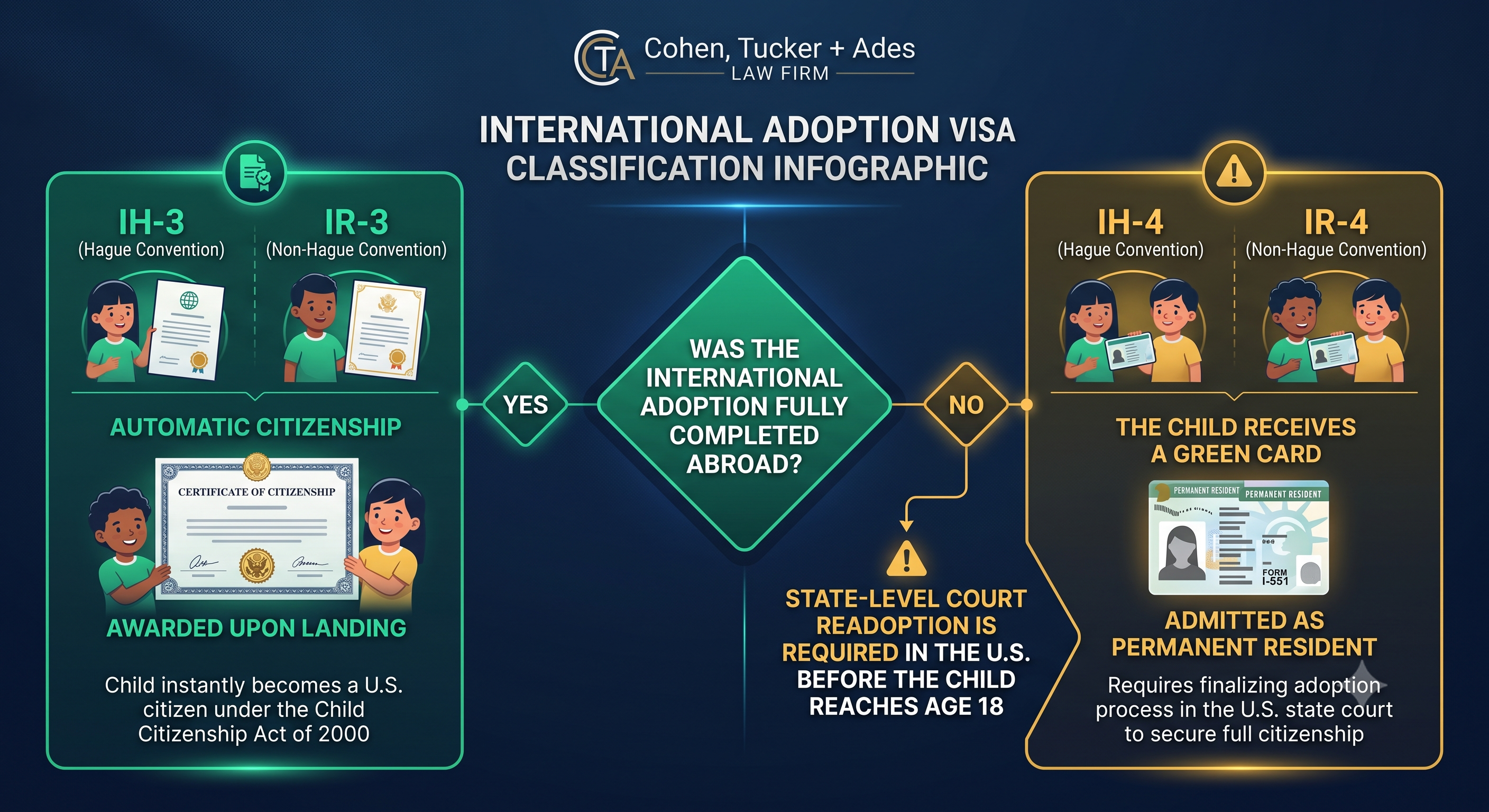
The U.S. government issues one of four distinct visa types to internationally adopted children: IH-3, IH-4, IR-3, or IR-4. Understanding which category your child falls into—and what steps you must take once you land—is vital to ensuring their status is legally protected under federal law.
The letter in your child’s visa code indicates the treaty pathway, while the number indicates whether the adoption was finalized overseas.
“IH” Visas: Issued to children adopted from countries party to the Hague Adoption Convention.
“IR” Visas: Issued to children adopted from Non-Hague countries.
                                  IMMIGRANT VISA CLASSIFICATION
                                 How Did the Adoption Conclude?
                                                │
                               Where was the adoption finalized?
                                                │
                     ┌──────────────────────────┴──────────────────────────┐
                ABROAD                                                   IN THE U.S.
  (Both parents present; fully final)                       (Proxy adoptions or custody transfer)
                     │                                                     │
           Is it a Hague Country?                                Is it a Hague Country?
                     │                                                     │
           ┌─────────┴─────────┐                                 ┌─────────┴─────────┐
          YES                  NO                               YES                  NO
           │                    │                                │                    │
     ▼─────▼─────▼        ▼─────▼─────▼                    ▼─────▼─────▼        ▼─────▼─────▼
     │   IH-3    │        │   IR-3    │                    │   IH-4    │        │   IR-4    │
     │ Automatic │        │ Automatic │                    │ Permanent │        │ Permanent │
     │Citizen on │        │Citizen on │                    │ Resident  │        │ Resident  │
     │  Landing  │        │  Landing  │                    │ (Green    │        │ (Green    │
     │           │        │           │                    │   Card)   │        │   Card)   │
     └───────────┘        └───────────┘                    └───────────┘        └───────────┘
If your child is issued an IH-3 or IR-3 visa, they are granted automatic U.S. citizenship the moment they clear customs at a U.S. port of entry.
The adoption must be fully recognized and legally finalized in the child’s country of origin.
For IR-3 Visas: If married, both prospective parents must have personally seen and observed the child prior to or during the foreign adoption proceedings.
Because citizenship is automatically acquired under the Child Citizenship Act of 2000, U.S. Citizenship and Immigration Services (USCIS) will typically mail a Certificate of Citizenship directly to your home address without requiring additional forms or processing fees.
If your child receives an IH-4 or IR-4 visa, they enter the United States as Lawful Permanent Residents (green card holders), not immediate citizens.
This visa classification is used when:
The foreign country only grants guardianship or legal custody rather than a full, final adoption decree.
Only one spouse of a married couple traveled to meet the child before the final foreign decree.
The parents did not physically meet the child prior to or during the legal process (sometimes referred to as proxy adoptions).
To secure automatic U.S. citizenship for an IH-4 or IR-4 visa holder, you must legally readopt or finalize the adoption in your home state’s court system.
⚠️ The Age 18 Deadline: This state-level court finalization must be completed before the child turns 18 years old. If you miss this window, your child will not benefit from automatic citizenship and must undergo the lengthy, complex, and expensive adult naturalization process.
Once the U.S. court issues the final decree, you must proactively file Form N-600 (Application for Certificate of Citizenship) with USCIS to obtain official proof of their citizenship.
| Visa Code | Country Type | Automatic Citizenship on Arrival? | Action Required in the U.S.? | Proof of Status Received |
| IH-3 | Hague | Yes | None (though state registration is recommended) | Certificate of Citizenship |
| IR-3 | Non-Hague | Yes | None (though state registration is recommended) | Certificate of Citizenship |
| IH-4 | Hague | No (Permanent Resident on entry) | Must finalize/readopt in state court before age 18 | Green Card, then Certificate of Citizenship after U.S. finalization |
| IR-4 | Non-Hague | No (Permanent Resident on entry) | Must finalize/readopt in state court before age 18 | Green Card, then Certificate of Citizenship after U.S. finalization |
If your child entered on an IH-3 or IR-3 visa, a domestic readoption is not legally required to secure citizenship. However, most family law and immigration attorneys strongly recommend completing a recognition of foreign adoption (or “domestication”) in your home state.
By registering your foreign adoption in a U.S. state court, you secure:
A State Birth Certificate: Your state’s Department of Health will issue a Certificate of Foreign Birth. This is widely recognized by schools, DMV offices, and local government agencies.
Safe Record Keeping: If the original foreign adoption decree is lost or destroyed, foreign central registries are notoriously difficult or impossible to coordinate with. A U.S. state court record provides permanent, readily accessible legal proof.
Legal Name Changes: The state recognition process allows you to easily update your child’s legal name or change their surname to match yours directly on their new birth certificate.
Welcoming your child home is the beginning of a beautiful journey, but ensuring their immigration file is securely closed is paramount to their future. Whether you need to navigate a state-level readoption for an IR-4/IH-4 visa, file Form N-600 to secure physical proof of citizenship, or register an overseas adoption decree, the experienced team at Cohen, Tucker + Ades is here to guide you through the final miles of your journey.
Schedule a Consultation to Finalize Your Child’s U.S. Citizenship Pathway