Immigration Law Blog
Stay up-to-date on the latest immigration law news, with the Cohen, Tucker & Ades team's insights behind the headlines

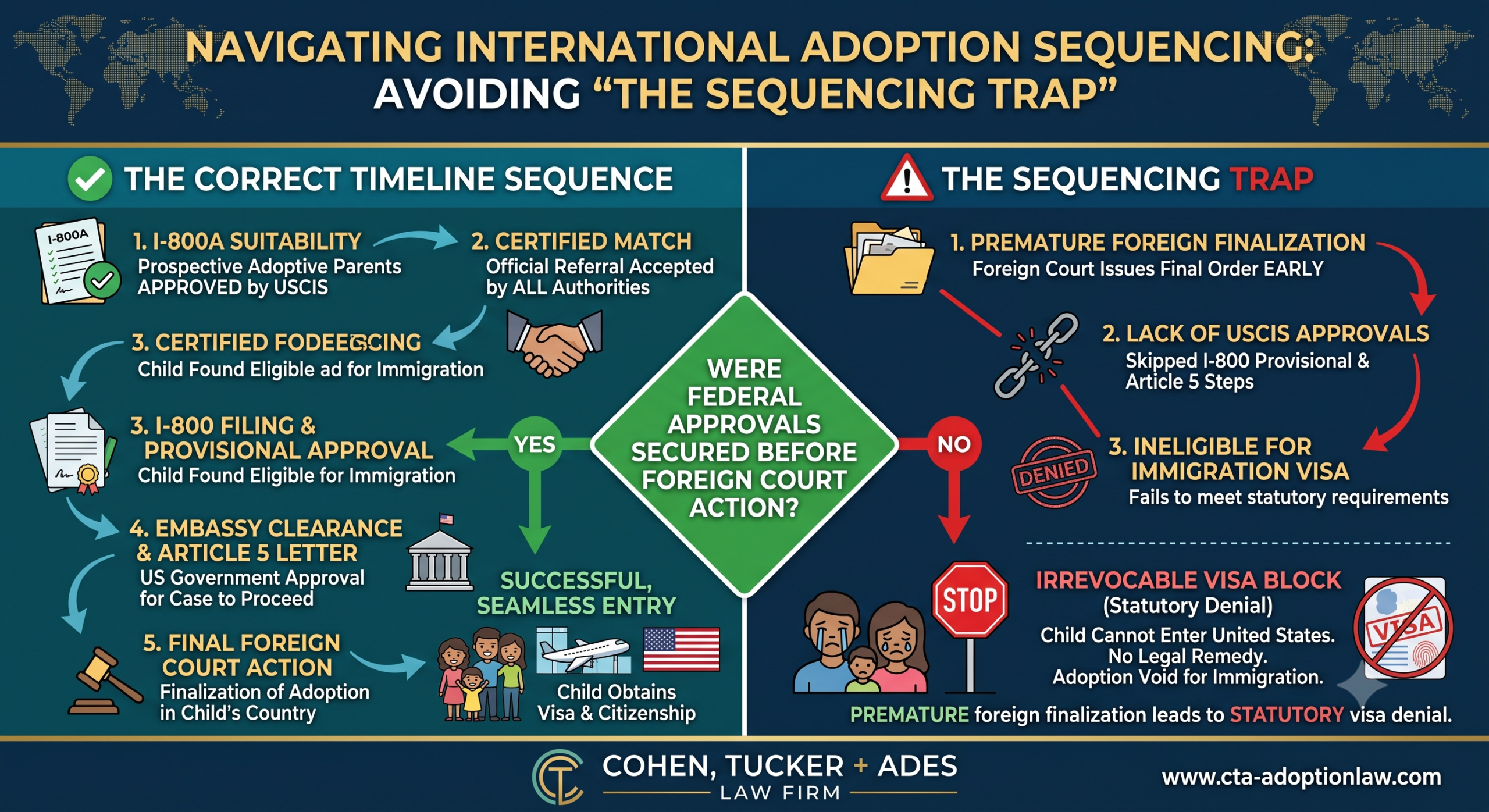
For many families pursuing international adoption, the emotional drive to secure a child’s safety can lead to critical, well-intentioned procedural mistakes. The most common—and devastating—of these errors is finalizing the adoption in a foreign country before securing the explicit permission of the United States government.
Under federal immigration law, the order in which you complete your adoption milestones is strictly regulated. If you fall into “The Sequencing Trap,” you may discover that while you are the child’s legal parents under foreign law, the U.S. government will refuse to issue an immigrant visa to bring your child home.
Here is how the strict required sequence of events protects your timeline and prevents irreversible visa blocks.
For adoptions originating in countries that are party to the Hague Adoption Convention (such as Colombia, India, or the Philippines), federal law dictates an absolute, inflexible order of operations.
The required sequence must proceed as follows:
  STEP 1: File Form I-800A & Obtain USCIS Suitability Approval
                            │
                            ▼
  STEP 2: Receive and Review a Certified Child Match/Referral
                            │
                            ▼
  STEP 3: File Form I-800 (The Child’s Initial Immigration Petition)
                            │
                            ▼
  STEP 4: Secure Article 5/15 Letter (U.S. Embassy Approves the Match)
                            │
                            ▼
  STEP 5: Finalize the Adoption or Custody in the Foreign Court
If a prospective family travels to a Hague Convention nation and finalizes an adoption or obtains legal custody of a child before completing Step 4, the U.S. government cannot legally approve the subsequent Form I-800 petition. The Central Authority of the target nation will also be unable to issue the mandatory Hague documentation.
This creates an agonizing legal limbo: you are legally bound to a child abroad, but that child is barred from entering the United States.
When adopting from a non-Hague country (such as Nigeria or Jamaica), the rules are managed under the traditional “Orphan” legal framework. While concurrent tracking is occasionally permissible, families face strict legal thresholds that are heavily audited.
The Eligibility Gap: Unlike the Hague track, where central authorities verify a child’s eligibility early in the timeline, the non-Hague track heavily relies on the I-604 Report of Overseas Investigation.
The Investigatory Risk: This mandatory verification is executed by local U.S. Embassy consular officers after the adoption is finalized and the Form I-600 is processed.
The Hurdle: If the investigation uncovers that the biological parents are alive and did not legally relinquish their rights under the strict federal definition of “abandonment,” the U.S. visa will be denied—even if a foreign court has already issued a valid, binding local adoption decree.
| Procedural Roadblock | Hague Track (Form I-800) | Non-Hague Track (Form I-600) |
| Premature Court Action | Fatal. Results in statutory visa denial that cannot be waived. | Risky. Valid locally, but entirely subject to the subsequent I-604 audit. |
| Pre-Approval Matching | Prohibited. Families cannot identify a child prior to full I-800A approval. | Permissible. Specific child identification is allowed earlier in the advance phase. |
| The Safety Valve | Article 5/15 clearance guarantees the U.S. will issue the visa post-court. | No pre-court guarantee; visa issuance hinges entirely on embassy review. |
The U.S. Supreme Court has famously noted that immigration laws are exceptionally complex. When managing an international adoption, you are forced to synthesize foreign family court processes, sovereign treaty guidelines, and rigid federal regulations simultaneously.
A mistake in sequencing is often impossible to cure retroactively. To protect your family’s future, every step taken in a foreign country must be synchronized with your concurrent immigration tracking in the United States.
Don’t let procedural formatting errors or premature court filings disrupt your international adoption journey. At Cohen, Tucker + Ades, we evaluate your timeline, ensure full compliance with the appropriate Hague or non-Hague sequence, and interface directly with federal agencies to pave a clear, legally secure path home for your child.
Consult with our New York-based International Adoption Attorneys Today.