Immigration Law Blog
Stay up-to-date on the latest immigration law news, with the Cohen, Tucker & Ades team's insights behind the headlines

From Investor to Citizen: Navigating the EB-5 Lifecycle and the 5-Year Naturalization Path
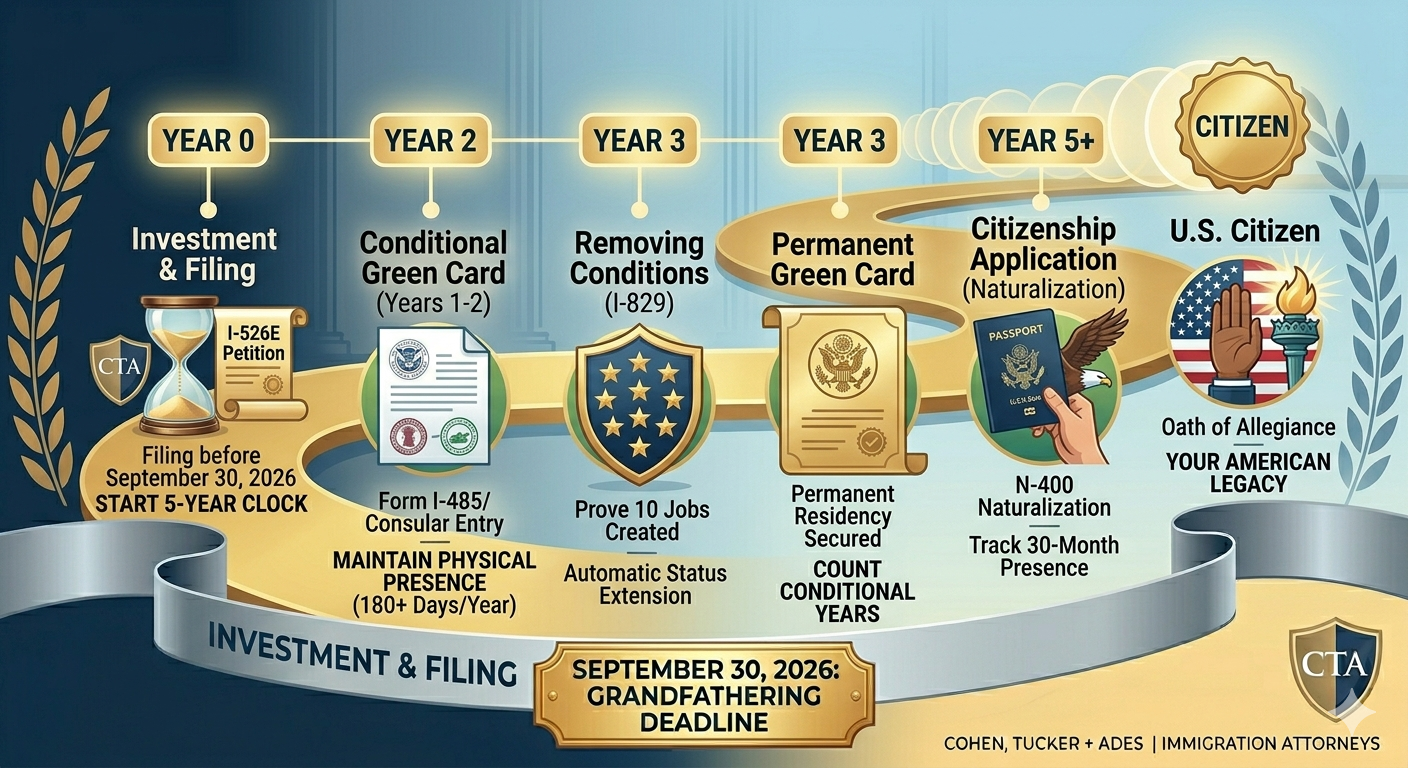
How long does it take to become a U.S. Citizen via EB-5? Typically, the journey takes 5 to 7 years. After your initial I-526E approval, you receive a 2-year “Conditional” Green Card. In 2026, you can apply for U.S. Citizenship (Naturalization) exactly 5 years from the date your initial conditional residency began, provided you have maintained physical presence and the “conditions” on your residency were removed via Form I-829.
Once your I-526E is approved and you adjust status (or enter via a consulate), you are a Conditional Permanent Resident.
Rights: You have almost all the rights of a citizen, including the right to work and live anywhere.
The “At-Risk” Requirement: In 2026, USCIS strictly monitors that your capital remains “at risk” and actively deployed in the project during these two years.
Travel Warning: To maintain residency, you should avoid being outside the U.S. for more than 180 days per year without a Re-entry Permit.
Ninety days before your 2-year card expires, Cohen, Tucker + Ades will file your Form I-829.
Goal: To prove the 10 promised jobs were actually created.
2026 Processing: Because I-829 processing can take 20+ months, USCIS currently issues receipt notices that automatically extend your status for 48 months, ensuring you stay legal even if the government is slow to adjudicate.
One of the biggest misconceptions in 2026 is that the 5-year “clock” for citizenship starts over when you get your permanent card. It does not.
The “Start” Date: Your 5-year requirement for citizenship actually includes the 2 years you spent as a conditional resident.
Physical Presence: You must have been physically present in the U.S. for at least 30 months out of the 60 months leading up to your application.
The CTA Advantage: We help you track your travel days and residency requirements from Day 1, so your citizenship application is a “rubber stamp” rather than a struggle.
The Grandfathering Deadline we have discussed throughout this series is what makes this entire 5-year lifecycle possible.
Protecting the Lifecycle: Filing by September 30, 2026, ensures that your path from I-526E to I-829 to Citizenship is protected by law. Even if the Regional Center program changes in 2027, your specific journey is “locked in” under today’s favorable rules.
EB-5 is more than an investment; it’s a legacy. Whether it’s access to in-state tuition for your children or the security of a U.S. passport, Cohen, Tucker + Ades is here to guide you through every year of the process—not just the first one.
Call to Action (CTA):
Ready to start your 5-year clock? Schedule a consultation to build your long-term immigration roadmap.
Wendy R. Barlow, Esq.is a Partner at Cohen, Tucker + Ades, P.C. with nearly 20 years of experience in high-stakes immigration litigation. A graduate of the Maurice A. Deane School of Law at Hofstra University, Wendy is admitted to practice in New York and New Jersey as well as before the U.S. Supreme Court and multiple Federal Circuit Courts. Wendy is recognized for her ability to handle cases that many consider insurmountable.
Disclaimer: This blog post contains general information and is for informational purposes only. It is not legal advice and does not create an attorney-client relationship between you and Cohen, Tucker + Ades P.C. Immigration laws and fee schedules are subject to frequent change. The information provided herein may not reflect the most current legal developments. You should not act or refrain from acting based on information contained in this post without seeking professional counsel from an attorney licensed in your jurisdiction. Cohen, Tucker + Ades P.C. expressly disclaims all liability in respect to actions taken or not taken based on any or all of the contents of this post.
Sources:
U.S. Congress, EB-5 Reform and Integrity Act of 2022
USCIS, EB-5 Questions and Answers: EB-5 Reform and Integrity Act of 2022 (updated April 2022)
8 U.S.C. 1427, Requirements for Naturalization