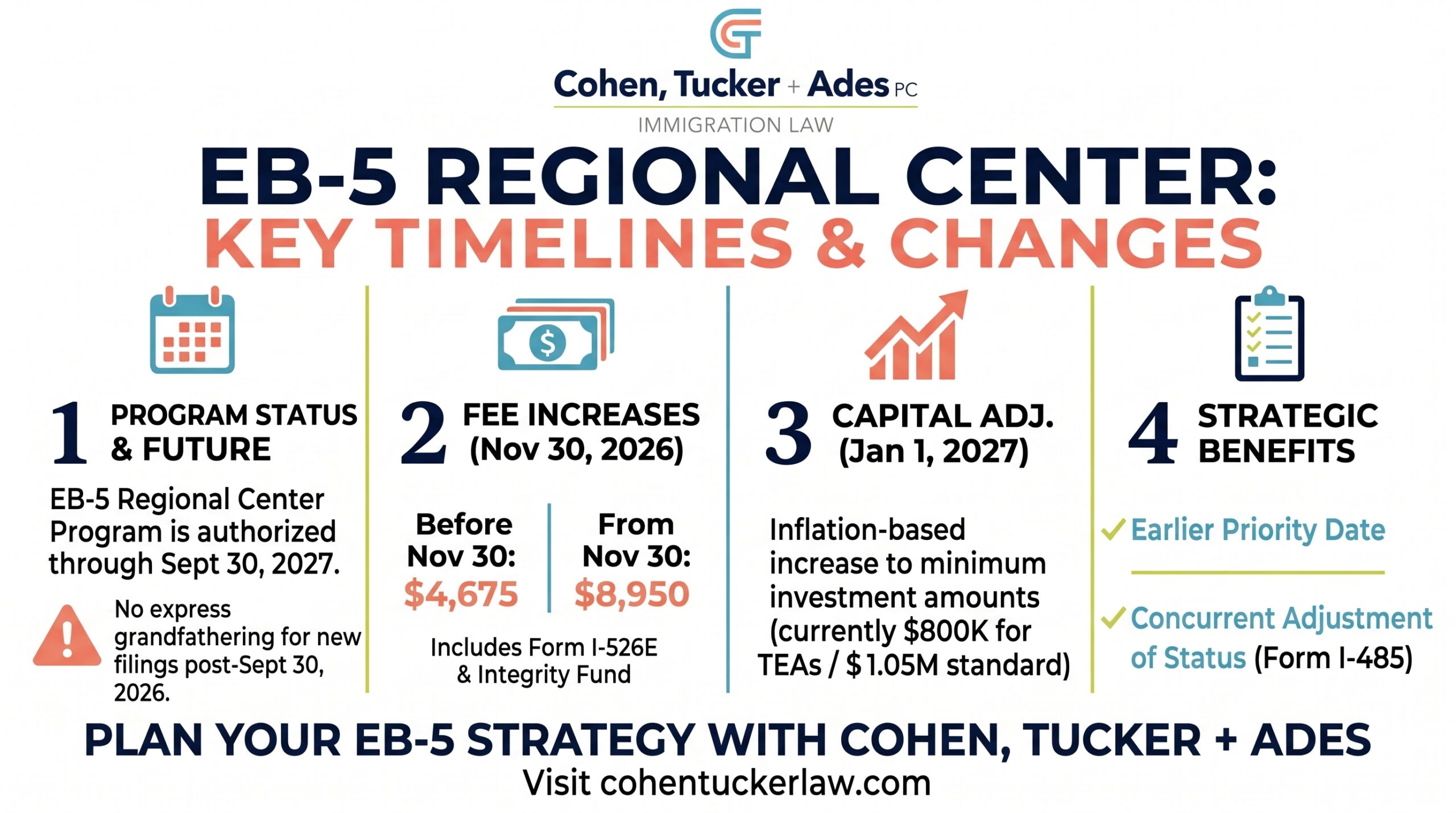
If you are evaluating an EB-5 Regional Center investment, the legal and regulatory landscape has entered an important transitional window. While prospective immigrant investors can continue filing Form I-526E, the rules governing program expiration protections, filing fees, and minimum investment amounts are actively evolving.
Below is an overview of what prospective EB-5 investors need to know about the current authorization status, upcoming cost increases, grandfathering risks, and timeline strategies.
1. Program Sunset vs. Grandfathering Cutoff: Understanding the Distinction
A critical issue in EB-5 planning is distinguishing between the program’s legislative authorization date and its statutory grandfathering protections.
-
Legislative Authorization Through September 30, 2027: The EB-5 Regional Center Program remains fully authorized by federal law through September 30, 2027. Eligible investors can continue to file Form I-526E.
-
The September 30, 2026 Grandfathering Cutoff: Under the Immigration and Nationality Act (INA § 203(b)(5)(S)), petitions filed on or before September 30, 2026, receive express statutory grandfathering. This ensures that even if Congress were to let the regional center program lapse in the future, USCIS must continue adjudicating those covered petitions and allocating visas.
-
Post-September 30, 2026 Filings: Form I-526E petitions filed on or after October 1, 2026, do not carry this express statutory guarantee. While approval remains legally permissible, if Congress allows the program to lapse after September 30, 2027, petitions without conditional permanent resident status could face adjudication halts or processing delays unless Congress passes new legislation or transition rules.
-
Standalone EB-5 Is Unaffected: The standalone (direct) EB-5 program is permanent statutory law and is not subject to regional center expiration dates or grandfathering cutoffs.
2. Upcoming Cost Changes: USCIS Fee Increases & Capital Thresholds
Investors preparing new filings face two imminent statutory and regulatory cost adjustments:
Form I-526E Fee Increase (Effective November 30, 2026)
USCIS filing fees for an initial Form I-526E increase significantly for petitions postmarked on or after November 30, 2026:
Note: This change represents an increase of $4,275 per petition. The rule applies based on the postmark date of your petition filing.
Automatic Capital Threshold Adjustment (January 1, 2027)
Federal statute requires an automatic, CPI-adjusted inflation increase to minimum EB-5 capital investment amounts for petitions filed on or after January 1, 2027.
-
Current thresholds remain $800,000 for Targeted Employment Areas (TEA: rural or high-unemployment) and infrastructure projects, and $1,050,000 for standard non-TEA investments.
-
The official increased threshold amounts will be published by USCIS in the Federal Register in January 2027. Petitions properly filed prior to the implementation date are locked into the previous threshold, provided that the investor has invested or is actively in the process of investing the full required capital.
3. What Happens to Your Capital in the Event of a Program Lapse?
A common question among prospective investors is whether a potential legislative pause impacts their invested funds.
-
Contractual Terms Govern Capital: A legislative sunset or USCIS adjudication pause does not automatically return your investment, nor does it mean capital is lost. The release, management, and repayment of funds are strictly governed by your project’s private placement memorandum (PPM), limited partnership agreement, escrow terms, and project performance.
-
At-Risk Requirement: EB-5 law strictly prohibits guaranteed returns or mandatory contractual buyback guarantees; capital must remain fully “at risk” throughout the statutory process.
-
Due Diligence Is Essential: Before signing subscription documents or wiring capital, investors must examine the project’s escrow release triggers, handling of potential program lapses, and refund provisions if an I-526E petition is delayed or denied.
4. Why File Now? Key Strategic Considerations
Despite the post-September 30, 2026 grandfathering nuance, many investors continue filing Form I-526E to achieve critical personal and family immigration goals:
The Importance of the Receipt Date
Under USCIS policy, your official EB-5 filing date is the day your petition is physically delivered and accepted at the designated USCIS lockbox—not when subscription agreements are executed, when funds are wired, or when the courier picks up the package. If an initial package is rejected for administrative or fee errors, the filing date is lost.
Navigating changing EB-5 filing fees, investment thresholds, and program timelines requires precise planning. If you are preparing an EB-5 investment or evaluating your concurrent adjustment options, our legal team at Cohen, Tucker + Ades can guide you through every step of the process.
About the Author
Wendy R. Barlow, Esq. is a Partner at Cohen, Tucker + Ades, P.C. with nearly 20 years of experience in high-stakes immigration litigation. A graduate of the Maurice A. Deane School of Law at Hofstra University, Wendy is admitted to practice in New York and New Jersey as well as before the U.S. Supreme Court and multiple Federal Circuit Courts. Wendy is recognized for her ability to handle cases that many consider insurmountable.
Need assistance with a complex immigration matter? Click here to schedule a consultation with Wendy.
Disclaimer: This blog post contains general information and is for informational purposes only. It is not legal advice and does not create an attorney-client relationship between you and Cohen, Tucker + Ades P.C. Immigration laws and fee schedules are subject to frequent change. The information provided herein may not reflect the most current legal developments. You should not act or refrain from acting based on information contained in this post without seeking professional counsel from an attorney licensed in your jurisdiction. Cohen, Tucker + Ades P.C. expressly disclaims all liability in respect to actions taken or not taken based on any or all of the contents of this post.