Quick Answer for Applicants:
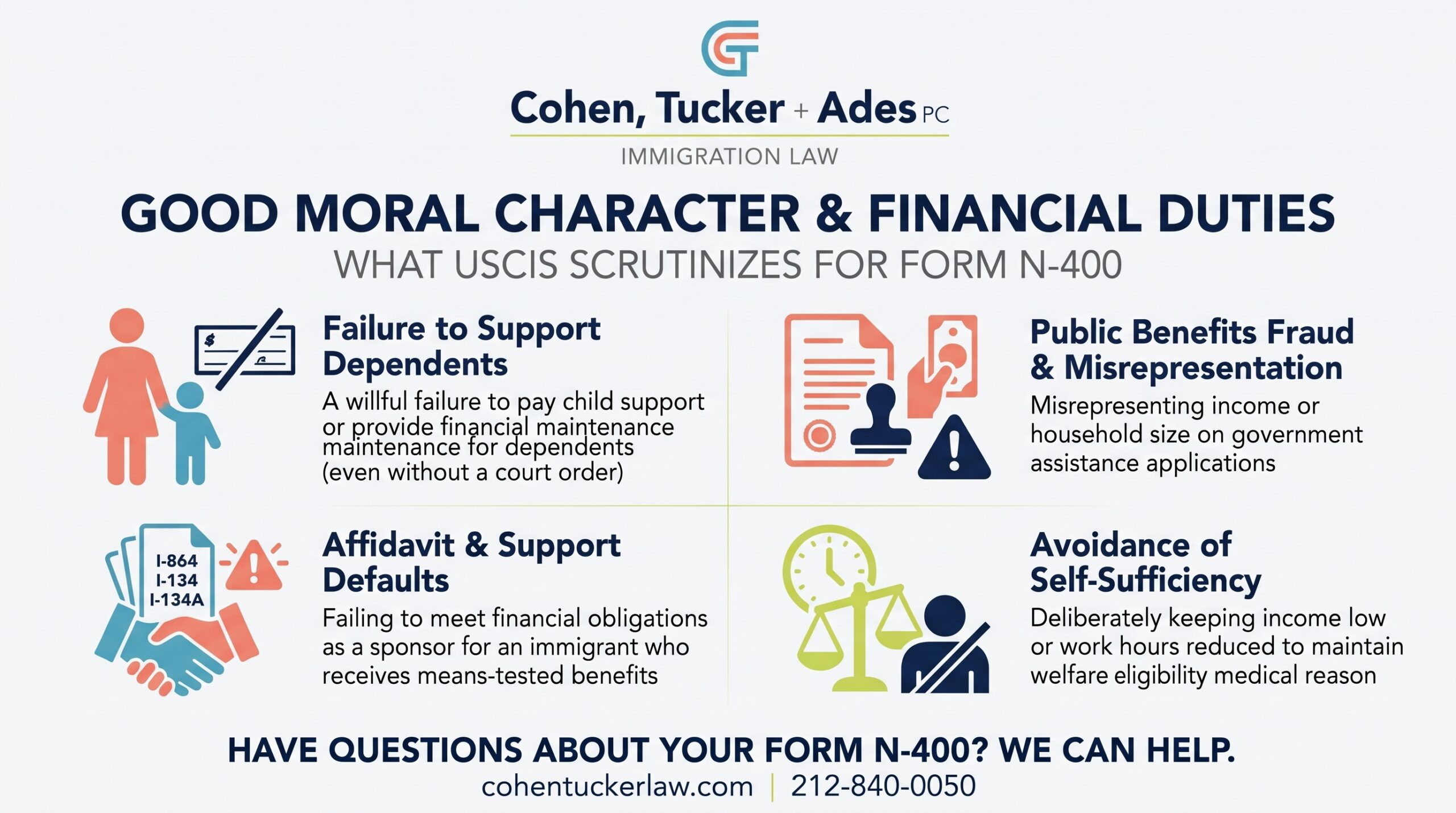
On November 4, 2026, USCIS published Policy Memorandum PM-602-0201, instructing adjudicating officers to intensify financial vetting during naturalization (Form N-400) interviews. The memo clarifies that naturalization applicants may be denied for lacking Good Moral Character (GMC) if they:
-
Willfully fail to support minor children or adult dependents (even without a formal child support order);
-
Breach financial obligations under an Affidavit of Support (Form I-864 / I-864A) or Declaration of Support (Form I-134 / I-134A);
-
Commit misrepresentation or omissions on public benefit applications; or
-
Engage in what USCIS designates as the “intentional avoidance of self-sufficiency” by deliberately curtailing employment to qualify for means-tested assistance.
The Form N-400 is slated for revision to mandate expanded disclosure of benefit receipt and dependent support records.
What Is USCIS Policy Memorandum PM-602-0201?
To naturalize as a United States citizen under Section 316 of the Immigration and Nationality Act (INA § 316; 8 CFR § 316.10), a Lawful Permanent Resident must establish that they have been and continue to be a person of Good Moral Character (GMC) throughout the statutory period (typically 5 years, or 3 years if married to a U.S. citizen).
While INA § 101(f) lists mandatory disqualifiers (such as murder or aggravated felonies), it also contains a broad “catch-all clause”. Under this clause, USCIS adjudicators evaluate whether an applicant’s conduct measures up to the “standards of the average citizen in the community”.
With PM-602-0201, USCIS ties an applicant’s private financial obligations and public benefit history directly to this community standard.
4 Critical Financial Areas Under New Scrutiny
1. Willful Failure to Support Dependents (Child Support)
Failing to provide child support has long been a conditional bar to GMC under 8 CFR § 316.10(b)(3)(i). However, PM-602-0201 significantly raises officer expectations:
-
No Court Order Required: Adjudicators can find a lack of GMC even if there is no formal family court order on file. The policy affirms that parents have an independent moral and legal obligation to provide continuous financial maintenance for minor children residing in the U.S. or abroad.
-
Insufficient Payments: Paying a token or clearly inadequate sum inconsistent with local living standards can be treated as a willful refusal.
-
Dependent Public Assistance as Evidence: If an applicant’s child or dependent relies on means-tested public assistance (such as Medicaid, SNAP, or TANF), USCIS officers may treat that reliance as circumstantial evidence of parental nonsupport.
2. Defaulting on Form I-864 and Form I-134 Sponsorship Duties
Immigration sponsorship is no longer evaluated in a vacuum. PM-602-0201 instructs officers to examine an applicant’s track record as an immigrant sponsor:
-
Form I-864 / Form I-864A Contracts: If you signed a legally binding Affidavit of Support for a relative or served as a joint sponsor/household member, and that immigrant received means-tested public benefits while the contract was enforceable, USCIS may hold this breach against your personal GMC.
-
Form I-134 / Form I-134A Supporter Declarations: Even though temporary declarations of financial support do not generate the same statutory reimbursement liabilities as Form I-864, the memo notes that abandoning promised financial support violates community expectations of good faith and counts adversely in the totality-of-circumstances review.
3. Public Benefits Fraud, Ineligibility, and Omissions
While lawful receipt of assistance is permitted, fraudulent or deceptive participation in government benefit programs is treated as an unlawful act or crime involving moral turpitude (CIMT):
-
Underreporting income or misrepresenting household composition.
-
Failing to report disqualifying changes in circumstances (such as extended foreign travel that forfeits Supplemental Security Income / SSI eligibility).
-
Failing to disclose an existing Form I-864 sponsor’s income or assets to welfare caseworkers when applying for state or federal aid.
4. The “Intentional Avoidance of Self-Sufficiency” Standard
The most controversial element of PM-602-0201 is USCIS’s position that technically legal actions can still trigger an adverse GMC finding.
Citing the Personal Responsibility and Work Opportunity Reconciliation Act of 1996 (PRWORA; 8 U.S.C. § 1601), USCIS instructs adjudicators to penalize applicants who display “deliberate dependency”.
Example cited in the memo: An applicant who voluntarily resigns, reduces full-time work to part-time, or keeps earnings artificially suppressed solely to remain under SNAP or Section 8 housing income thresholds—without a legitimate medical condition, disability, or personal necessity—may be found to lack Good Moral Character under the community standard.
Officers are required to evaluate the totality of circumstances, distinguishing legitimate poverty or disability from willful disengagement from self-sufficiency.
Who Is Most at Risk Under Policy Memo PM-602-0201?
Action Plan: How to Prepare Your Naturalization Application
Because USCIS has confirmed that officers will vigorously question applicants and that Form N-400 will soon be revised to gather granular data on dependent support and welfare usage, proactive preparation is vital:
-
Conduct a Child Support Audit: Gather 5 continuous years of canceled checks, bank transfers, money orders, or certified state registry statements demonstrating consistent payments. Informal cash handoffs without receipts will invite heavy skepticism.
-
Review Past Sponsorships: Review every Form I-864, Form I-864A, or Form I-134 you have signed over the past decade. Ascertain whether the sponsored immigrants became self-sufficient, naturalized, or accessed public safety-net benefits.
-
Document Circumstances for Any Benefit Usage: If you received means-tested public benefits during your statutory period, assemble evidence proving the necessity: medical treatment records, disability verifications, involuntary lay-off notices, enrollment in job retraining programs, or caregiving obligations.
-
Do Not File Unprepared: Submitting Form N-400 with unresolved child support arrears or benefit discrepancies can not only lead to a citizenship denial—it can also trigger a review of your underlying permanent resident status.
Frequently Asked Questions (FAQ)
Can my Form N-400 be denied if I lawfully received Medicaid or SNAP?
The lawful receipt of means-tested public benefits is not a legal bar to naturalization on its own. However, if an officer determines that an able-bodied applicant purposefully limited their earnings to remain on public benefits, or if benefit applications omitted sponsor details, an adverse GMC finding can be issued.
What if I pay child support in cash without receipts?
Cash transactions without paper documentation pose a major evidentiary hazard under PM-602-0201. If you do not have bank receipts or court registry prints, you should work with an immigration attorney to obtain sworn affidavits from the custodial parent, school tuition invoices, medical receipts, or clothing receipts to prove continuous support before filing.
When will the new Form N-400 questions take effect?
USCIS is currently updating the Form N-400 Application for Naturalization and its internal Policy Manual chapters. However, adjudicating officers are already authorized to examine these issues under the statutory GMC framework during pending citizenship interviews.
Consult an Experienced NYC Immigration Attorney
Since 1964, Cohen, Tucker & Ades P.C. has guided individuals and families through complex naturalization and citizenship proceedings. A Good Moral Character challenge requires strategic legal advocacy, meticulous document assembly, and a strong presentation of your totality of circumstances.
If you have questions about child support compliance, past sponsorship liabilities, or public benefits usage, schedule a consultation with our experienced legal team before submitting your application.