Immigration Law Blog
Stay up-to-date on the latest immigration law news, with the Cohen, Tucker & Ades team's insights behind the headlines

By Wendy R. Barlow, Esq. | Partner at Cohen, Tucker + Ades Specializing in Complex Immigration Matters
In an EB-5 petition, the legal integrity of the investment capital matters just as much as the project’s job creation. Under 8 CFR § 204.6(j)(3) and the statutory mandates of the EB-5 Reform and Integrity Act of 2022 (RIA), an immigrant investor must demonstrate by a preponderance of the evidence that their capital was obtained through lawful means and that every dollar can be traced from its origin to the New Commercial Enterprise (NCE).
As global wealth creation evolves, fewer petitioners fund their investments using simple salary savings. Today, petitions frequently involve modern liquidations—specifically cryptocurrency holdings and multi-tiered, multi-generational family gifts.
While both mechanisms are permissible under federal regulations, they face rigorous scrutiny from U.S. Citizenship and Immigration Services (USCIS). Gaps in transaction ledgers or incomplete gift documentation represent leading causes of Requests for Evidence (RFEs), Notices of Intent to Deny (NOIDs), and outright petition denials.
Under U.S. law, virtual currency is treated as property rather than fiat currency (IRS Notice 2014-21). While federal appellate courts recognize converted digital assets as qualifying capital, USCIS does not accept crypto balances at face value.
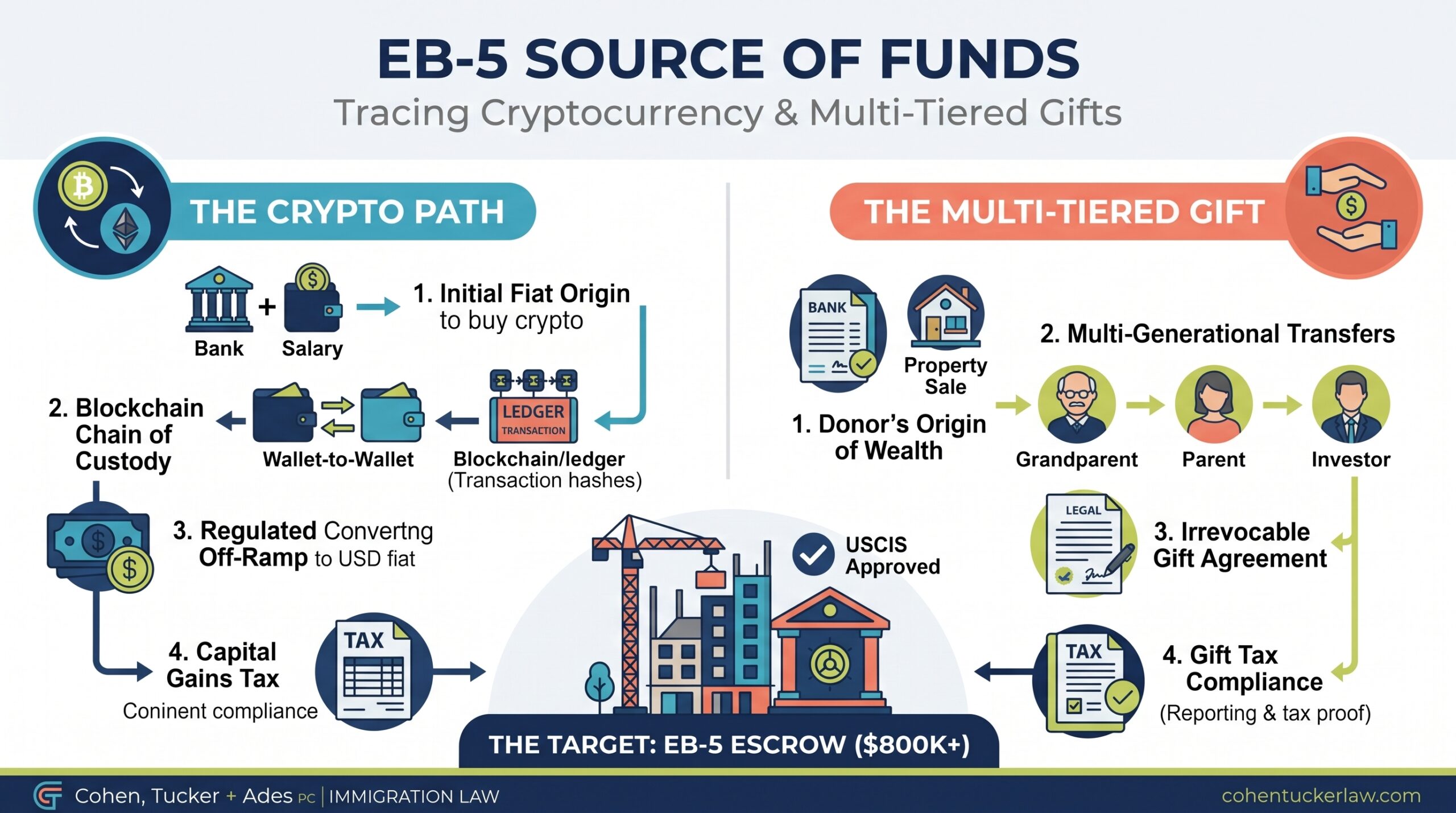
Adjudicators view digital assets not as a self-contained balance, but as a transitional vehicle. To satisfy the agency’s strict evidentiary standard, an investor must narrate and document every chapter in the capital’s lifecycle—from its original fiat roots, through years of on-chain movement, to its final liquidation and transfer into project escrow.
The narrative begins long before the investor opens a crypto wallet or trades a single token. USCIS requires definitive proof of the initial fiat currency used to acquire the digital assets. Whether an investor bought Bitcoin in 2016 or Ethereum during a market dip years later, the analysis traces back to the baseline earnings that funded that initial purchase:
The Sourcing: The petition must establish how the fiat was generated—substantiated through historic tax returns, corporate distributions, salary slips, or property sales deeds.
The On-Ramp: Bank statements must show the outbound fiat wire or ACH transfer clearing into a verified digital asset exchange, confirming that the seed money entered the digital ecosystem through legitimate financial channels.
Once fiat converts into digital tokens, the trail moves onto the public blockchain. Because pseudonymous wallet addresses do not display legal names, the narrative must affirmatively prove ownership of every wallet involved in the capital’s movement.
This phase accounts for every intermediate hop:
Exchange to Cold Storage: If tokens moved from an institutional exchange to a private hardware wallet, the record must pair withdrawal logs with on-chain public transaction hashes (TxIDs) matching timestamps and precise coin quantities.
Token Swaps and Yield: When an investor trades between assets (e.g., swapping BTC for ETH or participating in liquidity pools), each trade requires corresponding exchange trade slips, swap records, and fee deductions.
Forensic Attribution: For portfolios with extensive transaction histories, the narrative is reinforced by independent blockchain forensics reports (such as Chainalysis or TRM Labs audits) or cryptographic signed-message verifications that tie private key custody directly to the investor.
Appreciation in asset value is legally acceptable, but USCIS scrutinizes the exit ramp back into traditional banking just as rigorously as the entry point. Digital assets cannot be transferred directly to an EB-5 New Commercial Enterprise; they must return to fiat currency.
This stage requires:
Regulated Liquidation: Converting crypto back into U.S. dollars through a licensed, FinCEN-registered exchange or fully compliant institutional OTC desk. This generates transparent trade confirmations and settlement receipts.
Tax Compliance: The realization of capital gains creates an immediate tax liability. USCIS adjudicators cross-examine the fiat proceeds deposited into the investor’s bank account against filed tax returns, demanding proof that all national and local capital gains taxes were declared, assessed, and fully remitted.
The narrative concludes with the physical deployment of funds into the EB-5 project. After the liquidated funds land in the investor’s personal bank account, the capital must remain segregated from day-to-day living expenses or unrelated business revenue.
From that clean, dedicated account, an international wire transfer moves the exact qualifying amount ($800,000 for a TEA project) directly into the NCE’s designated escrow or operating account. By closing the loop with matching wire confirmation sheets, the investor delivers a transparent, verifiable chain of custody that leaves no room for agency skepticism.
A gift from a parent, spouse, or relative is a common way to satisfy the $800,000 minimum threshold. However, the RIA enacted explicit safeguards under INA § 203(b)(5) governing gifted capital:
The RIA Statutory Rule on Gifts: Gifted funds must be given in good faith and cannot be used to circumvent legal lending limitations or mask illicit capital. USCIS policy requires that the donor’s own acquisition of the capital be vetted to the exact same evidentiary standard as an investor.
When capital flows through multiple parties—such as a grandparent transferring wealth to a parent, who then gifts it to the investor—the filing involves a multi-tiered gift. In these cases, USCIS requires documentation for every layer of the chain.
The Donors’ Lawful Sourcing: Showing a bank statement with the gifted sum in the donor’s account is insufficient. The petition must prove how the donor accumulated those funds—whether via 5+ years of verified business revenue, executive compensation, an inheritance, or a vetted property sale.
Irrevocability: USCIS adjudicators examine whether a gift is an authentic, irrevocable transfer or a disguised, uncollateralized loan. A formal, legally executed Gift Agreement must explicitly state that the funds are transferred without expectation of repayment, equity stake, or conditional return.
Tax Compliance at Each Stage: Both the primary gift and any underlying upstream transfers must satisfy local gift tax reporting requirements. If the jurisdiction does not impose gift taxes, an opinion letter from an independent local tax attorney or licensed accountant must be included in the submission.
To avoid an RFE, every link in the path of funds must be corroborated by contemporaneous institutional records:
A common point of friction occurs when gifted or liquidated funds originate in countries with strict foreign exchange limitations (such as China’s $50,000 annual remittance cap or India’s Liberalized Remittance Scheme thresholds).
Investors frequently rely on friends, family members, or third-party intermediaries to convert local currency and wire funds to the U.S. (currency pooling).
The USCIS Standard: While currency pooling is not per se illegal under U.S. immigration law, USCIS applies heightened scrutiny to ensure funds were not laundered or routed through illicit channels.
The Solution: Every intermediary who assists in converting and remitting capital must provide signed affidavits, government-issued identification, and corresponding bank statements detailing the exact inflow and outflow of funds. Using informal, undocumented currency swap brokers is one of the most reliable ways to trigger an immediate denial.
Proving your Source of Funds to USCIS is not merely a record-gathering exercise; it is the construction of a comprehensive legal and financial brief.
Conduct a Pre-Filing Forensic Audit: Before wiring funds into an EB-5 escrow or NCE account, work with legal counsel to map your capital path. Identify missing years of tax returns, unexplained cash deposits, or missing wallet hashes months before submission.
Segregate Your EB-5 Capital: Never commingle your intended EB-5 capital with general operational funds, business revenue, or everyday checking accounts. Route the clean, verified sum into a dedicated account before executing the final capital transfer.
Engage Experienced Immigration Litigators: If USCIS issues an arbitrary RFE demanding documentation that is legally unavailable or nonexistent under foreign law, administrative compliance knowledge must be paired with federal litigation capability. When agency adjudicators exceed statutory authority or apply standards beyond the “preponderance of the evidence,” trial-ready litigators can file federal APA challenges to hold the agency accountable.
At Cohen, Tucker + Ades, P.C., we routinely structure complex Source of Funds packages involving multi-jurisdictional assets, digital currencies, and multi-tiered family wealth structures. Contact our New York office to consult with our immigration team and safeguard your path to permanent U.S. residency.
No. EB-5 regulations and project commercial enterprises require capital contributions to be made in U.S. dollars. Cryptocurrency must be converted into fiat currency via a licensed exchange and deposited into a personal bank account before being wired to the project or escrow account.
Under RIA guidelines, USCIS mandates a minimum of 5 years of personal tax returns from both the investor and the donor, or business tax records if the donor’s funds derived from corporate distributions. If the capital was generated through an asset sale (such as real estate), USCIS may look back further to confirm that the asset itself was initially purchased with lawful funds.
Yes, but proving lawful sourcing for DeFi or P2P trades is exceptionally difficult. Because P2P transactions often lack centralized KYC/AML compliance records, USCIS frequently issues RFEs questioning the legitimacy of counterparties. Successfully using DeFi or P2P earnings requires comprehensive on-chain forensic tracing by an accredited blockchain analysis firm.
Wendy R. Barlow, Esq. is a Partner at Cohen, Tucker + Ades, P.C. with nearly 20 years of experience in high-stakes immigration litigation. A graduate of the Maurice A. Deane School of Law at Hofstra University, Wendy is admitted to practice in New York and New Jersey as well as before the U.S. Supreme Court and multiple Federal Circuit Courts. Wendy is recognized for her ability to handle cases that many consider insurmountable.
Need assistance with an Asylum Cooperation Agreement case? Click here to schedule a consultation with Wendy.
Disclaimer: This blog post contains general information and is for informational purposes only. It is not legal advice and does not create an attorney-client relationship between you and Cohen, Tucker + Ades P.C. Immigration laws and fee schedules are subject to frequent change. The information provided herein may not reflect the most current legal developments. You should not act or refrain from acting based on information contained in this post without seeking professional counsel from an attorney licensed in your jurisdiction. Cohen, Tucker + Ades P.C. expressly disclaims all liability in respect to actions taken or not taken based on any or all of the contents of this post.